Hindu community subjected to explicit violent threats by Islamic terror group in Jammu and Kashmir
 Pahlgam, Jammu and Kashmir, India
  2 February, 2026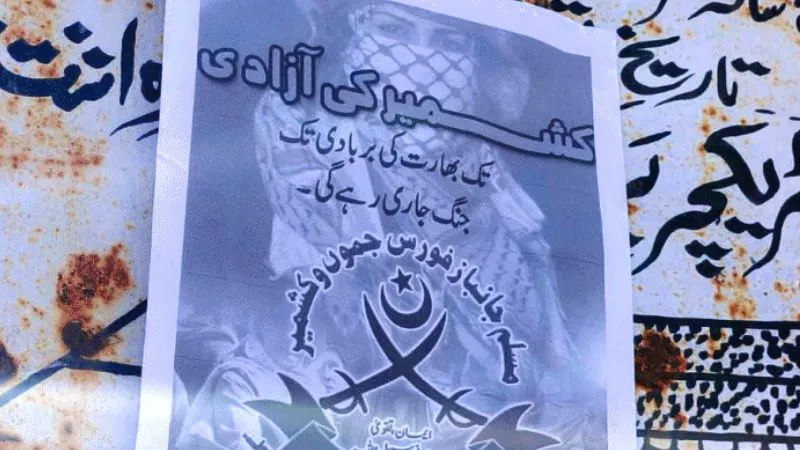
Case Summary
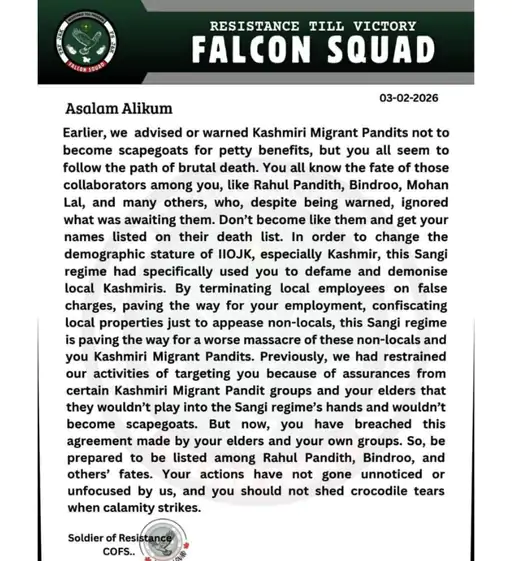
In Jammu and Kashmir, the Kashmiri Hindu Pandit community received explicit violent threats from an Islamic terror group named "The Resistance Front" (TRF), a proxy of another Islamic terrorist organisation, Lashkar-e-Taiba. The TRF issued a letter in the name of 'Falcon Squad', in which it threatened to make the remaining Kashmiri Pandits in Kashmir suffer targeted killings for their religious identity. Apart from this, the 'Muslim Jaanbaaz' force, which was an active Islamic terror group in the 1990s responsible for targeted killings of Kashmiri Pandits, also put up posters of threats. These threats frightened the approximately 300 Kashmiri Pandits living in Mattan, near Pahalgam. The village fell silent by 4 p.m. Police warned Hindu residents not to answer calls from strangers and not to leave their homes after dark. Kashmiri Pandits said that, given the threat from terrorists, they should be provided with training and licensed weapons, just like the Village Defence Guards in Jammu. On February 3, 2026, a letter issued in the name of the "Falcon Squad" threatened Kashmiri Pandits. The letter read, "Kashmiri Pandits, don't become scapegoats for petty gains. You've already seen that following this path results in death, as happened to Rahul Pandit, Makhan Lal Bindu, Mohan Lal, and others." The letter stated that they, too, had been warned, but they ignored it. They warned the remaining Kashmiri Pandits not to become like them and not to put their names on the death list. The letter also referred to the supposed "RSS government," referring to the Modi Government, claiming that the RSS government had used Kashmiri Pandits to 'defame' local Kashmiri Muslims. As a final warning, the letter stated, "We have refrained from targeting Kashmiri Pandits for a long time because some Kashmiri Pandit groups had assured us that they would not play into the hands of the government." The letter threatened that they were keeping an eye on all the activities of Kashmiri Pandits and said that if any problem arises in the coming days, then "crocodile tears should not be shed". Another Islamic terror group, "Muslim Janbaz," which was active during the genocide of Kashmiri Pandits in the 1990s, became active once again in the valley. Following the Delhi bombings in 2025, posters of the Muslim Janbaz Force were found in some areas in late January 2026. The posters read, "The war will continue until Kashmir's independence, until India's destruction. Jihad must be waged for God." Speaking to the media, Kashmiri Pandits explained that the valley had been peaceful for three years, but now they suddenly begun receiving threats. They added that threats had also been made before Home Minister Amit Shah's visit to Kashmir in February 2026. They said that while they were alert to these threats, they were not going to be deterred.
Case Images
Why it is Hate Crime ?
This case has been added to the tracker under the primary category- Hate Speech against Hindus. The subcategory selected is- Violent Threats. Violent threats, explicit, implicit or implied, is the most dangerous form of hate speech since it goes beyond discriminatory and prejudicial language to express the intent of causing harm to an individual or a group of people based on their religious identity and faith. There could be several different kinds of threats that are issued to Hindus based on religious animosity. An explicit threat would mean the direct threat of violence towards an individual Hindu, a group of Hindus or Hindus at large. Physical violence, death threats, threats of destruction of property belonging to Hindus and threats of genocide would mean explicit threats against Hindus for their religious identity. Implicit threats may not be a direct threat but implied through the use of symbols of actions – for example – in the Nupur Sharma case, other than explicit threats, there were also implicit threats when Islamists took to the streets to burn and beat her effigies. It implies that they want to do the same to Nupur Sharma – thereby is considered an implicit threat. Violent threats can be delivered in person, through letters, phone calls, graffiti, or increasingly through social media and other online platforms. It would be important to understand that a threat – explicit or implicit, online or offline – to an individual who happens to be a Hindu does not qualify as a religiously motivated threat. Such a threat, while vile and dangerous, could be owing to non-religious reasons and/or personal animosity. To qualify as a religiously motivated threat, it would need to exhibit an indication that the individual is being targeted for religious reasons and/or owing to his/her religious identity as a Hindu. This incident stands as a clear instance of religiously motivated hate speech, as Muslim perpetrators belonging to the Islamic terror group TRF targeted Kashmiri Pandits with explicit threats to kill, target, and murder them specifically for their Hindu religious identity, thereby showcasing the perpetrators' profound religious animosity. The Muslim perpetrators reminded the Hindu community of past victims like Rahul Pandit, Makhan Lal Bindu, and Mohan Lal, warning that the same fate awaited them if they persisted. This evoked the brutal 1990s anti-Hindu genocide, when Kashmiri Pandits faced mass targeted killings, rapes, murders, forced conversions to Islam, and expulsion from Kashmir by Muslim terror groups with support from the local Muslim community, all due to relentless religious persecution. By invoking these atrocities and threatening targeted murders for their Hindu religious identity, the perpetrators showcased their profound religious animosity while aiming to instil paralysing fear and panic among Kashmiri Pandits. Such violent threats transcend mere words; they frequently precipitate real-life violence against this already vulnerable Hindu minority in Kashmir, exposing the deep religious animosity driving these acts. Further, the perpetrators denigrated Kashmiri Pandits for supposedly supporting the so-called RSS government and playing into its hands, accusing them of defaming Kashmiri Muslims. Here, it is important to assert that the Kashmiri Pandits never defamed any Kashmiri Muslim; they merely recounted their own 1990s ordeal, when their community endured killings, rapes, murders, forced conversions to Islam by Islamic terror groups backed by the Kashmiri Muslim community, and ultimate expulsion from their homeland. Simply voicing their truth provoked this vicious backlash from Islamic terror groups, underscoring the precarious vulnerability with which Kashmiri Pandits survive and the profound hatred harboured by Muslim extremists towards them. This reflexive religious hostility to their lived experiences cements the case as religiously motivated hate speech. This pattern extended beyond the TRF, as the Muslim Jaanbaaz group, active during the 1990s Kashmiri Pandit genocide, resurfaced with posters declaring war for Kashmir's independence, India's destruction, and that jihad must be waged for God. Notably, Muslim extremists perceive India as a Hindu collectivity and view Kashmir, despite its integral status within the Indian Union, as Muslim sovereign territory under supposed illegal occupation by the Indian state and Hindus. This mindset traces back to the 1947 Partition of India and creation of Pakistan, where Muslims insisted Islam is a nation unto itself and could not coexist with a Hindu collectivity. They believed in transnational Muslim unity, known as the Ummah, and demanded separation, which created Pakistan. In short, religious animosity and prejudice towards Hindus resulted in Pakistan. Similarly, in this case, their calls for India's destruction and jihad, a holy war in Islam often directed against infidels, here Hindus, targeted the Hindu community explicitly, stoking religious hatred and inciting violence against Hindus under the guise of territorial claims. This showcased the depths of Islamic supremacist attitudes and anti-Hindu hostility of the Muslim perpetrators, making it religiously motivated hate speech. Since this case met the parameters of a religiously motivated offence, the Hinduphobia Tracker added it to its hate crime database. Disclaimer: In this case, TRF issued violent threats to Kashmiri Pandits, while the Muslim Jaanbaaz group threatened India's sovereignty and destruction. Therefore, the perpetrator count stands at two (2). This is recorded for documentation purposes only.
Victim Details
Total Victim
300
Deceased
0
Gender
- Male 0
- Female 0
- Third Gender 0
- Unknown 300
Caste
- SC/ST 0
- OBC 0
- General 300
- Unknown 0
Age Group
- Minor 0
- Adult 0
- Senior Citizen 0
- Unknown 300


Case Status
Unknown


Perpetrators Details
Perpetrators
Muslim Extremists
Perpetrators Range
Unknown
Perpetrators Gender
unknown
 Sources




