Hindu temple and sacred religious items vandalised by miscreants after Ramayan recitation event in Uttar Pradesh
 Budaun, Uttar Pradesh, India
  15 February, 2026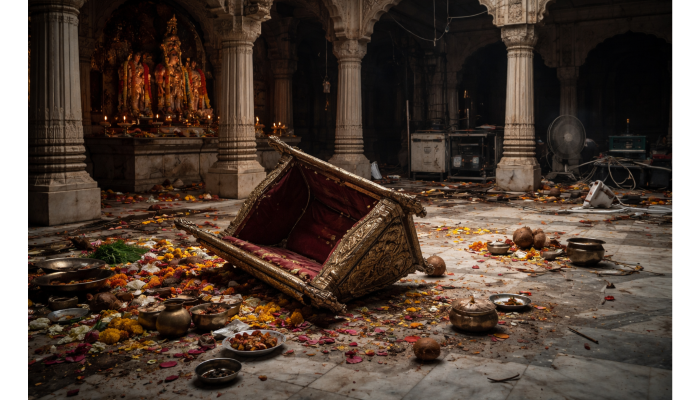
Case Summary
In Keli village, Kunwargaon police station area, Badaun district, Uttar Pradesh, a Hindu temple and its sacred religious items were vandalised by two men who created a ruckus shortly after the conclusion of an Akhand Ramayan Paath (continuous recitation of the Ramayana) on Monday (16 February 2026). The perpetrators were identified as Amanesh and his brother Rajkumar, both residents of the same village. They were intoxicated and damaged religious items like the Vyas Gaddi (sacred seat used for scriptural recitation) and other items like the generator and electrical lights. According to media reports, the Akhand Ramayan Paath was organised in the temple premises in Keli village on 16 February 2026 and concluded peacefully with proper rituals. Throughout the day, the atmosphere remained peaceful with bhajans (devotional songs) and prayers, and in the evening, after the proper conclusion ceremony, prasad (sacred food offering distributed to devotees) was distributed. The religious programme was conducted with full devotion and religious sanctity. However, shortly after the programme concluded, Amanesh and his brother Rajkumar, both residents of Keli village, arrived at the temple premises in an intoxicated state. According to villagers, the two brothers were drunk and began creating a disturbance in the temple area. In their intoxicated condition, they overturned the Vyas Gaddi, which is the sacred seat used by the priest for recitation of the Ramayana. In addition to damaging the Vyas Gaddi, the two men also vandalised the generator and electrical lights that had been set up for the religious programme. The vandalism created chaos in the temple premises, and people present at the scene managed to control the situation with difficulty. Members of the organising committee, including Atul Singh, Vijay Singh, Nanhe, Mahavir, and other villagers, went to the police station and filed a written complaint demanding strict action against the perpetrators. They stated that such an incident immediately following a religious programme had hurt the religious sentiments of the people. Circle Officer Sukendra Pal Singh stated that action was taken against Amanesh under breach of peace (Shantibhang) provisions. Police searched for the second perpetrator, Rajkumar. The incident created tension in the village, with residents expressing anger over the disrespect shown to their religious programme and the sacred items used during the Ramayana recitation.
Why it is Hate Crime ?
The primary category selected here is- Attack on Hindu religious representations. The secondary category that this case qualifies for is- Desecration of Hindu religious symbol. Icons and symbols or a religious representation of a spiritual ideal are widely revered in Hinduism. Iconography is of vital significance in the Hindu milieu. It helps connect people’s spiritual beliefs with the real world. Iconography within the Hindu faith takes several shapes and forms. Murtis are of most significance to Hindus, to which daily rituals, prayers and offerings are done. Besides the murtis, there are several other symbols which have deep significance in the Hindu faith – the Om and Swastika for example. Since these Hindu religious symbols hold paramount importance in Hinduism, any desecration of symbols, icons, murtis, religious representations and manifestations, is driven by animosity towards the faith itself which manifests itself through these murtis, icons and symbols. Therefore, any desecration of these Hindu religious symbols and representations is considered religiously motivated hate crimes under this category. Another subcategory this case qualifies for is- Attack on temples. In Hinduism, a temple is the abode of the Deity. The Deity in the Temple is consecrated, thereby, making it a real, breathing entity. Hindus believe that not just the Deity but the temple premises itself are sacred to Hindus since Hindus hold the faith that the entire Temple space is an amalgamation of the divine energy of the deity. Given the central significance of Temples in Hindu Dharma, any attack against a Hindu Temple or its peripheral premises is an attack on the faith itself and is born out of animosity towards the faith, of which, the Temple is a central tenet. Any manner of attack against a Temple and/or its premises would therefore be considered a religiously motivated hate crime. Another subcategory this case qualifies for is- Breaking rules of place of worship. Sanatan Dharma is not a religion of one book, which is to say that while it has religious scriptures that form the central tenets of the faith, there are several traditions followed through thousands of years, mostly passed from generation to generation orally. One of these oral traditions or written traditions is the rules of specific temples. Certain temples have rules which are traditional rules, dependent on the worship of the presiding deities. These rules and traditions have been followed for thousands of years whether they find scriptural mention or not. Such traditions are based on the nature and rules of worship of the presiding deity of that temple. Any non-compliance of these traditions owing to animosity towards the faith or for the sake of activism stems not only from the lack of faith in the presiding deity but also disregard for the faith of the devotees of that deity/temple and implicit bias against the faith, the tradition and the deity itself. Since these specific traditions are central to the faith of the devotees of that specific temple and presiding deity, any non-compliance with these traditional rules would be considered a religiously motivated hate crime. Another subcategory selected is- Defiling religious customs. Sanatan Dharma is not a religion of one book, which is to say that while it has religious scriptures that form the central tenets of the faith, there are several traditions followed through thousands of years, mostly passed from generation to generation orally. There are several such customs and traditions that are followed by various Hindus and Hindu sects. Defiling of these traditions and customs is a breach of an individual or group’s religious practices. Such practices can range from dietary restrictions like not eating non-vegetarian food for a certain period of the year, not eating non-vegetarian food at all, not eating beef since the cow is considered holy in Hinduism, the sanctity of religious customs followed in the house (like many ISCKON devotees), etc. Any malicious action leading to the breach of such traditions or defilement of these traditions owing to animosity towards the faith or for the sake of activism stems not only from the lack of faith in the religion itself but also from disregard for the faith of the devotees who follow the customs/traditions and implicit bias against the faith, the tradition itself. Since these specific traditions are central to the faith of the devotees of that specific sect of Hindus, any non-compliance with these traditional rules would be considered a religiously motivated hate crime. This incident involved the deliberate vandalism of sacred religious items at a temple's premises immediately following the conclusion of an Akhand Ramayan Paath, a continuous recitation of the Ramayana, a sacred Hindu recital event. The case exhibited clear characteristics of an attack on Hindu religious representations, where sacred objects used for worship were intentionally desecrated in an act that showed complete disregard for Hindu religious practices and sentiments. The perpetrators specifically targeted the Vyas Gaddi, which is a sacred seat used by priests and religious scholars for reciting Hindu scriptures, particularly the Ramayana. The Vyas Gaddi holds special significance in Hindu religious ceremonies as it represents the honoured position from which sacred texts are read and transmitted. By overturning this sacred seat, Amanesh and Rajkumar demonstrated deliberate intent to desecrate a symbol that is central to Hindu religious practice and scriptural recitation. The act of physically damaging the Vyas Gaddi went beyond mere vandalism; it represented a direct assault on the sanctity of Hindu religious traditions. The timing of the attack added a particularly offensive dimension to this desecration. The vandalism occurred shortly after the completion of an Akhand Ramayan Paath, which is an important Hindu religious observance involving continuous recitation of the Ramayana over an extended period. Devotees had spent the entire day in prayer, bhajans, and religious devotion, and the programme had just concluded with proper rituals and prasad distribution. The deliberate choice to vandalise the temple premises immediately after this sacred ceremony demonstrated a calculated intent to violate the sanctity of the religious gathering and hurt the sentiments of devotees at the moment of their spiritual fulfilment. Such acts were clear examples of desecration of sacred religious events and customs, making it a hate-driven act. The vandalism also included damage to the generator and electrical lights that had been set up specifically for the religious programme. While these items may seem less inherently religious than the Vyas Gaddi, they were integral to conducting the religious ceremony and facilitating worship. By destroying equipment that had been arranged for the Akhand Ramayan Paath, the perpetrators demonstrated their intent to attack the entire religious gathering and disrupt Hindu religious activities. This systematic destruction of both sacred and functional items used in the ceremony indicated a deliberate assault on the temple and its religious functions. The temple premises where this vandalism occurred served as a sacred space for the Hindu community of Keli village to gather for worship and religious observances. By creating a ruckus and vandalising items in this holy space, the perpetrators violated the sanctity that temples hold in Hindu tradition. Temples are considered dwelling places of the divine and spaces of peace and devotion. The deliberate act of entering this sacred space and causing destruction represented an attack on the temple itself as a centre of Hindu religious life and community faith. Another point to highlight is that the perpetrators entered the temple in an intoxicated state, which itself violated the temple's sacred rules. Hindu temples uphold strict rules to maintain purity and sanctity. Despite knowing that alcohol and intoxication are prohibited in the temple, considered impure and a sacrilege, the perpetrators entered anyway. This showcased their lack of respect for the temple's sacred rules and deliberate violation, making it a case of religiously motivated crime. The state of intoxication of the perpetrators, while explaining their lack of inhibition, did not excuse or diminish the religious nature of their attack. Their decision to enter temple premises while drunk and vandalise sacred religious items showed profound disrespect for Hindu religious spaces and practices. The fact that they specifically targeted a temple and its religious items, rather than any other location, religious spaces of other faiths or completely secular places, suggested that even in their intoxicated state, they deliberately chose to violate Hindu religious representations and sacred spaces. This selective targeting and desecration of a Hindu religious place and event showcased the deep-seated animosity of the perpetrators towards Hinduism and the Hindu community. The fact that the perpetrators were from the same village added complexity to this case. As residents of Keli village, Amanesh and Rajkumar would have been well aware of the Akhand Ramayan Paath taking place and the religious significance of the items they vandalised. Their decision to attack the temple premises and sacred objects despite this knowledge suggested deliberate targeting rather than ignorance. This local knowledge made their actions even more offensive to the Hindu community, as it represented betrayal of shared religious spaces and traditions by members of their own village. Given that this case met several parameters of a religiously motivated offence, it was added to the hate crime database of the tracker.


Case Status
Case sub-judice


Perpetrators Details
Perpetrators
Others
Perpetrators Range
From 2 To 5
Perpetrators Gender
male
 Sources




