Hindu families targeted in coordinated communal violence by Muslim mob, amidst persecution of Hindus in Bangladesh
 Noakhali District, Bangladesh
  12 February, 2026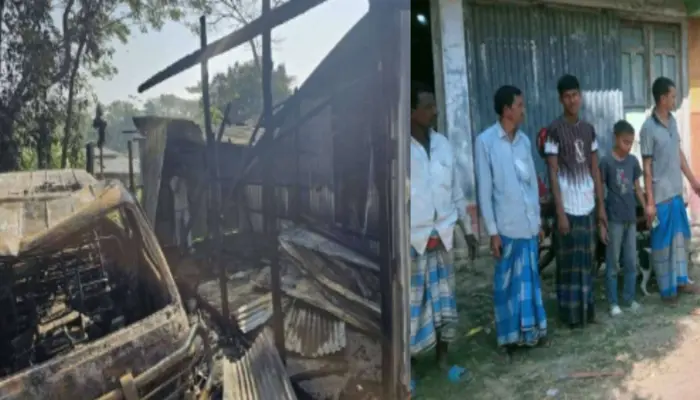
Case Summary
In Hatiya Upazila under Noakhali district, Bangladesh, Hindu families were targeted in a series of coordinated attacks involving assault, looting, vandalism and arson by Muslim mob, who were part of the Jamaat-e-Islami–NCP coalition. According to reports, within 72 hours of the 13th National Parliamentary Election 2026 in Bangladesh, coordinated violence unfolded against Hindu minorities. The violence occurred across Sonadia, Burirchar and Char Ishwar unions shortly after the announcement of the election results. Muslim mob identified locally as cadres of the Jamaat-e-Islami–NCP coalition ravaged through the Hindu localities, entering homes by force, smashing doors and damaging property. Around ten houses in BanglaBazaar and Riyaz Market areas of Sonadia Union were vandalised and looted. Families reported that cash and gold ornaments were taken, livestock were attacked, and explicit warnings were issued instructing them to leave the area. On 13 February 2026, Deepak Chandra Das and his son were beaten in a marketplace after being accused of voting for the Bangladesh Nationalist Party. On the same day, Kaakan Chandra Das was struck with a hammer while travelling to the market and had money seized from his pocket. In Burirchar Union, the residence of Mridul Chandra Das was surrounded by armed Muslim men who accused him of harbouring supporters of the BNP. The Muslim attackers hacked at the walls with machetes and forced entry while his three daughters remained inside. The family did not flee out of concern for the safety of the women. Local physician Khanesh Das was threatened at weapon-point during the unrest and subsequently restricted his movements out of fear. In Char Ishwar Union’s Mula Market, seven houses belonging to H. K. Sardar were set ablaze overnight. Some vehicles were also torched on fire. The violence followed prior intimidation connected to voting preferences in favour of opposition parties. Video footage circulated on social media showed a female member of one affected Hindu family in tears, describing abuse and threats issued by local political workers. In response to the attacks, Hindu residents formed a human chain in Hatiya Upazila, demanding administrative intervention, security guarantees and prosecution of those responsible. Protesters stated that naval personnel deployed during the election were not informed in time to prevent the violence, and that local police action remained inadequate in the immediate aftermath. A fresh wave of anti-Hindu violence followed the 13th National Parliamentary Election 2026 in Bangladesh, reinforcing a recurring pattern of post-poll violence targeting Hindu minorities. Within days of the announcement of results, Hindu families in districts such as Noakhali, Rangpur, Nilphamari, Sylhet, Thakurgaon, and Dinajpur reported coordinated attacks involving arson, looting, assault, and vandalism of temples and homes. In several instances, Hindu homes were selectively targeted, looted, and families were threatened with displacement. This escalation of violence against Hindus in Bangladesh unfolded in three distinct phases: first, following the ouster of Sheikh Hasina’s government in August 2024; second, after the death of Sharif Osman Bin Hadi in December 2025; and third, in the immediate aftermath of the 13th National Parliamentary Election 2026. This electoral violence unfolded against the broader backdrop of sustained anti-Hindu hostility that had persisted since the ouster of the Sheikh Hasina government in August 2024. During that period, multiple reports documented attacks on Hindu homes, temples, and religious institutions, alongside intimidation campaigns, arson, and mob assaults targeting minority neighbourhoods. The Hinduphobia tracker has recorded 336 such incidents against the Hindu minority, underscoring the scale and persistence of anti-Hindu violence during this period. A further escalation occurred following the death of Sharif Osman Bin Hadi, a Muslim political activist and student leader known for his anti-Hindu and anti-India rhetoric. Hadi had been involved in political unrest after the fall of the Hasina government and was killed in Dhaka on 18 December 2025 during clashes. In the aftermath of his death, Hindu communities were blamed and subsequently targeted in retaliatory violence. Hindu homes were selectively set ablaze in multiple localities, forcing families to flee and leaving many displaced. The attacks appeared patterned rather than sporadic, with Muslim mobs focusing on Hindu neighbourhoods, properties, and religious symbols. Among the victims was Dipu Chandra Das, who was lynched to death and his body was set ablaze by a Muslim mob over false blasphemy allegations. The Hinduphobia tracker documented 51 incidents of anti-Hindu violence in the period following Hadi’s death alone. Such incidents underscore the vulnerability of the Hindu minority amid rising communal hostility and the weaponisation of religious accusations. Reports further indicated that posters and written materials calling for the extermination of Hindus were displayed in public spaces, signalling an alarming normalisation of genocidal rhetoric. When combined with acts of arson, vandalism, assault, and targeted intimidation, these developments suggest a coordinated environment of hostility aimed at terrorising the Hindu community and reinforcing majoritarian dominance.
Why it is Hate Crime ?
This case has been added to the tracker under the primary category of - Attack not resulting in death. Within this, the subcategory selected is- Attacked for Hindu identity. In several cases, Hindus are attacked merely for their Hindu identity without any perceived provocation. A classic example of this category of religiously motivated hate crime is a murder in 2016. 7 ISIS terrorists were convicted for shooting a school principal in Kanpur because they got ‘triggered’ seeing the Kalava on his wrist and tilak that he had put. In this, the Hindu victim had offered no provocation except for his Hindu religious identity. The motivation for the murder was purely religious, driven by religious supremacy. Such cases where Hindus are targeted merely for their religious identity would be documented as a hate crime under this category. The other sub-category selected here is - Attacked to induce migration from non-Hindu dominated area. There have been cases where the Hindus living in an area, often with a majority dwelling belonging to non-Hindus or those harbouring animosity towards the Hindu faith, the Hindu residents experience threats and violence. The violence is employed with the aim of making the Hindus leave the area and relocate, so the area could be turned into an exclusive ghetto for adherents of the non-Hindu faith or those who harbor animosity towards the Hindu faith. In several cases, the aim of exodus is explicit. However, in several cases, the demand for exodus of Hindu residents is not explicit, however, violence by non-Hindu residents leaves the Hindu residents no option but to leave the area, thereby, turning the area into an exclusive ghetto of non-Hindu residents. In such cases, there are instances violence against the Hindu residents explicitly. For example, in the Hauz Qazi case of 2019, the Muslim residents claimed that mob violence against the Hindu residents had been triggered by a parking dispute. However, the violence did turn religious with a temple being desecrated and was directed specifically against the Hindu residents. The Hindu residents of the area were clear that the violence was religiously motivated and one of the motives was to affect an exodus of the Hindu residents. In such cases, even though the perpetrators have not explicitly expressed the aim of affecting exodus, the given circumstances and violence and precedent point to the intention of exodus and therefore would be categorized under this sub-category. Such crimes are religiously motivated and therefore are hate crimes. This case has been added to the tracker as a clear instance of post-poll religious targeting, where Hindu families in the Noakhali district were brutally attacked by Muslim men, part of the Jamaat-e-Islami–NCP coalition, immediately after the declaration of the 13th National Parliamentary Election 2026 results in Bangladesh. The violence was not random criminality but followed accusations that Hindu residents had voted for the Bangladesh Nationalist Party. The timing of the assaults, within hours of the elections results. and the selective targeting of Hindu households demonstrate that the victims were punished on the basis of their perceived political choice intertwined with their religious identity. The Muslim attackers, cadres associated with the Jamaat-e-Islami–NCP coalition, entered Hindu homes by force, vandalised property, looted valuables, assaulted male members in marketplaces, and issued explicit warnings instructing families to leave the area. The pattern of violence, forced entry, economic looting, arson, public beatings, and threats of displacement, indicates coordinated intimidation designed to terrorise the Hindu minority and impose collective punishment for electoral participation. This form of collective punishment is symbolic of a deep-rooted religious animosity, where the Hindu identity of the victims became the sole basis for their persecution. Additionally, the nature of the assault demonstrates an effort to intimidate or displace Hindu residents from areas where they are vulnerable minorities. Entering homes at night, damaging property, and using physical force are tactics often used to push minority communities into migration. Hindu families were explicitly warned to leave the area. Such acts go beyond spontaneous unrest; they reflect organised intimidation aimed at economically destabilising and terrorising a religious minority because of their religious identity and election results. It is particularly significant that Muslim mob attacked Hindu families merely by accusing them of voting for a different political party. In reality, voting in Bangladesh is conducted through secret ballot, making it impossible to definitively know how any individual voted. Despite this, Hindu households were singled out and collectively blamed for supporting an opposition party. This demonstrates that the accusation itself functioned as a pretext rather than a verifiable grievance. The fact that Hindus were targeted without any objective proof of their voting choices indicates that religious identity, not electoral certainty, was the primary basis for retaliation. In effect, Hindu residents were treated as a monolithic political bloc and punished collectively, reinforcing the perception that their religious identity alone made them suspect and disloyal. The selective nature of the attacks further reinforces the communal character of the violence. Such selectivity reveals that the violence was not indiscriminate unrest but was religion based targeting. The combination of arson, physical assault, and warnings to vacate the area reflects methods commonly used to intimidate minority communities and create pressure for displacement, even where no formal expulsion order is issued. This incident also fits within a broader climate of insecurity faced by Hindus in Bangladesh since the political upheaval of August 2024. Recurrent attacks on Hindu temples, homes and businesses, coupled with periodic surges of mob mobilisation, have reinforced a perception of vulnerability among minority communities. The Noakhali post-poll attacks form part of this continuum, demonstrating how electoral transitions can become flashpoints for communal aggression when extremist elements exploit political outcomes to settle ideological scores. This targeted attack must be understood as more than spontaneous mob violence. It is a reflection of the broader climate of anti-Hindu hatred that is prevalent in Bangladesh. This happens due to the doctrinal animosity that exists in Islam against Non-Muslims, where the lives of non-Muslims are considered inferior to those of Muslims. This was not just an attack, it was also a statement that any dispute between Hindus and Muslims will be met with disproportionate violence by the Muslims against the whole community. Taken together, the evidence indicates that the Hindu victims were targeted not merely over a political disagreement, but because they were Hindus. The accusations regarding their voting choices functioned as a trigger, but the violence itself was directed at them collectively as members of a religious minority. The coordinated assaults, public beatings, systematic looting, arson of homes, and explicit threats of expulsion demonstrate an intent to intimidate and punish the community on the basis of religious identity. For these reasons, the case has been added to the tracker. Disclaimer: In this case, it is mentioned that members of at least 7 Hindu families were targeted in coordinated attacks. However, the exact number of individuals affected has not been specified in available reports. Additionally, four individuals are specifically named as victims of assault and threats. Due to the lack of clarity regarding total family size, we have relied on the most recent Bangladesh Bureau of Statistics data, which indicates that the average household size in Bangladesh is approximately 4.2 persons per household. To ensure a conservative and standardised estimation, we have considered an average of 4 members per family. Based on this approach, the estimated total number of victims in this case is calculated as 32 individuals.
Victim Details
Total Victim
32
Deceased
0
Gender
- Male 4
- Female 0
- Third Gender 0
- Unknown 28
Caste
- SC/ST 0
- OBC 0
- General 0
- Unknown 32
Age Group
- Minor 0
- Adult 0
- Senior Citizen 0
- Unknown 32


Case Status
Unknown


Perpetrators Details
Perpetrators
Muslim Extremists
Perpetrators Range
Unknown
Perpetrators Gender
unknown
 Sources




