Hindu temple targeted for encroachment, sacred idol desecrated on eve of Mahashivratri in Uttar Pradesh
 Budaun, Uttar Pradesh, India
  13 February, 2026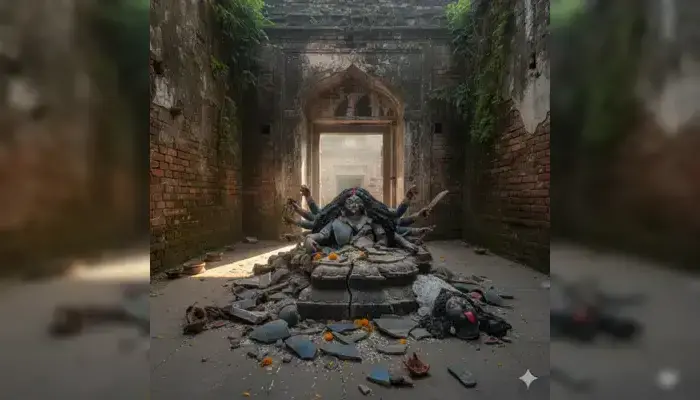
Case Summary
In Narayan Nagla village, Kaderchowk police station area, Badaun district, Uttar Pradesh, a sacred idol of Kali Mata at a local temple was desecrated by a miscreant on 14 February 2026. The temple was preparing for the Mahashivratri celebrations of 15 February 2026; this incident caused disruption in the festival. The accused, who did this, had previously tried to encroach on and illegally capture the temple for a long time. The accused was identified as a man named Baburam, son of Keshari Lal, who entered the temple premises and damaged the sacred idol of Kali Mata. This desecration caused deep hurt to the religious sentiments of the Hindu community in the area. The desecration of the Kali Mata idol was discovered on 14 February 2026, and news of the vandalism spread quickly among local residents, triggering anger and distress in the community. The seriousness of the act prompted police to take immediate action under the instructions of Senior Superintendent of Police Dr Brijesh Kumar Singh. Police arrested Baburam from Narayan Nagla village itself on 15 February 2026. A case was registered at Kaderchowk police station under sections 298, 352, and 351(2) of the Bharatiya Nyaya Sanhita. After completing the legal process, Baburam was presented before the court. Following the incident, new idols of the Shiva family and Kali Mata were installed at the temple. Even Mahashivratri was celebrated peacefully, and a community feast was organised for devotees. Reports also confirmed that the temple was built by a Hindu man named Pyarelal in 2006 and it regularly hosted many religious and community events and feasts. The accused Baburam repeatedly tried to encroach on and capture the temple. Baburam also had a criminal history, with a previous case registered against him in 2022 under Section 366 of the Indian Penal Code at Kaderchowk police station, Badaun. Police station in-charge Vikram Singh and his team carried out the arrest, and police stated that intensive operations would continue to maintain peace and law and order in the area.
Why it is Hate Crime ?
The primary category for this case is "Attack on Hindu religious representations". The sub-category here is "Desecration of Hindu religious symbols". Icons and symbols or a religious representation of a spiritual ideal are widely revered in Hinduism. Iconography is of vital significance in the Hindu milieu. It helps connect people’s spiritual beliefs with the real world. Iconography within the Hindu faith takes several shapes and forms. Murtis are of most significance to Hindus, to which daily rituals, prayers and offerings are done. Besides the murtis, there are several other symbols which have deep significance in the Hindu faith – the Om and Swastika for example. Since these Hindu religious symbols hold paramount importance in Hinduism, any desecration of symbols, icons, murtis, religious representations and manifestations, is driven by animosity towards the faith itself which manifests itself through these murtis, icons and symbols. Therefore, any desecration of these Hindu religious symbols and representations is considered religiously motivated hate crimes under this category. Another sub-category this case qualifies for is "Attack on temples". In Hinduism, a temple is the abode of the Deity. The Deity in the Temple is consecrated, thereby, making it a real, breathing entity. Hindus believe that not just the Deity but the temple premises itself are sacred to Hindus since Hindus hold the faith that the entire Temple space is an amalgamation of the divine energy of the deity. Given the central significance of Temples in Hindu Dharma, any attack against a Hindu Temple or its peripheral premises is an attack on the faith itself and is born out of animosity towards the faith, of which, the Temple is a central tenet. Any manner of attack against a Temple and/or its premises would therefore be considered a religiously motivated hate crime. Another sub-category selected is "Encroachment or illicit takeover of temple/temple land". In Hinduism, a temple is the abode of the Deity. The Deity in the Temple is consecrated, thereby, making it a real, breathing entity. Hindus believe that not just the Deity but the temple premises itself are sacred to Hindus since Hindus hold the faith that the entire Temple space is an amalgamation of the divine energy of the deity. Not only the Temple but the Temple premises in its entirety are considered sacred by Hindus. In several cases, the premises of the Temple and/or religious centre are illicitly taken over by institutions belonging to other faiths – like the Waqf board or the Church. Other times, the temple property, land or the property of religious centres are illicitly encroached by non-Hindu groups. Any illicit take over or encroachment is a crime an initio, however, when non-Hindu groups illicitly take over or encroach the sacred land of Hindus, it is an affront to the Hindu community and is therefore classified as a religiously motivated hate crime under this category. This case stands as a clear instance of a religiously motivated hate crime, where the perpetrator deliberately desecrated the sacred idol of Goddess Kali in a local temple, wounding the sentiments of Hindu devotees just before their revered festival of Mahashivratri. Mahashivratri, celebrated on 15 February 2026 in this instance, holds profound spiritual significance for Hindus as one of the most auspicious nights dedicated to Lord Shiva, symbolising the triumph of austerity, meditation, and divine union. Devotees fast, pray through the night, and perform rituals to seek blessings for spiritual growth and worldly prosperity, filling temples with fervent devotion and communal harmony. Carrying out such desecration of a sacred Hindu idol right before Mahashivratri inflicted deep-seated hurt on Hindu sentiments, shattering the peace and purity that devotees cherish during this holy time. It disrupted the sacredness of the festival, preventing families and communities from immersing themselves in worship and turning a night of joy into one of grief and outrage. The deliberate timing of the attack on 14 February 2026 unmistakably showed that the perpetrator intended to sabotage the festival, striking at the heart of the Hindu faith when emotions ran highest. The act of desecration of the Kali Mata idol itself amounted to a hate crime because, for Hindus, idols serve as revered manifestations of the divine, embodying the presence of gods and goddesses in tangible form. Hindus pour their devotion into these idols through daily worship, offerings, and rituals, viewing them as living conduits to the sacred. By desecrating the Kali Mata idol, a fierce protector deity symbolising strength and justice, the perpetrator showed utter contempt for these holy symbols that Hindus hold dear, committing the act with clear intent to inflict emotional agony on the community. This was no random vandalism but a targeted assault driven by religious animosity, where the attacker held no respect for Hindu sacred traditions and deliberately aimed to humiliate and hurt devotees' deepest beliefs, marking it as a religiously motivated crime. The attack on the idol amounted to an attack on the entire temple ecosystem itself, since idols form the essential core of Hindu temples, around which all rituals, gatherings, and spiritual life revolve. Any act of desecration or assault on an idol desecrates the entire temple, violating its sanctity and turning a place of solace into one of violation. Temples are revered religious institutions where Hindus believe the divine truly resides, fostering community bonds and preserving cultural identity across generations. Thus, this outrage represented a direct assault on the Hindu community and their faith identity, eroding the sense of security in their places of worship and signalling hostility towards their way of life, which unequivocally qualifies it as a religiously motivated hate crime. The fact that the accused, Baburam, had repeatedly tried to encroach upon and illegally seize the temple further showcased his malicious, hateful intent towards this sacred space, which holds immense religious significance for the local Hindu community. Despite knowing the temple's role as a hub for worship, festivals, and social events, built in 2006 by a devoted Hindu named Pyarelal, he persisted in these aggressive attempts, demonstrating a profound disregard for the sentiments of devotees who see it as their spiritual home. This pattern of behaviour revealed not mere land greed but a deeper animosity, where the perpetrator trampled over Hindu religious rights with force, amplifying the desecration into a blatant religiously motivated hate crime. In summary, this case was an attack on the sentiments of the Hindu community just before one of their most sacred festivals. Such attacks on temple idols just before revered Hindu festivals cause deep hurt to sentiments, disrupt the festival's sacred rituals, and overall amount to a hate crime. Since this case met the parameters of a religiously motivated crime, it was added to the hate crime database of the Hinduphobia Tracker.


Case Status
Arrested


Perpetrators Details
Perpetrators
Others
Perpetrators Range
One Person
Perpetrators Gender
male
 Sources




