200 Hindu families forced to flee after prolonged harassment and expulsion threats by Muslims in Bareilly
 Bareilly, Uttar Pradesh, India
  15 January, 2026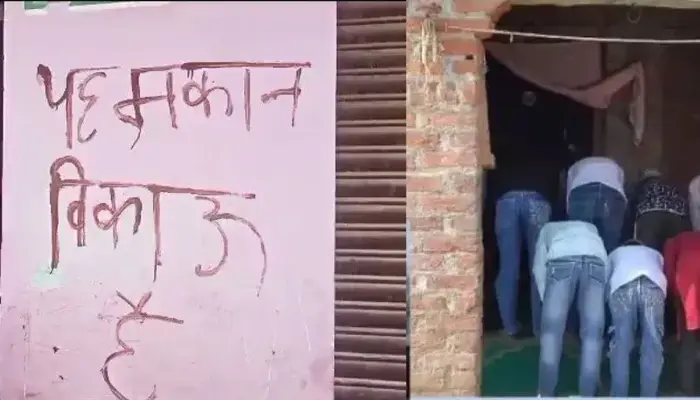
Case Summary
In Mohammadganj village, Bareilly district, Uttar Pradesh, 200 Hindu families were forced to flee after prolonged harassment, expulsion threats, and abuse by members of the Muslim community. The victims put up "House for Sale" signs outside their homes, and this incident resulted in religious tensions across the entire locality. According to reports, around 200 Hindu families put up “House for Sale” signs outside their homes and announced their intention to leave the village. The immediate trigger was the continuation of Friday prayers/namaz being conducted inside some of the private residences, an attempt at converting Muslim homes into mosques. The Hindu community said that it amounted to a violation of a long-standing local understanding. Hindu residents stated that in 1995, both communities had agreed that neither a temple nor a mosque would be constructed in the village in order to preserve communal harmony. Due to this, all these years, the Muslim community had been travelling to a neighbouring village to offer namaz. However, since January 2026, Muslims had been gathering in large numbers for prayers inside houses, including on rooftops and in rooms to offer namaz, which was viewed by Hindu families as an attempt to convert houses into mosques and madrassas inside the village. A similar incident had surfaced on 16 January 2026, when a video of Muslims offering namaz in a house went viral. Police detained 12 individuals at that time and initiated action for disturbing the peace, after which the matter temporarily subsided. However, prayers were again held at the same premises, reigniting communal tensions. Hindu residents stated that despite repeated complaints to the local administration, no effective steps were taken to stop the Friday prayers. Hindu women in the village also stated that Muslims not only offered namaz at home, but also gathered in the name of namaz and then abused Hindus. Hindus were being threatened and intimidated by Muslims. According to the women, Muslims say, "Nothing right now, let our government come, then we will drive you all out of here." Muslims would often throw dirty water into Hindu homes. Hindus also revealed that when they protested, the Muslim side intimidated them and opened fire, spreading terror throughout the village. Women from the Hindu community described feeling insecure and said the situation compelled families to consider migration. Several households painted or pasted notices stating “This house is for sale” on their doors as a mark of protest. They sought intervention from Chief Minister Yogi Adityanath and demanded demolition of the structure being used for collective prayers. Hindu organisations also visited the village and extended support. On the other hand, members of the Muslim community claimed that there was no mosque or designated public place for worship in the village and that offering namaz inside a private home did not violate any law. They maintained that prayers had been conducted in homes for decades and that recent objections were politically motivated. The village head and other Muslim residents indicated that they would abide by the court’s decision, as the matter had reached the High Court following earlier police action, though it was still pending at the time of reporting. Superintendent of Police Anshika Verma stated that a joint team led by the Circle Officer and Sub-Divisional Magistrate had been formed to engage with both sides, that police forces were deployed as a precaution, and that the situation was under control. The administration continued dialogue efforts to prevent further deterioration of communal relations in the village.
Why it is Hate Crime ?
This case has been added to the tracker under the primary category of - Attack not resulting in death. Within it, the sub-category selected is - Attacked for Hindu identity. In several cases, Hindus are attacked merely for their Hindu identity without any perceived provocation. A classic example of this category of religiously motivated hate crime is a murder in 2016. 7 ISIS terrorists were convicted for shooting a school principal in Kanpur because they got ‘triggered’ seeing the Kalava on his wrist and tilak that he had put. In this, the Hindu victim had offered no provocation except for his Hindu religious identity. The motivation for the murder was purely religious, driven by religious supremacy. Such cases where Hindus are targeted merely for their religious identity would be documented as a hate crime under this category. The other sub-category selected here is - Attacked for opposing radicals or trying to save victim. In several cases, Hindus are attacked for opposing religiously motivated crimes being committed against a fellow Hindu or simply for voicing an opinion opposing radical elements, who either have in the past or continue to persecute Hindus. In such cases, the initial attack against the victim, against which the Hindu was trying to defend the victim, would also need to be classified as a religiously motivated hate crime. Since the initial crime itself was religiously motivated and the subsequent crime of attempting to save the victim or speaking against the radical elements ends up inviting a violent attack, it would also be classified as a religiously motivated hate crime under this category. The second primary category selected here is - Hate speech against Hindus. Within it, the sub-categories selected here is - Violent threats. Violent threats, explicit, implicit or implied, is the most dangerous form of hate speech since it goes beyond discriminatory and prejudicial language to express the intent of causing harm to an individual or a group of people based on their religious identity and faith. There could be several different kinds of threats that are issued to Hindus based on religious animosity. An explicit threat would mean the direct threat of violence towards an individual Hindu, a group of Hindus or Hindus at large. Physical violence, death threats, threats of destruction of property belonging to Hindus and threats of genocide would mean explicit threats against Hindus for their religious identity. Implicit threats may not be a direct threat but implied through the use of symbols of actions – for example – in the Nupur Sharma case, other than explicit threats, there were also implicit threats when Islamists took to the streets to burn and beat her effigies. It implies that they want to do the same to Nupur Sharma – thereby is considered an implicit threat. Violent threats can be delivered in person, through letters, phone calls, graffiti, or increasingly through social media and other online platforms. It would be important to understand that a threat – explicit or implicit, online or offline – to an individual who happens to be a Hindu does not qualify as a religiously motivated threat. Such a threat, while vile and dangerous, could be owing to non-religious reasons and/or personal animosity. To qualify as a religiously motivated threat, it would need to exhibit an indication that the individual is being targeted for religious reasons and/or owing to his/her religious identity as a Hindu. This case has been added to the tracker as a hate crime because it involved the collective targeting of Hindu families in Mohammadganj village, where nearly 200 Hindu households put up “House for Sale” posters due to prolonged harassment, threats of expulsion and abuse by the members of the Muslim community. The tensions occurred due to Friday namaz being offered inside private residences despite a long-standing 1995 understanding between the two communities that neither a temple nor a mosque would be constructed in the village. The Hindu community was harassed and abused by the Muslim community. The actions by the Muslim community went beyond a mere dispute over religious practice and transformed into targeted harassment of the Hindu community. Muslims community offered namaz, issued threats, hurled abuses, and warned that Hindus would be driven out once political circumstances changed. This declaration leaves no doubt that the crime was religiously motivated with the intention to drive the Hindus out of the area. When Hindus protested, they were intimidated, including firearms being discharged, creating an atmosphere of fear and coercion. The pattern described by villagers showed systematic targeting of Hindu households rather than any personal quarrel between individuals. The hostility was directed at them as Hindus, and the pressure created a climate in which families felt unsafe in their own ancestral homes. These acts were not isolated incidents of criminality but were part of a broader, coordinated pattern of religious intimidation tactics designed to instil fear and insecurity, ultimately compelling Hindus to leave the area. Effectively, the Muslim community created such a hostile and unsafe atmosphere in the region that it forced Hindu residents to flee. The posters outside Hindu homes reported that they were being forced to sell their houses and migrate due to terror caused by the members of the Muslim community. This further proves that such actions by the Muslim community were part of an orchestrated attempt to drive Hindus out and make the locality a Muslim majority. Such tactics not only strip the victims of their basic right to live safely in their homes but also reflect a deeper pattern of religious hatred and ideological hostility towards the Hindu faith. The objective is not merely to harass, but to transform the area into an exclusive Muslim zone by pushing out all non-Muslims, especially Hindus. This wasn’t just a forced eviction; it was a calculated effort to drive out a particular community using fear, violence, and humiliation as weapons. The targeting of Hindu families was not based on personal enmity or individual disputes but on their religious identity. The harassment was collective, identity-based, and directed exclusively at Hindu homes. The use of threats, the brandishing and firing of weapons to instil fear, and the messaging that Hindus would not be allowed to remain in the village underscored a communal motive. The absence of any prior personal conflict, combined with the coordinated nature of intimidation, demonstrated that the hostility was rooted in religious hatred and an assertion of dominance over the Hindu community within that locality. The Muslim community specifically threatened the Hindus, stating they would drive them out once political circumstances changed, showcasing the depth of their religious hostility. Threatening an entire community with forced expulsion from a village solely due to their religious identity confirms this was a religiously motivated hate crime targeted specifically at Hindus. Furthermore, even though the matter remained pending before the High Court following earlier police action, namaz was again conducted at the same residential premises. The decision to resume namaz despite the dispute being pending in court further demonstrated malicious intent and a conscious disregard for communal sensitivities. Rather than allowing the court to adjudicate the issue and maintain the status quo, the continuation of the practice intensified tensions and reinforced the perception among Hindu residents that the move was deliberate and assertive. It was done to assert the Muslim identity and portray religious dominance. This case, therefore, reflected a deeper communal assault aimed at eroding the Hindu presence in the village through sustained intimidation. The forced display of migration posters, the atmosphere of terror, and the identity-based targeting together satisfied the parameters of a religiously motivated hate crime. Since the actions described were rooted in religious hostility towards the Hindu faith and its adherents, this case has been added to the hate crime database of the tracker. Disclaimer: Media reports state that around 200 Hindu families in Mohammadganj village were compelled to put up “House for Sale” posters and threatened with migration due to intimidation and communal hostility. However, no gender-wise or age-wise breakdown of the affected individuals was provided. For documentation clarity, the Hinduphobia Tracker has estimated the total number of victims at approximately 1,000 individuals, assuming an average rural household size of five members per family, in line with India’s Census 2011 and NFHS-5 (2019–21) rural demographic patterns. Accordingly, the affected population is proportionally estimated to include 750 adults and 250 children, reflecting typical rural household distribution ratios. For internal gender classification purposes, the total has been further recorded as 500 males and 500 females. This numerical estimate is solely for documentation purposes. It is important to clarify that none of the media sources covering this case has specified the exact date when the harassment and intimidation of the Hindu families first began. The earliest clearly documented incident is 16 January 2026, when a video of mass namaz being conducted inside a residential premises surfaced, and police action was initiated against 12 individuals. Since the Hinduphobia Tracker records incidents from the date the victim community’s ordeal became evident rather than when it was reported, the date of the incident has been recorded as 16 January 2026.
Victim Details
Total Victim
1000
Deceased
0
Gender
- Male 500
- Female 500
- Third Gender 0
- Unknown 0
Caste
- SC/ST 0
- OBC 0
- General 0
- Unknown 1000
Age Group
- Minor 250
- Adult 750
- Senior Citizen 0
- Unknown 0


Case Status
Case sub-judice


Perpetrators Details
Perpetrators
Muslim Extremists
Perpetrators Range
Unknown
Perpetrators Gender
unknown
 Sources




