Hindu villagers, including children, targeted for conversion under guise of prayer meeting by Christian man in Maharajganj, Uttar Pradesh,
 Maharajganj, Uttar Pradesh, India
  14 February, 2026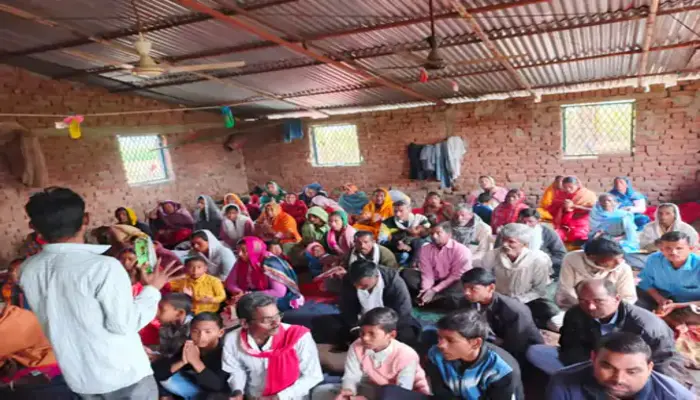
Case Summary
In the Sonbarsa village of Maharajganj district, Uttar Pradesh, Hindu villagers, including women and children, were targeted for conversion under the guise of a prayer meeting by a Christian man named Rajkishore. The incident occurred on 15 February 2026, when members of local Hindu organisations received information that a religious gathering was being held where conversion activities were taking place. Acting on this information, BJP provincial council member Dharamnath Kharwar, accompanied by Pawan Pandey, Gyanendra Pathak, Hridayesh Tiwari, Deepak Soni, Yogesh Jaiswal, Amit Puri and Vishwajeet Choubey, reached the location at around 11 a.m. They discovered that a prayer meeting was being conducted and conversion activities targeting Hindus, including women and children, were taking place. They immediately informed the Kothibar police station, and police officials arrived at the spot, halted the gathering, and arrested one accused identified as Rajkishore, a resident of Sonbarsa. During the raid, religious books were also recovered from the premises. According to police officials, an FIR was registered on the complaint of Pawan Pandey under relevant sections pertaining to unlawful religious conversion. Inspector in-charge Dharmendra Singh confirmed that the accused had been taken into custody and that further legal proceedings were initiated. It was also revealed that the same individual had previously faced legal action two years earlier in connection with a similar incident regarding forced religious conversion, during which police had proceeded against him and four others.
Why it is Hate Crime ?
This case has been added to the tracker under the primary category of - Predatory Proselytisation. Within it, the sub-category selected is- Proselytisation by grooming, brainwashing, manipulation or subtle indoctrination. The tertiary category selected is - Conversion of minor and Pattern of targeting Hindus. Religious brainwashing essentially means the often subtle and forcible indoctrination to induce someone to give up their religious beliefs to accept contrasting regimented ideas. Religious grooming or brainwashing also involves propaganda and manipulation. It involves the systematic effort, driven by religious malice and indoctrination, to persuade “non-believers’ to accept allegiance, command, or doctrine to and of a contrasting faith. Cases of such grooming or brainwashing are far more nuanced than direct threats, coercion, inducement and violence. In such cases, it is often seen that there is repeated, subtle and continual manipulation of the victim to induce disaffection towards their own faith and acceptance of the contrasting faith of the perpetrator. While subtle indoctrination is widely acknowledged as predatory, an element which is often understated in such conversions or the attempts of such conversion is the role of loyalty and trust which might develop between the perpetrator and the victim. Fiduciary relationships are often abused to affect such religious conversion. For example, an educator transmitting religious doctrine of a competing faith to a Hindu student. The Hindu student is likely to accept what the teacher is transmitting owing to existence of the fiduciary relationship. The exploitation of the fiduciary relationship to religiously indoctrinate victims would also be included in this category. Since the underlying animosity towards the victim’s faith forms the basis of predatory proselytization, such cases are considered religiously motivated hate crimes. This case has been added to the tracker because Hindu villagers were targeted for conversion under the guise of a prayer meeting by a Christian man named Rajkishore. Firstly, the victims were drawn into conversion efforts under the guise of a prayer meeting. What was presented as a prayer gathering is often a covert attempt at religious conversion. Such meetings are not genuine community prayers, but structured efforts designed to exploit trust and familiarity in order to influence Hindus to abandon their faith. By disguising conversion activity as prayer meetings, the Christian man deliberately manipulated vulnerable individuals, using emotional and social circumstances to exert religious pressure. Secondly, police also recovered religious literature from the premises. Thus, the Christian accused was also actively attempting to indoctrinate the Hindu victims by using Christian religious texts and literature. Using the scriptures or literature of one faith to deliberately target and manipulate members of another, with the clear intention of religious conversion, represents a direct attack on the Hindu faith. Such actions are designed to violate and undermine the beliefs of Hindu victims and are clear indicators of religious hostility towards Hindus and their religious identity. When Christian religious material is used to exploit trust, sow doubt, and misrepresent the beliefs of Hindus to coerce conversion, particularly in a systematic manner, it constitutes a religiously motivated offence. Thirdly, some of those present at the prayer meeting were children, which means the element of consent and genuine change of conscience was missing ab initio. Minors, due to their young age and lack of maturity, are particularly vulnerable to manipulation and coercion. They may not have the ability to fully understand the implications of converting to another religion, and the perpetrator purposely targeted and exploited this vulnerability of the victim. Since this case exemplifies the use of coercion and manipulation to achieve religious conversion, it is a blatant act of religious hate. Furthermore, it was revealed that the accused had previously faced legal action in connection with a similar incident regarding conversion, during which police had proceeded against him and four others. Thus, this was not an isolated incident of evangelism, but rather part of a broader, organised operation to further religious conversions, indicating a targeted action against Hindus as a collectivity. When individuals or groups focus their efforts on converting members of a particular religion, in this case, Hindus, then it demonstrates a fundamental disregard for the Hindu faith. Conversion, especially when not based on personal conviction but rather on external persuasion or pressure, is not simply about sharing a different belief system. It is an attempt to undermine the values, traditions, and identity of the Hindu community. The Christian faith, by its very theological foundations, places a strong emphasis on proselytisation. In pursuit of conversion objectives, Christian evangelists often employ unethical means, ranging from psychological pressure and misinformation to inducements such as money or jobs. This systematic attempt to erode the religious foundation of individuals and replace it with allegiance to another faith reflects deep religious malice and animus against the Hindu identity. Because the core motivation of the act stems from hostility toward the victim’s religion, it meets the threshold of a hate crime. Hence, categorised as a hate crime in the database. Disclaimer: It is important to clarify that the news reports covering this incident did not explicitly state that women and children were present at the prayer meeting. However, the image published alongside the reports clearly showed the presence of women and children at the gathering. Accordingly, for the purpose of documentation in this tracker, women and children visible in the published image have been considered as the victims. This classification is based on visual evidence accompanying the report and does not rely on textual assertions within the news coverage.


Case Status
Arrested


Perpetrators Details
Perpetrators
Christian Extremists
Perpetrators Range
One Person
Perpetrators Gender
male
 Sources




