Hindu temple land targeted for encroachment as Buddhists demolish compound wall and forcibly install Buddha idol
 Surat, Gujarat, India
  13 October, 2025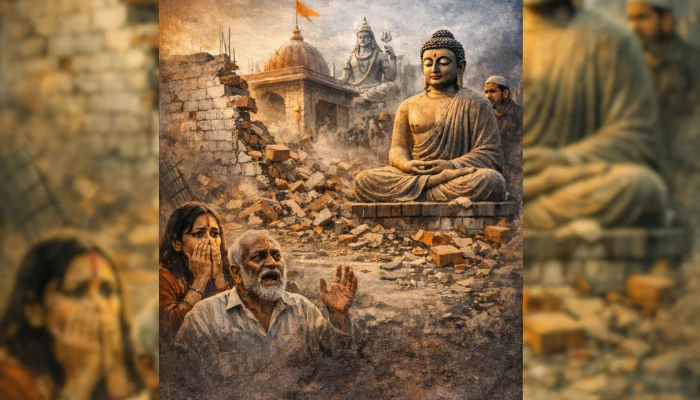
Case Summary
A Hindu temple compound wall belonging to the Sahajanand Mahadev Charitable Trust was demolished by a group of twelve Buddhists, including five women. On 14 February 2026, in Dindoli, Surat, the accused attempted to encroach on the temple land. Previously, they had also forcibly installed a Buddha idol inside the premises. The Sahajanand Mahadev Charitable Trust had been allotted two open plots by the society’s landowner, Jayesh Patel, for the construction of a temple and a cow shelter. Patel had also granted power of attorney to Hitesh Vishwakarma, the administrator of the trust, to manage the land and oversee temple activities. Construction work for the temple had been underway since 2023. According to the complaint filed by the Hindu administrator, Vishwakarma, one of the accused, Buddhist society member Anil Sonawane, along with his associates, had earlier installed a Buddha idol near the temple site without permission. Suspecting an attempt to encroach upon the land, Vishwakarma approached the collector’s office in October 2025 seeking intervention. He also asked Sonawane to remove the idol, but the latter refused. Subsequently, Vishwakarma removed the idol and placed it at his residence. On the morning of 14 February 2026, Vishwakarma learned that a group of Buddhists had entered the temple premises after demolishing the compound wall. When he reached the spot, he found Anil Sonawane, his brother Dhiraj, and their mother Sunanda inside the compound along with several relatives and associates. The accused were armed with hammers and spades. Police were alerted, following which all twelve persons were booked under charges of criminal trespass, unlawful assembly, and property damage. A case was registered by the Dindoli police, and an investigation was underway at the time of writing this report.
Why it is Hate Crime ?
This case has been documented under the primary category: Attack on Hindu religious representations. Under this, the sub-category selected is: Encroachment or illicit takeover of temple land/land near the temple. In Hinduism, a temple is the abode of the Deity. The Deity in the Temple is consecrated, thereby making it a real, breathing entity. Hindus believe that not just the Deity but the temple premises itself are sacred to Hindus since Hindus hold the faith that the entire Temple space is an amalgamation of the divine energy of the deity. Not only the Temple but the Temple premises in its entirety are considered sacred by Hindus. In several cases, the premises of the Temple and/or religious centre are illicitly taken over by institutions belonging to other faiths, like the Waqf board or the Church. Other times, the temple property, land or the property of religious centres are illicitly encroached upon by non-Hindu groups. Any illicit takeover or encroachment is a crime an initio; however, when non-Hindu groups illicitly take over or encroach on the sacred land of Hindus, it is an affront to the Hindu community and is therefore classified as a religiously motivated hate crime under this category. Another sub-category selected is - Attack on temples. In Hinduism, a temple is the abode of the Deity. The Deity in the Temple is consecrated, thereby making it a real, breathing entity. Hindus believe that not just the Deity but the temple premises itself are sacred to Hindus since Hindus hold the faith that the entire Temple space is an amalgamation of the divine energy of the deity. Given the central significance of Temples in Hindu Dharma, any attack against a Hindu Temple or its peripheral premises is an attack on the faith itself and is born out of animosity towards the faith, of which the Temple is a central tenet. Any manner of attack against a Temple and/or its premises would therefore be considered a religiously motivated hate crime. The other subcategory selected is- Desecration of Hindu religious symbol. Icons and symbols or a religious representation of a spiritual ideal are widely revered in Hinduism. Iconography is of vital significance in the Hindu milieu. It helps connect people’s spiritual beliefs with the real world. Iconography within the Hindu faith takes several shapes and forms. Murtis are of most significance to Hindus, to which daily rituals, prayers and offerings are done. Besides the murtis, there are several other symbols which have deep significance in the Hindu faith – the Om and Swastika for example. Since these Hindu religious symbols hold paramount importance in Hinduism, any desecration of symbols, icons, murtis, religious representations and manifestations, is driven by animosity towards the faith itself which manifests itself through these murtis, icons and symbols. Therefore, any desecration of these Hindu religious symbols and representations is considered religiously motivated hate crimes under this category. This incident was recorded as a hate crime because the violence was directed at a Hindu religious site and involved the destruction of the wall of the temple due to illegal encroachment. Such actions desecrated the sanctity of the worship space itself. Firstly, it is important to note that Hindu temples hold profound religious importance as sacred centres of worship, divine presence, and communal devotion in Hinduism. These temples embody the abode of deities, sites for rituals, festivals, and spiritual solace, revered across millennia in Hindu scriptures and traditions. Their compound walls form an integral, inseparable part of the temple ecosystem itself, equally revered and sacred boundaries that demarcate, protect, and sanctify the holy precinct from the mundane world. Even the temple land is an inseparable part of the temple, hailed as sacred by devotees who view it as an extension of the divine realm, consecrated for worship and construction, and inviolable under Hindu tenets. On 14 February 2026, in Dindoli, Surat, the Buddhist perpetrators demolished the entire temple compound wall belonging to the Sahajanand Mahadev Charitable Trust, amounting to a direct attack on the temple and desecration of the under-construction site. This forcible encroachment showcased deep-seated religious animosity and undermining of the Hindu faith and its sacred spaces, making it a clear case of a religiously motivated anti-Hindu hate crime. Forcibly placing a Buddha idol inside the temple premises showcased deep hatred and religious supremacism. The perpetrators' actions, encroaching on Hindu temple land, breaking its walls, and imposing a Buddhist symbol, demonstrated intent to establish the supremacy of Buddhism over Hinduism and desecrate land allotted for a Hindu temple. Forcing another religion's symbols onto this designated sacred space highlighted profound animosity and supremacism, confirming it as a religiously motivated hate crime. Since this case meets all parameters of a religiously motivated hate crime, it is added to the hate crime database of the Hinduphobia Tracker. Disclaimer: The Hinduphobia tracker records incident dates based on when the crime began, rather than when it was reported by the media. In this case, the recent demolition occurred on 14 February 2026. However, reports also noted that the earliest incident took place in October 2025, when Buddhist society member Anil Sonawane and his associates installed a Buddha idol near the temple site without permission, marking the initial unauthorised encroachment. Henceforth, 14 October 2025 was selected as the indicative incident date to mark the beginning of the forced encroachment. This is recorded for documentation purposes only.


Case Status
Complaint registered


Perpetrators Details
Perpetrators
Others
Perpetrators Range
From 10 to 100
Perpetrators Gender
both
 Sources




