Mahashivaratri procession targeted as Muslim children throw garbage and sticks at Hindu Kanwar pilgrims in Uttarakhand
 Jaspur, Uttarakhand, India
  14 February, 2026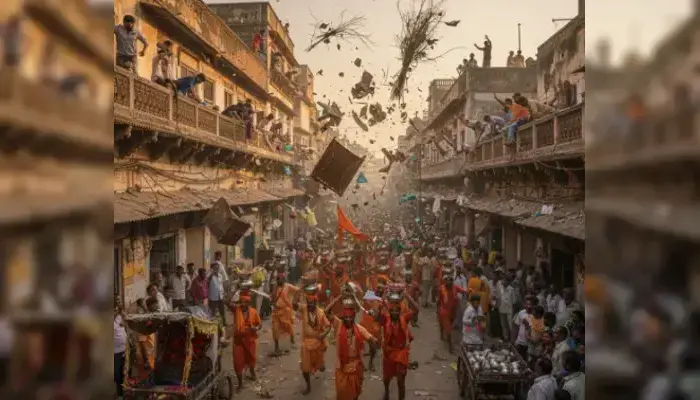
Case Summary
In Jaspur of Udham Singh Nagar district, Uttarakhand, tension erupted on the occasion of Mahashivaratri after garbage was thrown on Hindu pilgrims carrying Kanwar by Muslim children. According to media reports, the incident occurred on 15 February 2026, near Abdulwari Chowk, when Hindu devotees carrying water (Kanwar) as part of their religious observance were passing through the area. From the rooftops of nearby houses, some Muslim children deliberately threw empty Frooti packets towards the pilgrims and then hurled sticks in their direction. A video of the incident circulated widely on social media, triggering anger among sections of the Hindu community and leading to unrest in the locality. Following the circulation of the video, workers of the Bharatiya Janata Party and members of Hindu organisations went to the local police station to demand action. Members of the Muslim community also gathered there, resulting in a brief confrontation between the two groups. The situation became tense before the police intervened to restore order. Police personnel were deployed in the area and acted promptly to prevent further deterioration of the law-and-order situation. The police summoned the Muslim children involved and their parents to the police station for questioning and assured those present that strict action would be taken after due inquiry. Some individuals were detained as part of the investigation. BJP leader Sheetal Joshi stated that the act had been premeditated and intended to disrupt the Kanwar Yatra during the Shivratri festival, and called for stringent measures against those responsible. The Superintendent of Police of Kashipur confirmed that a video from the Jaspur Kotwali area had come to notice and that the matter was under investigation. He further stated that peace and order were maintained in the area and that adequate police forces were deployed to prevent any further disturbance.
Why it is Hate Crime ?
This case has been added to the tracker under the primary category- Attack not resulting in death. Within it the sub-category selected is - Attack on religious procession. The outward celebration and display of religious symbols in an intrinsic part of Hinduism. Religious processions on various festivals are age-old traditions and a way to manifest faith and form a part of the religious practices of Hindus. On several occasions, such religious processions come under attack by non-Hindu mobs, in a manifestation of their animosity towards Hinduism and their practices. The reasons cited for such violent attacks are many and range from crossing a non-Hindu resident-dominated area to playing loud music, crossing from an area where there is a religious structure of another faith etc. The violent attacks are triggered by the outward display of religiosity by Hindus. The attacks are mainly a manifestation of religious supremacist doctrine which believes that idolatry, essentially the Hindu faith, is one that deserves to be annihilated since the very tenets of Hinduism, its practices and traditions are considered a sin in those doctrines. Since these attacks emanate from intrinsic and doctrinal animosity towards Hindus and Hinduism, it is considered a religiously motivated hate crime under this category. The other sub-category selected here is - Attack against Hindu devotees. Hindu devotees are a few of the easiest targets of religiously motivated hate crimes because during the festival/procession/puja etc, for non-Hindus it is easy to profile their victims on the basis of religion. Hindu devotees come under attack on several occasions by individual non-Hindus or mobs of non-Hindus owing to their animosity against Hinduism, its symbols and tradition/practices. There are several instances of Hindu devotees being attacked while they worship in temples or temporary religious structures, during religious processions, doing bhajan/kirtan/puja in their own homes, in the residential society etc. These attacks are perpetrated by non-Hindus primarily because of their animosity towards Hindus and their faith. In some cases, the trigger for the violence may be non-religious, however, there are two elements that make these hate crimes. First, the Hindus who come under attack are attacked violently while indulging in religious activity. Whether they are in a place of worship or not is immaterial to the crime. When individuals are attacked while indulging in religious practices, the attack in itself is a hindrance to their freedom to practice religion and therefore constitutes a hate crime. Secondly, religious supremacist doctrines and ideologies deem religious practices of Hindus to be offensive ab initio since they are considered “sinful” by these ideologies, worthy to be annihilated by force or coercion. Driven by these religious supremacist ideologies and doctrines, the attacks against Hindu devotees stem from intrinsic animosity towards Hinduism. In some cases, the trigger for the violence may be non-religious, however, it develops into a religiously motivated crime during the course of the violence. Since these attacks stem from animosity towards Hindus and Hinduism, they are considered religiously motivated hate crimes under this category. The second primary category selected here is - Attack on Hindu religious representations. Within it, the sub-category selected is - Defiling religious customs. Sanatan Dharma is not a religion of one book, which is to say that while it has religious scriptures that form the central tenets of the faith, there are several traditions followed through thousands of years, mostly passed from generation to generation orally. There are several such customs and traditions that are followed by various Hindus and Hindu sects. Defiling of these traditions and customs is a breach of an individual or group’s religious practices. Such practices can range from dietary restrictions like not eating non-vegetarian food for a certain period of the year, not eating non-vegetarian food at all, not eating beef since the cow is considered holy in Hinduism, the sanctity of religious customs followed in the house (like many ISCKON devotees), etc. Any malicious action leading to the breach of such traditions or defilement of these traditions owing to animosity towards the faith or for the sake of activism stems not only from the lack of faith in the religion itself but also from disregard for the faith of the devotees who follow the customs/traditions and implicit bias against the faith, the tradition itself. Since these specific traditions are central to the faith of the devotees of that specific sect of Hindus, any non-compliance with these traditional rules would be considered a religiously motivated hate crime. This case has been added to the tracker because on the occasion of Mahashivaratri, Muslim children threw sticks and garbage at Kanwariyas, while they were carrying holy water as part of their religious observance. Mahashivratri is one of the most sacred festivals in Hinduism, dedicated to Lord Shiva, during which devotees fast, offer prayers, and perform rituals that symbolise spiritual purification and devotion. The Kanwariyas, identifiable by their saffron attire and the Gangajal they carried, were visibly engaged in a Hindu religious act when objects, including empty fruit juice packets and sticks, were thrown at them from a rooftop. The targeting of Kanwariyas during Mahashivratri by the Muslim community established a direct connection between the victims’ religious identity and the act committed against them. The devotees were not engaged in any private activity; they were undertaking a sacred pilgrimage and ritual observance intrinsic to Hindu tradition. Throwing dirty objects at them while they were carrying holy water for ritual offerings amounted to a disruption and defilement of religious practice and an interference with their right to practise their faith peacefully. The deliberate nature of the act, occurring during a major Hindu festival and directed at clearly identifiable Hindu pilgrims, indicated hostility towards their religious expression. The Kanwar Yatra is not merely a physical journey; it is one of the most sacred annual Hindu pilgrimages, deeply rooted in spirituality, devotion, and faith. Kanwariyas undertake this pilgrimage as a form of penance, walking for days, often barefoot, across long distances to collect holy water from the river Ganga and offer it to Lord Shiva. To throw garbage at them is a deliberate act to defile the sacred Kanwar Yatra itself. It is a direct attack on the sanctity of their religious practice and an attempt to undermine the devotion of Hindus. These are not accidents or oversights; rather, they are deliberate, malicious actions aimed at insulting and desecrating a sacred Hindu tradition. Such actions are a result of deep-seated religious animosity towards the Hindu community. This is far more than an attack on individuals; it is a direct attack on Hindu devotees and their religious sentiments. By choosing to defile and attack the Kanwariyas during a period of spiritual dedication, the Muslim perpetrators sought to humiliate and degrade the Hindu community and their faith. Such acts are designed to violate the faith of Hindu devotees and cause deep emotional and spiritual distress. Such actions are calculated and malicious, intended to provoke outrage and instil insecurity among those Hindus who are peacefully practising their religion. Such instances showcase that the act was rooted in religious hostility towards Hinduism and its adherents, making it a religiously motivated crime. This act reflects a mindset of religious supremacy and communal entitlement amongst the members of the Muslim community. This sense of entitlement and superiority not only reflects deep-seated prejudice but also highlights an attempt to assert religious dominance over public spaces. Such actions were motivated by Islamic supremacist ideology, wherein Muslims tend to look down upon Hindus and their religious practices, and believe that they have the right to dictate to Hindus on how to conduct their celebrations. In conclusion, the act of throwing sticks and garbage at Kanwariyas during Mahashivaratri, while they were visibly engaged in carrying holy water for religious offerings, constituted a direct disruption of a Hindu religious observance. By interfering with devotees in the course of their ritual practice, the Muslim children targeted individuals on the basis of their religious identity and disrupted the peaceful exercise of their faith. Therefore, this case has been added to the Hate Crime database of the tracker.


Case Status
Unknown


Perpetrators Details
Perpetrators
Muslim Extremists
Perpetrators Range
Unknown
Perpetrators Gender
unknown
 Sources




