Mahashivratri procession passing by a mosque attacked, devotees subjected to stone-pelting by Muslims in Mathura
 Mathura, Uttar Pradesh, India
  14 February, 2026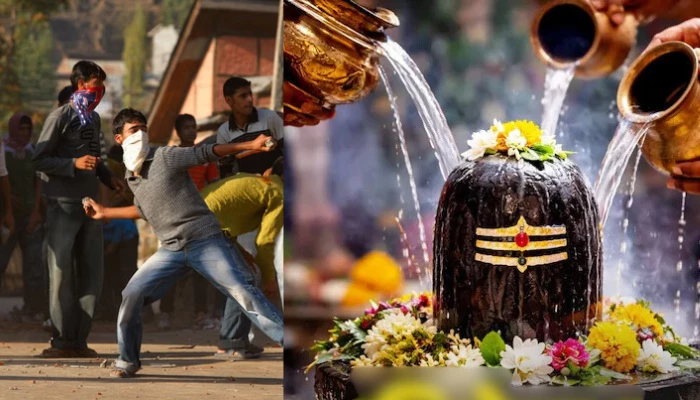
Case Summary
In Sahar village under the Barsana police station area of Mathura, a Hindu religious procession on the occasion of Mahashivratri was attacked by Muslim men. The attack occurred on 15 February 2026 when the procession passed by a mosque. Devotees faced stone-pelting, and the bhajans on the DJ were forced to stop by the Muslim perpetrators. According to media reports, the incident occurred when Gagan Saini, a young Hindu man from the village, was visiting the temple with his newlywed wife. Other devotees were also on their way to the Shiva temple to perform the Jalabhishek (offering water to the Shiva lingam) by taking out a Kanwar procession, a sacred Hindu ritual where devotees carry water to the Shiva temple for offering it, accompanied by a DJ and a band. While passing in front of the mosque, members of the Muslim community disrupted the band and demanded that the DJ stop. A dispute broke out between the two parties over this issue. According to the police, a compromise was reached after some social media figures intervened, and Gagan Saini’s wife went to the Shiva temple to perform the ritual of offering water. Upon returning, the Hindu devotees were attacked with bricks and stones being thrown, initiated by a seven-year-old Muslim child and later, other Muslim members joined. This led to heated arguments, and chaos ensued. Upon information of the chaos, the police immediately arrived at the scene to control the situation. During the investigation, the villagers said that during the religious programme, the DJ was stopped, the bhajans were stopped, and then stones were thrown. As soon as Bajrang Dal members received information of the incident, Ram Tomar and Jitendra Gupta of the Bajrang Dal arrived at the scene and demanded police action against the accused. Following this, the police detained two members of the Muslim community. Due to the tension, Provincial Armed Constabulary personnel were deployed in the village. According to the police, some of the people involved in the incident were detained, and a thorough investigation was underway at the time of writing this report.
Why it is Hate Crime ?
In this case, the primary category selected is - Attack not resulting in death. The first subcategory selected within this is- Attack on a religious procession. The outward celebration and display of religious symbols is an intrinsic part of Hinduism. Religious processions on various festivals are age-old traditions and a way to manifest faith and form a part of the religious practices of Hindus. On several occasions, such religious processions come under attack by non-Hindu mobs, in a manifestation of their animosity towards Hinduism and its practices. The reasons cited for such violent attacks are many and range from crossing a non-Hindu resident-dominated area to playing loud music, crossing from an area where there is a religious structure of another faith, etc. The violent attacks are triggered by the outward display of religiosity by Hindus. The attacks are mainly a manifestation of religious supremacist doctrine, which believes that idolatry, essentially the Hindu faith, deserves to be annihilated since the very tenets of Hinduism, its practices and traditions are considered a sin in those doctrines. Since these attacks emanate from intrinsic and doctrinal animosity towards Hindus and Hinduism, it is considered a religiously motivated hate crime under this category. The other subcategory selected is- Attack against Hindu devotees. Hindu devotees are a few of the easiest targets of religiously motivated hate crimes because, during the festival/procession/puja, etc., for non-Hindus, it is easy to profile their victims based on religion. Hindu devotees come under attack on several occasions by individual non-Hindus or mobs of non-Hindus owing to their animosity against Hinduism, its symbols and tradition/practices. There are several instances of Hindu devotees being attacked while they worship in temples or temporary religious structures, during religious processions, doing bhajan/kirtan/puja in their own homes, in the residential society, etc. These attacks are perpetrated by non-Hindus primarily because of their animosity towards Hindus and their faith. In some cases, the trigger for the violence may be non-religious; however, two elements make these hate crimes. First, the Hindus who come under attack are attacked violently while indulging in religious activity. Whether they are in a place of worship or not is immaterial to the crime. When individuals are attacked while indulging in religious practices, the attack in itself is a hindrance to their freedom to practice religion and therefore constitutes a hate crime. Secondly, religious supremacist doctrines and ideologies deem religious practices of Hindus to be offensive ab initio since they are considered “sinful” by these ideologies, worthy to be annihilated by force or coercion. Driven by these religious supremacist ideologies and doctrines, the attacks against Hindu devotees stem from intrinsic animosity towards Hinduism. In some cases, the trigger for the violence may be non-religious; however, it develops into a religiously motivated crime during the course of the violence. Since these attacks stem from animosity towards Hindus and Hinduism, they are considered religiously motivated hate crimes under this category. The other subcategory selected is: Attacked for crossing 'Muslim area'. One of the reasons that Hindus get attacked unprovoked, specifically by Islamists, is for crossing ‘Muslim areas’. Essentially, Muslim mobs often attack Hindus crossing or present in certain areas that have a majority Muslim population. It has often been cited as one of the reasons to blame Hindus for attacks against themselves, signalling that Hindus displaying religious symbols, taking our religious processions or crossing any area which is dominated by Muslim residents is a provocation in and of itself. These areas are mostly ghettoised areas where mobs mobilise quickly to attack Hindus for a variety of reasons, like playing music during a religious procession, crossing a mosque, wearing a tilak or any other religious symbol in a Muslim-dominated area, praying at a local temple in that area, etc. There have been cases where the few local Hindus of that area have been attacked on their way to the Temple for prayers as well, simply because the area is considered a Muslim-dominated area. Several times, it is entirely possible that the immediate trigger for the violence against Hindus was non-religious in nature; however, the violence became religiously motivated in nature because the area was Muslim-dominated and the residents, on the whole, harboured animosity towards Hindus, evidenced from the actions of the mob, the slogans, and the nature of the attack. Such crimes are motivated by the religious identity of the victims and are therefore classified as hate crimes under this category. This case stood as a clear instance of a religiously motivated hate crime, where Muslim perpetrators attacked a sacred Hindu Kanwar procession on the occasion of Mahashivratri while it passed by a mosque in Sahar village, Mathura. Mahashivratri ranks as Hinduism's holiest night dedicated to Lord Shiva, when families fast through the day, hold sleepless vigils, and offer Gangajal in fervent prayer for spiritual renewal and family blessings. The Kanwar procession amplified this sanctity, as devotees trekked with holy water from the Ganga precisely for Shiva lingam abhishek, a ritual of profound penance and devotion that binds communities in joyous faith. Attacking this procession revealed the perpetrators' deep-seated religious animosity towards the Hindu community, transforming a peaceful sacred observance into brutal violence and marking it a religiously motivated hate crime. The perpetrators launched a vicious stone-pelting attack on the Hindu devotees themselves, even after a compromise allowed the rituals to proceed. This onslaught went beyond disrupting music; it sought to inflict physical wounds and psychological terror on innocent worshippers, including a newlywed couple like Gagan Saini and his wife, who simply sought Shiva's blessings. Hindu families felt the raw fear of such betrayal during their most revered festival, exposing intent not just to desecrate Mahashivratri but to shatter Hindu spirits through physical and psychological harm. This assault on devotees during a sacred procession amounted to a stark, religiously motivated offence, fuelled by profound hatred for Hinduism and its joyful religious expressions. The perpetrators' demand to silence the bhajans, religious music, and the DJ during the sacred Kanwar procession exposed their deep-seated hatred, as they could not tolerate even the joyous sound of Hindu faith in public. Bhajans hold profound significance in Hinduism as devotional hymns sung in praise of deities like Shiva, evoking divine presence through melody, rhythm, and lyrics that stir the soul during festivals, families sway together, children clap along, and elders find transcendence in every note, turning rituals into living celebrations of devotion. Forcing this stop mid-procession on Mahashivratri screamed intolerance for Hindu expression, transforming sacred song into a trigger for violence and underscoring the religious animosity that fuelled the hate crime. The fact that this attack occurred right near the mosque sharpened the religiously motivated nature of the crime to a glaring point. Muslims often treat areas around mosques, dargahs, or madrassas as exclusive zones reserved solely for their community, calling them 'Muslim areas', where non-Muslims face exclusion and control over public movement. This disturbing assertion of Islamic supremacy allowed perpetrators to dictate how Hindus could pass through, viewing the procession's bhajans and DJ as an intolerable intrusion on their turf. Even a sacred Mahashivratri ritual became an affront in what they claimed as Muslim space, sparking stones from a Muslim child to adult Muslim mobs in a frenzy of religious exclusion. Such dominance over public areas screamed animosity towards Hindus, cementing this as a clear, religiously motivated hate crime. Such attacks amount to outright communal assaults on Hindus, where mere visibility of the Hindu faith, like a festival procession, in public spaces triggers savage violence against devotees and their traditions. This pattern of brutality whenever Hindu processions cross perceived Muslim boundaries exposes systemic hatred, rendering every stone a weapon of religious supremacy and a blatant hate crime. Given that this case met multiple parameters of a religiously motivated offence, it was added to the hate crime database of the Hinduphobia Tracker. Disclaimer: Media reports stated that multiple Hindu victims were targeted by Muslim perpetrators; however, the total number of victims was not specified. Only two victims, Gagan Saini and his wife, were named. Therefore, these two were recorded as the victims, with the victim count kept at two (2). This is a conservative estimate, as the total number of victims could be higher. Similarly, reports stated that multiple Muslims launched the attack, but only a minor Muslim boy and two other Muslims who were arrested were specified. Therefore, the perpetrator count was recorded as three (3). This is a conservative estimate, as the number of perpetrators could be higher.
Victim Details
Total Victim
2
Deceased
0
Gender
- Male 1
- Female 1
- Third Gender 0
- Unknown 0
Caste
- SC/ST 0
- OBC 0
- General 0
- Unknown 2
Age Group
- Minor 0
- Adult 2
- Senior Citizen 0
- Unknown 0


Case Status
Case sub-judice


Perpetrators Details
Perpetrators
Muslim Extremists
Perpetrators Range
From 2 To 5
Perpetrators Gender
male
 Sources




