Hindu temple's sanctity desecrated as man plays movie songs on loudspeakers inside its premises
 Palani, Tamil Nadu, India
  10 February, 2026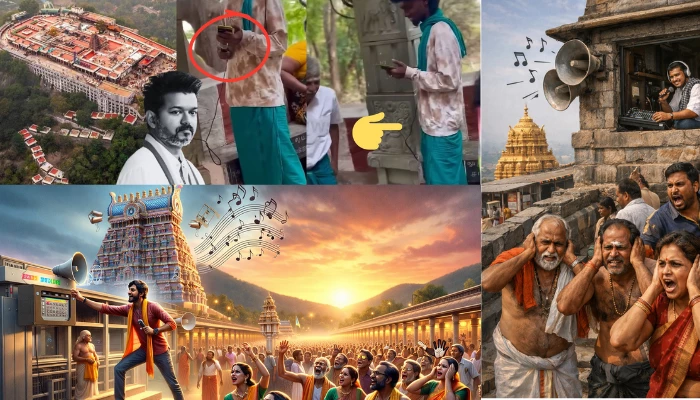
Case Summary
In Palani, Tamil Nadu, a Hindu temple's sanctity was desecrated and rules were violated by a man who played movie songs through the public announcement system along the steps pathway without authorisation. A video that later circulated on social media showed the accused connecting his mobile phone to the loudspeaker setup, the public announcement system, reserved exclusively for official temple announcements, and playing music. This setup was used by temple authorities and security personnel to broadcast information to pilgrims. The video showed the accused playing a film song featuring actor Vijay through the announcement system. This song, broadcast without authorisation, was associated with Tamilaga Vettri Kazhagam (TVK), a political party, and taken from one of Vijay’s films. Preliminary inquiries by temple authorities confirmed that the youth had played it without permission. Devotees present at the temple stated that they expressed anger over the incident, stating that broadcasting cinema songs inside a sacred temple space violated established traditions and undermined the spiritual atmosphere of the shrine. Temple officials confirmed that an inquiry was underway into the breach. They further added that they would implement additional security measures to prevent unauthorised access to the announcement system and to ensure that similar incidents did not occur in the future.
Why it is Hate Crime ?
The primary category selected in this case is- Attack on Hindu religious representations. The sub-category selected is- Breaking rules of the place of worship. Sanatan Dharma is not a religion of one book, which is to say that while it has religious scriptures that form the central tenets of the faith, there are several traditions followed through thousands of years, mostly passed from generation to generation orally. One of these oral traditions or written traditions is the rules of specific temples. Certain temples have rules that are traditional, dependent on the worship of the presiding deities. These rules and traditions have been followed for thousands of years, whether they find scriptural mention or not. Such traditions are based on the nature and rules of worship of the presiding deity of that temple. Any non-compliance of these traditions owing to animosity towards the faith or for the sake of activism stems not only from the lack of faith in the presiding deity but also disregard for the faith of the devotees of that deity/temple and implicit bias against the faith, the tradition and the deity itself. Since these specific traditions are central to the faith of the devotees of that specific temple and presiding deity, any non-compliance with these traditional rules would be considered a religiously motivated hate crime. The other sub-category selected is- Defiling religious customs. Sanatan Dharma is not a religion of one book, which is to say that while it has religious scriptures that form the central tenets of the faith, there are several traditions followed through thousands of years, mostly passed from generation to generation orally. Several such customs and traditions are followed by various Hindus and Hindu sects. Defiling of these traditions and customs is a breach of an individual or group’s religious practices. Such practices can range from dietary restrictions like not eating non-vegetarian food for a certain period of the year, not eating non-vegetarian food at all, not eating beef since the cow is considered holy in Hinduism, the sanctity of religious customs followed in the house (like many ISCKON devotees), etc. Any malicious action leading to the breach of such traditions or defilement of these traditions owing to animosity towards the faith or for the sake of activism stems not only from the lack of faith in the religion itself but also from disregard for the faith of the devotees who follow the customs/traditions and implicit bias against the faith, the tradition itself. Since these specific traditions are central to the faith of the devotees of that specific sect of Hindus, any non-compliance with these traditional rules would be considered a religiously motivated hate crime. In this case, the actions of the man playing a film song inside the sacred Palani Murugan Temple premises constituted more than mere public nuisance or irresponsible behaviour. It reflected a deliberate act of religious desecration and must be recognised as a hate crime. To understand the gravity of this violation, one must recognise that for Hindus, a temple is not merely a building or a social hall. It is the Devalaya, the literal abode of the Divine. Every inch of a consecrated temple, especially one with centuries of history and devotion like the Palani Murugan Temple, one of the Arupadai Veedu (six sacred abodes of Lord Murugan), is considered infused with spiritual energy and governed by strict codes of purity. Hindus revere these spaces as the physical manifestation of the deity on Earth, approaching them with immense devotion, ritual cleanliness, and a profound sense of awe. The temple is the soul of the community, a sanctuary for meditation and prayer where the mundane world is left behind to seek the transcendental. The incident involved broadcasting a cinematic song featuring actor Vijay, associated with Tamilaga Vettri Kazhagam (TVK), a political party, through the temple's public announcement system, reserved exclusively for official announcements, without authorisation. Palani Murugan Temple is not just a tourist site. It is a historic Hindu place of worship with immense spiritual and religious significance for millions of Hindus, and any attempt to desecrate or dishonour its sanctity is an affront to the faith itself. Playing the film song through the temple's loudspeakers and public announcement system was not merely an act of public nuisance. It constituted a direct affront to the sanctity of a revered heritage site. Such acts not only disturbed the spiritual atmosphere but also fostered a climate of hostility towards Hindu sacred spaces and the broader cultural ethos of Sanatan Dharma. By breaching temple rules despite security measures, this behaviour reinforced a narrative that these sacred customs are optional or dismissible, thereby fostering an environment of hostility and cultural insensitivity toward Hindu religious institutions and practices. Such deliberate violations cannot be viewed in isolation. They must be recognised as part of a broader pattern of disrespect and bias against Hindu places of worship. Hence, this case is included in the hate crime database of the Hinduphobia Tracker. Disclaimer: The Hinduphobia Tracker records incident dates based on when the crime occurred, not when the media reports it. In this case, media reports did not specify the exact date when the crime occurred. We have therefore selected 11 February 2026, the date of media reporting, as the indicative incident date. This is recorded for documentation purposes only.


Case Status
Unknown


Perpetrators Details
Perpetrators
Unknown
Perpetrators Range
One Person
Perpetrators Gender
male
 Sources




