Hindu temple in Jabalpur defiled as Muslim man urinates near sacred Shivalinga ahead of Mahashivratri festival
 Jabalpur, Madhya Pradesh, India
  8 February, 2026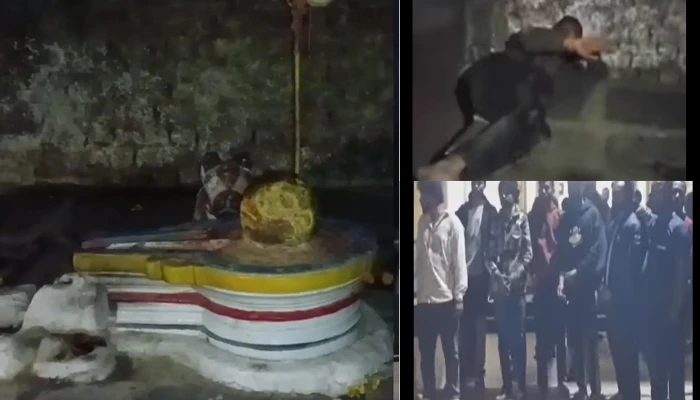
Case Summary
In the Chhoti Bajariya area of Gada, Jabalpur, Madhya Pradesh, a Hindu temple was defiled when a Muslim man named Mohammad Rizwan alias Rizzu Bhura urinated on the platform near the sacred Shivalinga. According to media reports, this occurred on 9 February 2026. Eyewitnesses saw Mohammad Rizwan, alias Rizzu Bhura, a resident of Qazi Mohalla, in an intoxicated state. He entered the temple premises and urinated on the platform near the Shivalinga. He then fell asleep nearby. People present at the scene caught him and beat him in anger. Following this, a few members of a Hindu organisation intervened and handed the Muslim man over to the police. Upon news of the incident circulating widely, a large number of officials and activists from the Bajrang Dal, the Vishwa Hindu Parishad, and other Hindu organisations reached the Gada police station. Slogans were raised in the police station premises, demanding strict action against the accused. The organisations stated that such incidents hurt religious sentiments and created tension in society. Following this entire incident, several purification rituals were carried out inside the temple premises on 10 February 2026. The police administration appealed to the public not to take the law into their own hands and to allow the investigation to be completed in this case. Gada police arrested the accused, Rizwan, under Sections 196B, 298, and 299 of the Indian Penal Code. After interrogation, he was sent to jail. Police said preventive action was also prepared against the accused for hurting religious sentiments. Additional Superintendent of Police, Jabalpur, Suryakant Sharma, said that in view of the upcoming Maha Shivratri festival and the incident, security at temples in the police station area was tightened. Police personnel were instructed to regularly patrol their assigned areas and monitor temple premises, particularly around Shivalingas.
Why it is Hate Crime ?
This case has been added to the tracker under the primary category- Attack on Hindu religious representations. The subcategory selected is- Desecration of Hindu religious symbols. Icons and symbols or a religious representation of a spiritual ideal are widely revered in Hinduism. Iconography is of vital significance in the Hindu milieu. It helps connect people’s spiritual beliefs with the real world. Iconography within the Hindu faith takes several shapes and forms. Murtis are of most significance to Hindus, to which daily rituals, prayers and offerings are done. Besides the murtis, there are several other symbols which have deep significance in the Hindu faith – the Om and Swastika for example. Since these Hindu religious symbols hold paramount importance in Hinduism, any desecration of symbols, icons, murtis, religious representations and manifestations, is driven by animosity towards the faith itself which manifests itself through these murtis, icons and symbols. Therefore, any desecration of these Hindu religious symbols and representations is considered religiously motivated hate crimes under this category. The other subcategory selected is- Defiling religious customs. Sanatan Dharma is not a religion of one book, which is to say that while it has religious scriptures that form the central tenets of the faith, there are several traditions followed through thousands of years, mostly passed from generation to generation orally. There are several such customs and traditions that are followed by various Hindus and Hindu sects. Defiling of these traditions and customs is a breach of an individual or group’s religious practices. Such practices can range from dietary restrictions like not eating non-vegetarian food for a certain period of the year, not eating non-vegetarian food at all, not eating beef since the cow is considered holy in Hinduism, the sanctity of religious customs followed in the house (like many ISCKON devotees), etc. Any malicious action leading to the breach of such traditions or defilement of these traditions owing to animosity towards the faith or for the sake of activism stems not only from the lack of faith in the religion itself but also from disregard for the faith of the devotees who follow the customs/traditions and implicit bias against the faith, the tradition itself. Since these specific traditions are central to the faith of the devotees of that specific sect of Hindus, any non-compliance with these traditional rules would be considered a religiously motivated hate crime. This case stood as a clear instance of a religiously motivated hate crime as the Muslim perpetrator defiled and desecrated a sacred Hindu religious symbol of Lord Shiva, the Shivalinga, by urinating on it. This act also amounted to the desecration of the temple entirely, as the Shivalinga was an integral aspect of the entire temple. For Hindus, temples hold profound religious significance. They are considered the living abodes of deities, where divine presence resides, and devotees seek spiritual connection. Any act of desecration or defilement against them constitutes a crime rooted in deep-seated animosity towards Hinduism and the Hindu community. The Shivalinga holds profound sacred significance in Hinduism as the aniconic embodiment of Lord Shiva, representing his formless, infinite nature as the cosmic pillar of fire without beginning or end, symbolising the eternal cycle of creation, preservation, and destruction. It unites the masculine (Shiva) and feminine (Shakti) principles in perfect harmony, serving as the abode of divine consciousness where devotees pour water, milk, and bilva leaves in rituals to invoke blessings, purity, and spiritual awakening. For millions of Hindus, it is the very heart of worship, evoking deep reverence during festivals like Maha Shivratri, when families gather to honour Shiva's boundless energy that sustains the universe. The act of defiling a Shivalinga by urinating on it constituted a direct and deliberate desecration of this holiest icon, shattering its pristine purity, an act that no devout Hindu can view as accidental, but as a brazen assault on the faith's core sanctity. This violation struck at the soul of Hindu devotion, where every drop of impurity introduced mocked the meticulous rituals maintained to preserve the Shivalinga's holiness as Shiva's living presence. Such an act revealed unmistakable religious animosity, as the perpetrator singled out a Hindu symbol for maximum humiliation, knowing its desecration would wound the sentiments of the entire community far beyond any random act, making it a religiously motivated hate crime. The timing of this desecration, occurring just days before Maha Shivratri, the grandest festival honouring Lord Shiva, when millions fast, pray, and anoint Shivalingas with sacred offerings, reveals the perpetrator's malicious intent to disrupt Hindu devotion at its peak. By targeting the Shivalinga on the eve of this joyous celebration of cosmic renewal, the Muslim accused sought to sow fear, shatter communal harmony, and rob devotees of their spiritual upliftment. This calculated strike amplified the wound to Hindu sentiments, turning a time of reverence into one of outrage and grief. Some may argue that the perpetrator acted under the influence of alcohol. Yet this raised a vital question. Even if alcohol influenced him, the end result was the desecration of a Hindu sacred symbol. If religious animosity played no role and alcohol alone drove him, why target a functioning Hindu temple specifically? Why not a neutral public place or a religious site of another faith, such as a church or mosque? This selective targeting of a temple showed that alcohol served merely as an excuse and pretext to justify the crime. Alcoholism never excuses desecrating a sacred temple and defiling sacred Hindu symbols, as it deeply hurts the sentiments of the Hindu community. Overall, this case met several parameters of a crime motivated by religious animosity. Therefore, it was added to the Hinduphobia Tracker's hate crime database.


Case Status
Arrested


Perpetrators Details
Perpetrators
Muslim Extremists
Perpetrators Range
One Person
Perpetrators Gender
male
 Sources




