Minor Hindu girl lured into marriage, sexually exploited, and forced to convert to Islam by Muslim man posing as Hindu
 Palia Kalan, Uttar Pradesh, India
  9 February, 2025
Case Summary
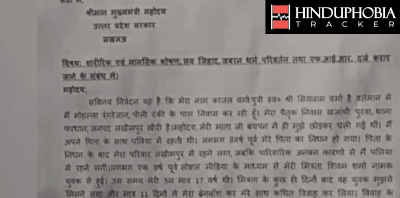
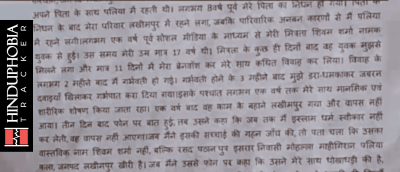
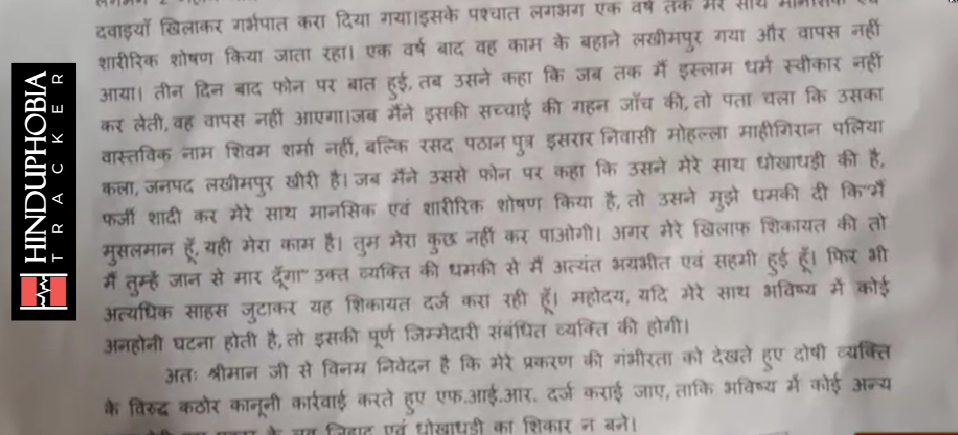
A minor Dalit Hindu girl, aged 17, from Palia, Uttar Pradesh, was deceived into a relationship and marriage by a Muslim man, Rasad Pathan, who concealed his Muslim identity by using the false Hindu name "Shivam Sharma." The victim, when she became an adult woman, filed a complaint with the Uttar Pradesh Chief Minister's office detailing how she was subjected to physical and mental exploitation, forced abortion, and coerced religious conversion over the course of approximately one year. According to reports, the victim had lost both her parents when she was a child, and she lived with the rest of her family in Lakhimpur Kheri. But due to disputes with her relatives, she began living in Palia. Approximately one year before (2025) filing the complaint, the victim, who was 17 years old at the time, became friends with someone calling himself Shivam Sharma through social media. Within days of their friendship, the man began meeting her in person. About 11 days after they started meeting, he brainwashed her, took her with him, and married her. Two months after the marriage, the victim became pregnant. When she was three months pregnant, she was threatened and forced to consume medicines that terminated her pregnancy. For nearly one year following this, she endured continuous mental and physical exploitation. The perpetrator subjected her to ongoing abuse that left her in severe distress, exploiting her vulnerable position after having taken her away from her family and support system. After approximately a year, Rasad Pathan left for Lakhimpur under the pretext of work and did not return. Three days later, during a phone conversation, he told the victim that he would not return until she accepted Islam. This revelation prompted her to investigate his true identity more deeply. Through her investigation, the victim discovered that the man's real name was not Shivam Sharma but Rasad Pathan, son of Israr Bismillah, a resident of Mohalla Chhoti Ganj, Palia Kalan, District Lakhimpur Kheri. When she confronted him over the phone about the deception, fraudulent marriage, and exploitation, Rasad Pathan told her that he was a Muslim and "this was what he did." He warned her that she would not be able to do anything against him and threatened to kill her if she filed a complaint. Despite the threats and fear, the victim filed a complaint with the Uttar Pradesh Chief Minister's office through the Chief Minister's complaint portal, requesting that strict legal action be taken and a First Information Report be registered against Rasad Pathan.
Case Images
Why it is Hate Crime ?
The primary category for this case is- Predatory Proselytisation. The sub-category that this case falls under is "Proselytisation by grooming, brainwashing, manipulation or subtle indoctrination". The tertiary categories for this case are "Conversion of minor" and "Rape and Sexual Assault/harassment." Religious brainwashing essentially means the often subtle and forcible indoctrination to induce someone to give up their religious beliefs to accept contrasting regimented ideas. Religious grooming or brainwashing also involves propaganda and manipulation. It involves the systematic effort, driven by religious malice and indoctrination, to persuade “non-believers’ to accept allegiance, command, or doctrine to and of a contrasting faith. Cases of such grooming or brainwashing are far more nuanced than direct threats, coercion, inducement and violence. In such cases, it is often seen that there is repeated, subtle and continual manipulation of the victim to induce disaffection towards their own faith and acceptance of the contrasting faith of the perpetrator. While subtle indoctrination is widely acknowledged as predatory, an element which is often understated in such conversions or the attempts of such conversion is the role of loyalty and trust which might develop between the perpetrator and the victim. Fiduciary relationships are often abused to affect such religious conversion. For example, an educator transmitting religious doctrine of a competing faith to a Hindu student. The Hindu student is likely to accept what the teacher is transmitting owing to existence of the fiduciary relationship. The exploitation of the fiduciary relationship to religiously indoctrinate victims would also be included in this category. Since the underlying animosity towards the victim’s faith forms the basis of predatory proselytization, such cases are considered religiously motivated hate crimes. The other sub-category for this is "Harassment, threats, coercion for conversion". Harassment covers a wide range of behaviours of an offensive nature. It is commonly understood as behaviour that demeans, humiliates, and intimidates a person, including threats and coercion. Harassment and threats, in this case, find their root on discriminatory grounds which has the effect of nullifying a person’s rights or infringing upon his freedom to exercise his right specifically owing to the victim’s religious identity. Verbal and physical threats and psychological or physical harassment are often used against Hindu victims because they choose to practice their professed religion. Religious harassment also includes forced and involuntary conversions by harassment, threats or coercion. Coercion includes intimidatory tactics like force-feeding a Hindu victim beef to convert to another religion, forceful circumcision etc. In several cases documented, non-Hindu perpetrators or those who harbour specific animosity towards Hinduism, harass victims simply based on their religious identity. Such cases often also include harassment to ensure the Hindu victim abandons his/her professed religion and adopts the religion of the perpetrator. Such cases where Hindu victims are harassed to convert to the perpetrator’s religion are rooted in animosity towards the victim’s religious identity and are therefore documented as religiously motivated hate crimes. One other primary category that this case falls under is "Crimes against women in relationships and other sexual crimes". The sub-category for this case is "Man pretends to be Hindu". The tertiary category for this case is "Name changed". When a non-Hindu man pretends to be a Hindu to deceive a Hindu woman into a relationship, the act is seen as triggered by malafide intentions. In some cases, the woman eventually accepts the man’s original religious identity and converts after the man’s identity is revealed. These cases could be argued as cases of religious brainwashing and a result of the pressure a woman feels after getting into a relationship with a man. The woman, it can be argued, also changed her religious identity because of the stigma she believes she might face if she chooses to walk out of a deceptive relationship. However, for the purpose of documenting hate crimes, the cases in this subcategory are limited to those where there is explicit violence aimed at religious conversion against the wishes of the victim (force-feeding beef, blackmailing with intimate videos, rape on refusal to convert, etc), or if the woman herself complains of the man’s religious deception. In such cases, it is established that the deception of the non-Hindu man had a specific aim of religious conversion or targeting of the victim due to her Hindu religious identity, therefore, making it a religiously motivated hate crime. The other subcategory selected is- Brainwashed and/or Groomed. The tertiary categories selected are- Rape and sexual assault/harassment, Conversion of Minor. In our database, we have not added incidents where women have converted to another religion of their free will and no allegations of forced/involuntary conversion have been made. However, there are certain cases of conversion where the consent itself is a result of the brainwashing or grooming of a minor by the non-Hindu perpetrator trying to victimise a woman for her Hindu religious identity. The phenomenon of grooming points to non-Hindu perpetrators identifying their Hindu victims’ vulnerabilities and exploiting them over months and sometimes years, to extract the supposed ‘consent’ in order to convert their religion. In most cases of grooming, the victims are minors or the grooming started when the victim was a minor. In other cases of grooming, the non-Hindu perpetrator brainwashes and grooms a minor victim to extract their trust and then proceeds to rape them repeatedly with the intent of converting them to their faith. It is pertinent to understand here that when the victim is a minor, the ‘consent’ to convert or enter into a romantic relationship with an adult itself is redundant – addressed by POCSO. While every case of conversion of a minor and incidents of establishing a physical relationship with a minor by an adult is a crime, for the purpose of this database, a case would be considered a hate crime only if there is a distinct religious angle to the grooming. For example, in the UK, if a Hindu minor is targeted by Pakistani grooming gangs, it would be considered a hate crime because the victims are specifically targeted owing to their non-Muslim religious identity with the perpetrators being Muslim. In other cases, if a Hindu minor is brainwashed into entering a physical relationship with the non-Hindu adult perpetrator and the family alleges grooming/brainwashing of the minor to convert her religion, it would form a part of this database. If the victim is a Hindu adult, the case would form a part of this database only if the victim herself says that she was brainwashed/groomed to convert her religion. However, if the victim is deceased (murdered or otherwise), the case would form a part of this database if her family/friends provided testimony that the victim was brainwashed/groomed to convert her religion. Since these crimes have a distinct religious angle where the victim is being targeted owing to her Hindu religious identity, these cases are considered a hate crime. Another sub-category that this case qualifies for is "Forced conversion after marriage". In such cases, a non-Hindu man marries a Hindu woman, and the force/pressure to convert to any Abrahamic faith, like Islam, begins after marriage. In such cases, typically, two patterns emerge. First, when the relationship is consensual, and the religious identity of the perpetrator is known to the Hindu woman in the relationship. The marriage could be under the Special Marriages Act, where neither parties are required to convert their religion for the marriage to be considered legitimate. While the victim in such cases enters matrimony assuming that religious identity is not a barrier, the non-Hindu man starts to pressure the woman to convert her religion after marriage. The second is when the woman gets into a marriage with the man, pretending to share her faith. Later, when the truth is revealed, the man starts pressuring the woman to convert her religion and give up her religious identity. In both situations, there is application of force by the perpetrator, including the denial of the woman’s religious rights. Some of the means by which the woman is forced/pressured to convert include force-feeding beef, being forced to read the Kalma, being forced to wear a hijab, forced to undergo Halala, etc. There are several instances where, after marriage, the woman voluntarily converts to Islam. Such cases are often argued to be a result of religious brainwashing, however, for the purpose of documenting religiously motivated hate crimes, in the absence of the victim complaining of forced conversion, such cases do not form a part of the database. In this case, a minor Hindu girl was lured into a relationship. She was sexually exploited and later pressured to convert to Islam by a Muslim man named Rasad Pathan, who posed as Shivam Sharma. This entire case showcases clear religious animosity behind the crime, as the deception targeted her Hindu identity from the start, exploiting her trust to inflict harm rooted in anti-Hindu hatred. Since the victim was a minor, the element of consent and genuine change of conscience was missing ab initio. Minors, due to their young age, are more vulnerable to manipulation and coercion. They do not grasp the long-term implications of entering a relationship, marrying, or converting their faith. The Muslim perpetrator exploited this vulnerability to prey on her for his sexual and religious motives, making it a hate crime. She also endured coercion due to her vulnerability as an orphan whose parents had died, leaving her isolated and easier to control. The perpetrator exploited this personal fragility alongside her religious identity, pressuring her towards forced conversion and sexual exploitation. Such calculated targeting of her Hindu background amid her orphan status reveals deliberate animosity, marking this as a religiously motivated hate crime. Luring the victim into a relationship solely to force her conversion to Islam and sexually exploit her demonstrates that she was targeted from the outset for her religious identity. This premeditated scheme was not random but driven by hatred towards her Hindu faith, underscoring the religiously motivated nature of the crime and qualifying it as a hate crime. The Muslim man deliberately concealed his religious identity to initiate a relationship and marriage with the Hindu victim. This manifests clear bias and malicious intent towards her religion, qualifying it as a hate crime. By hiding his true identity as Rasad Pathan and posing as the Hindu "Shivam Sharma," he exploited her trust under false pretences, revealing premeditated manipulation based solely on her religious background. In cases like this, adopting a false Hindu identity to ensnare a Hindu individual transcends personal betrayal; it expresses disdain for Hinduism and its customs, reflecting deeper animosity towards Hindus and their beliefs. Here, luring the victim into a relationship and marriage by faking a Hindu identity demonstrates she was targeted precisely for being Hindu, making the religiously driven nature of the crime unmistakable. The act of sexually exploiting her under the pretext of a shared Hindu identity exemplifies religiously motivated sexual violence, qualifying it unequivocally as a hate crime. By posing as a fellow Hindu named Shivam Sharma, the perpetrator built false intimacy to perpetrate repeated physical and mental abuse over nearly a year, including forced abortion. Such acts transcend mere personal gratification; they deliberately violate and demean a Hindu girl precisely because of her religious identity, aiming to shatter her sense of safety within her own faith community. This targeted sexual assault, rooted in deception about shared beliefs, highlights hate-driven intent to humiliate and dominate based on her Hinduism, cementing its status as a hate crime. After exploiting her for nearly a year, the accused abruptly left home for Lakhimpur Kheri and conditioned his return on her converting to Islam, exposing this as a religiously motivated hate crime. This ultimatum, forcing a vulnerable Hindu girl, isolated from her family, to renounce her faith, directly violates her religious autonomy and fundamental right to practise Hinduism freely. It reveals premeditated coercion designed not for reconciliation but to erase her Hindu identity, leveraging her orphan status and prior abuse to break her spirit. Such an explicit demand for conversion, after prolonged deception and harm, demonstrates deep animosity targeted at her religious background, rendering the entire scheme a hate crime. The victim faced explicit threats not to file a complaint, with the perpetrator warning over the phone that he would kill her if she did, which escalates the offence into a clear hate crime through intimidation. By admitting his Muslim identity, boasting "this is what he did," and vowing impunity while threatening her life, he sought to terrorise her into silence as a Hindu girl who had uncovered his deceit. This post-exploitation menace, aimed at preventing justice for a victim of interfaith targeting, lays bare the perpetrator's hateful mindset and reinforces the crime's religious bias. Issuing death threats to suppress her voice amplifies the severity, confirming the religiously motivated hate crime classification. Given that this case meets the parameters of a hate crime, it is being added to the hate crime database of the Hinduphobia Tracker. Disclaimer: The Hinduphobia Tracker records incident dates based on when the victim's ordeal begins, rather than media reporting dates. In this case, the incident was reported by the media on 10 February 2026, but the victim's ordeal started in 2025 without a specific date provided. Accordingly, an indicative date of 10 February 2025 has been selected as the incident date for documentation purposes.
Victim Details
Total Victim
1
Deceased
0
Gender
- Male 0
- Female 1
- Third Gender 0
- Unknown 0
Caste
- SC/ST 1
- OBC 0
- General 0
- Unknown 0
Age Group
- Minor 1
- Adult 0
- Senior Citizen 0
- Unknown 0


Case Status
Complaint filed


Perpetrators Details
Perpetrators
Muslim Extremists
Perpetrators Range
One Person
Perpetrators Gender
male
 Sources




