Sacred Hindu temple in Indore defiled as three men caught urinating on its walls
 Indore, Madhya Pradesh, India
  8 February, 2026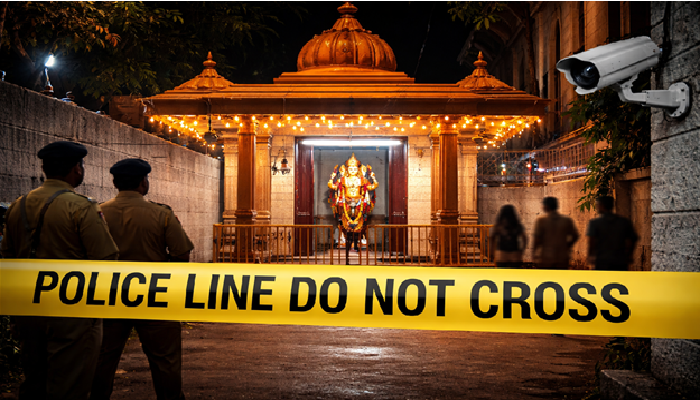
Case Summary
A sacred Hindu temple dedicated to Lord Hanuman in Indore, Madhya Pradesh, was defiled as three men urinated on its walls. This occurred on the night of 9 February 2026. The three perpetrators, Raja Dubey, Kamal Ahirwar, and Arpit Chauhan, were captured on CCTV cameras urinating on the outer boundary wall of an ancient Hanuman temple located in the Moti Tabele area under the Ravji Bazaar police station jurisdiction in Indore. The incident occurred late at night when the area was relatively quiet. The act was recorded by surveillance cameras installed near the temple premises. Police statements confirmed that the three men arrived together and were under the influence of alcohol at the time. The footage showed them standing near the temple wall, engaging in the act, and then leaving the spot. The matter came to light after local residents and temple devotees reviewed the CCTV footage. News of the incident spread in the locality, following which members of Hindu organisations, including the Vishva Hindu Parishad (VHP), reached the police station and demanded action. A formal complaint was lodged at Ravji Bazaar Police Station, after which the police identified the three individuals through the CCTV footage. Acting on the complaint and video evidence, police detained and subsequently arrested the three men. Police registered a case against them under relevant sections of the Bharatiya Nyaya Sanhita (BNS) and other applicable legal provisions related to hurting religious sentiments and disturbing public order. Officials stated that the accused admitted to the act during questioning and confirmed they were intoxicated at the time. After being taken into custody, visuals surfaced showing the three men at the police station holding their ears and apologising. Authorities confirmed that further legal proceedings were underway and that an investigation was conducted in accordance with due process. The incident led to protests and demands for strict action from local residents and Hindu groups, who gathered at the police station seeking accountability.
Why it is Hate Crime ?
The primary category selected in this case is- Attack on Hindu religious representations. The sub-category this case falls under is- Desecration of Hindu religious symbols. Icons and symbols or a religious representation of a spiritual ideal are widely revered in Hinduism. Iconography is of vital significance in the Hindu milieu. It helps connect people’s spiritual beliefs with the real world. Iconography within the Hindu faith takes several shapes and forms. Murtis are of most significance to Hindus, to which daily rituals, prayers and offerings are done. Besides the murtis, there are several other symbols which have deep significance in the Hindu faith – the Om and Swastika for example. Since these Hindu religious symbols hold paramount importance in Hinduism, any desecration of symbols, icons, murtis, religious representations and manifestations, is driven by animosity towards the faith itself which manifests itself through these murtis, icons and symbols. Therefore, any desecration of these Hindu religious symbols and representations is considered religiously motivated hate crimes under this category. The other subcategory selected is- Breaking rules of place of worship. Sanatan Dharma is not a religion of one book, which is to say that while it has religious scriptures that form the central tenets of the faith, there are several traditions followed through thousands of years, mostly passed from generation to generation orally. One of these oral traditions or written traditions is the rules of specific temples. Certain temples have rules which are traditional rules, dependent on the worship of the presiding deities. These rules and traditions have been followed for thousands of years whether they find scriptural mention or not. Such traditions are based on the nature and rules of worship of the presiding deity of that temple. Any non-compliance of these traditions owing to animosity towards the faith or for the sake of activism stems not only from the lack of faith in the presiding deity but also disregard for the faith of the devotees of that deity/temple and implicit bias against the faith, the tradition and the deity itself. Since these specific traditions are central to the faith of the devotees of that specific temple and presiding deity, any non-compliance with these traditional rules would be considered a religiously motivated hate crime. The other subcategory selected is- Defiling religious customs. Sanatan Dharma is not a religion of one book, which is to say that while it has religious scriptures that form the central tenets of the faith, there are several traditions followed through thousands of years, mostly passed from generation to generation orally. There are several such customs and traditions that are followed by various Hindus and Hindu sects. Defiling of these traditions and customs is a breach of an individual or group’s religious practices. Such practices can range from dietary restrictions like not eating non-vegetarian food for a certain period of the year, not eating non-vegetarian food at all, not eating beef since the cow is considered holy in Hinduism, the sanctity of religious customs followed in the house (like many ISCKON devotees), etc. Any malicious action leading to the breach of such traditions or defilement of these traditions owing to animosity towards the faith or for the sake of activism stems not only from the lack of faith in the religion itself but also from disregard for the faith of the devotees who follow the customs/traditions and implicit bias against the faith, the tradition itself. Since these specific traditions are central to the faith of the devotees of that specific sect of Hindus, any non-compliance with these traditional rules would be considered a religiously motivated hate crime. This case stands as a clear instance of a religiously motivated hate crime as the three perpetrators defiled and desecrated a sacred Hindu temple of lord Hanuman in Indore by urinating on its walls, striking at the heart of the Hindu faith with deliberate contempt. Hindu temples hold profound religious significance for Hindus as the living abode of deities, where divine presence resides, and devotees seek spiritual connection. Any act of desecration against them constitutes a religiously motivated hate crime. In this case, the perpetrators desecrated and defiled this sacred symbol of Hindu faith by urinating on the temple walls, an integral part of the temple property. Such a violation wounds the deep reverence Hindus hold for these holy premises. This act also shattered the sacred rules upheld by Hindu temples, which demand strict purity and cleanliness to honour the divine. Urination on temple property blatantly violated these norms. The perpetrators knew this yet chose to defile the site, revealing their utter disregard for Hindu faith and sentiments, showcasing the religiously motivated nature of the crime. Some may argue that the perpetrators acted under the influence of alcohol, as they claimed. Yet this raises a vital question. Even if alcohol influenced them, the end result was the desecration of a Hindu temple. If religious animosity played no role and alcohol alone drove them, why target a functioning Hindu temple specifically? Why not a neutral public place or a religious site of another faith, such as a church or mosque? This selective targeting of a temple showcases that alcohol served merely as an excuse and pretext to justify the crime. Alcoholism never excuses desecrating a sacred temple, as it deeply wounds the sentiments of the Hindu community. Overall, this case meets several parameters of a crime motivated by religious animosity. Therefore, it is being added to the Hinduphobia Tracker's hate crime database.


Case Status
Arrested


Perpetrators Details
Perpetrators
Others
Perpetrators Range
From 2 To 5
Perpetrators Gender
male
 Sources




