Hindu sentiments insulted after plastic bag containing meat and bones deliberately thrown inside Hindu temple
 Ballari, Karnataka, India
  5 February, 2026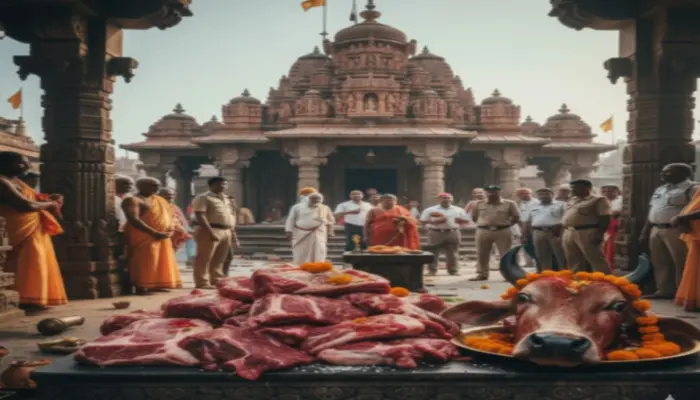
Case Summary
In Ballari city, Karnataka, Hindu sentiments were insulted after a plastic bag containing meat and bones was deliberately thrown inside the premises of a Hindu temple by unknown miscreants. According to reports, a plastic bag containing pieces of meat and bones, believed to be beef, was found at the Veera Balanjaneya Temple in the Nagalakeri locality on the morning of 6 February 2026. The bag was discovered by the temple priest in the early morning hours, with police indicating it had been thrown onto the temple premises before his arrival, around 5.45 am. Upon noticing the contents, the priest immediately informed the police, who reached the site promptly, removed the bag, and registered a criminal case at the Cowl Bazaar police station. The discovery led to a large gathering of Hindu devotees and local residents, who viewed the incident as an attempt to hurt Hindu religious sentiments, resulting in heightened tension in and around the temple complex. Additional police personnel were deployed to maintain law and order. BJP leaders and Hindu activists also pointed to past similar incidents in Ballari district, stated that the temple’s compound wall had been crossed to throw the bag inside, and suspected the meat to be beef, though no forensic examination had been conducted at that stage. Senior police officials, including the Ballari Range IGP and the ASP, visited the site, appealed for calm, advised against sensationalising the matter, and assured that a transparent investigation was underway. The Veera Balanjaneya Temple, an ancient shrine housing idols of Lord Hanuman, Lord Venkateshwara, Lord Ayyappa, and Lord Shiva, holds significant religious importance, particularly during Vaikunta Ekadashi, when thousands of devotees visit, which further intensified concerns surrounding the incident.
Why it is Hate Crime ?
This case has been added to the tracker under the primary category- Attack on Hindu Religious Representations. The subcategory selected is- Defiling Religious Customs. Sanatan Dharma is not a religion of one book, which is to say that while it has religious scriptures that form the central tenets of the faith, there are several traditions followed through thousands of years, mostly passed from generation to generation orally. There are several such customs and traditions that are followed by various Hindus and Hindu sects. Defiling of these traditions and customs is a breach of an individual or group’s religious practices. Such practices can range from dietary restrictions like not eating non-vegetarian food for a certain period of the year, not eating non-vegetarian food at all, not eating beef since the cow is considered holy in Hinduism, the sanctity of religious customs followed in the house (like many ISCKON devotees), etc. Any malicious action leading to the breach of such traditions or defilement of these traditions owing to animosity towards the faith or for the sake of activism stems not only from the lack of faith in the religion itself but also from disregard for the faith of the devotees who follow the customs/traditions and implicit bias against the faith, the tradition itself. Since these specific traditions are central to the faith of the devotees of that specific sect of Hindus, any non-compliance with these traditional rules would be considered a religiously motivated hate crime. The other subcategory selected is- Breaking rules of place of worship. Sanatan Dharma is not a religion of one book, which is to say that while it has religious scriptures that form the central tenets of the faith, there are several traditions followed through thousands of years, mostly passed from generation to generation orally. One of these oral traditions or written traditions is the rules of specific temples. Certain temples have rules which are traditional rules, dependent on the worship of the presiding deities. These rules and traditions have been followed for thousands of years whether they find scriptural mention or not. Such traditions are based on the nature and rules of worship of the presiding deity of that temple. Any non-compliance of these traditions owing to animosity towards the faith or for the sake of activism stems not only from the lack of faith in the presiding deity but also disregard for the faith of the devotees of that deity/temple and implicit bias against the faith, the tradition and the deity itself. Since these specific traditions are central to the faith of the devotees of that specific temple and presiding deity, any non-compliance with these traditional rules would be considered a religiously motivated hate crime. The other subcategory selected is- Attack on Temples. In Hinduism, a temple is the abode of the Deity. The Deity in the Temple is consecrated, thereby, making it a real, breathing entity. Hindus believe that not just the Deity but the temple premises itself are sacred to Hindus since Hindus hold the faith that the entire Temple space is an amalgamation of the divine energy of the deity. Given the central significance of Temples in Hindu Dharma, any attack against a Hindu Temple or its peripheral premises is an attack on the faith itself and is born out of animosity towards the faith, of which, the Temple is a central tenet. Any manner of attack against a Temple and/or its premises would therefore be considered a religiously motivated hate crime. This incident constituted a religiously motivated hate crime as it involved the deliberate introduction of meat and bones, presumably beef in this context, within the premises of the Veera Balanjaneya Temple in Ballari. Hindu temples are regarded as sacred and ritually pure spaces, and the introduction of meat into such premises represented a clear desecration of a place of worship. Such an act reflects a profound disregard for the faith and its practices, stemming from underlying animosity toward Hinduism. This incident exemplifies an intentional effort to insult religious sentiments, warranting its inclusion as a serious offence motivated by hatred. This act cannot be viewed merely as a breach of law and order but as a calculated attempt to dishonour Hindu religious customs, particularly those linked to temple purity and ritual observance. The discovery of meat inside the Hindu temple, where the presence of meat is strictly prohibited, further underscored the severity of the act. The defilement of a shrine dedicated to Lord Hanuman, along with other deities worshipped at the site, reflected a profound disregard for Hindu religious traditions and the reverence attached to temple spaces. The incident caused distress among devotees and disrupted communal harmony, reinforcing the perception that the act targeted Hindu religious identity and sacred symbols. This clearly demonstrates a profound disregard for Hindu religious sites and their established customs. The act is indicative of deep-seated animosity towards Hinduism and its sacred shrines, which are held in the highest regard by Hindus. Such incidents reflect a persistent hostility towards both the Hindu community and their religious shrines. It is also important to mention here that, though the last update was that the miscreants were unknown, the action stemmed from hatred against Hinduism and resulted in the defilement of the premises of the Hindu temple. Therefore, this case is considered a religiously motivated hate crime and thus has been added to the hate crime database.


Case Status
Complaint registered


Perpetrators Details
Perpetrators
Unknown
Perpetrators Range
Unknown
Perpetrators Gender
unknown
 Sources




