Hindu temple targeted, sacred idols desecrated by miscreants in Bangladesh amidst ongoing rampant persecution of Hindus
 Rajbari District, Bangladesh
  1 February, 2026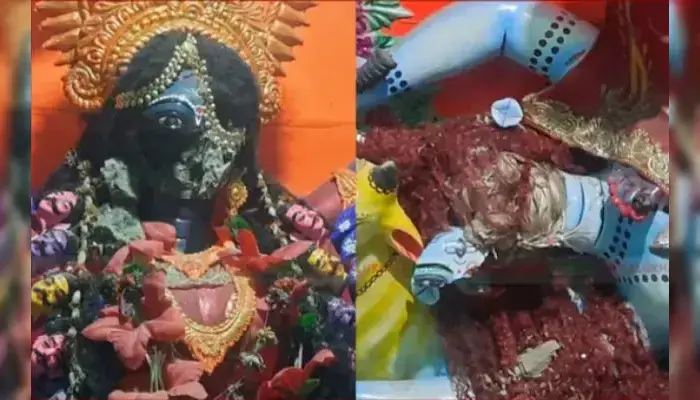
Case Summary
In Hatbangram Baro Palli of Sarisha Union in Pangsha Upazila of Rajbari in Bangladesh, a Hindu temple named Sri Sri Mahasmashan Kali Temple was targeted, and the temple idols were desecrated by miscreants on 2 February 2026. According to media reports, the temple committee stated there was a Kali idol made of clay in the roofed temple. On 3 February 2026, in the afternoon, a person named Mamata Barman visited the temple and found the idols of Goddess Kali, Lord Shiva, a snake, and the faces of the Dakini-Yogini desecrated and deformed. When the news of the attack spread, leaders of the temple committee and local Hindu community members gathered at the site. Later, Assistant Superintendent of Police (Pangsha Circle) Debabrata Sarkar and Officer-in-Charge of Pangsha Model Police Station Sheikh Mainul Islam visited the spot and spoke with the people present. General Secretary of Pangsha Puja Celebration Committee Bidhan Kumar Biswas said that since the crematorium is a temple, there were no guards and no CCTV cameras. Taking advantage of this, miscreants disfigured the faces of each idol with a large stick or an iron tool from outside the temple. He also said that such incidents had never happened before. He further stated, "Those responsible are inhuman. The people of this region have lived here for generations, regardless of religion or caste. A vested interest group did this to destroy the community’s brotherly relations." Assistant Superintendent of Police Debabrata Sarkar said, “After receiving the news, we visited the spot. The police are gathering information. Preparations for the case are underway. The culprits will be identified and brought to justice.” In this regard, Pangsha Upazila Executive Officer Md. Rifatul Haque said work was underway to identify those involved. The police had started investigations. He had spoken to the cremation committee. Since this idol was supposed to be immersed long ago but could not be immersed for some reason, a new idol would be created after the immersion of the current one. He also said, "A group was trying to create chaos ahead of the next elections. They thought that by creating unrest, they would create panic among the voters. We are vigilant, and no miscreant will be spared." A fresh wave of anti-Hindu violence prevailed across Bangladesh following the death of Sharif Osman Bin Hadi. This escalation occurred against the backdrop of ongoing anti-Hindu violence that had persisted since the ouster of the Sheikh Hasina government in August 2024, during which Hindu homes, temples, and religious spaces were repeatedly attacked, and the Hindu community faced intimidation, arson, and mob attacks. In the aftermath of Hadi’s death, Hindu homes were selectively targeted and set ablaze in multiple localities by Muslim mobs, forcing families to flee and rendering many homeless. The violence was not sporadic but patterned, with Muslim mobs targeting Hindu neighbourhoods, properties, and religious symbols with impunity. One of the many victims of this wave of violence was a Hindu man named Dipu Chandra Das, who was brutally lynched by a Muslim mob over false allegations of blasphemy. Such targeting of innocent Hindus over fabricated charges illustrated the vulnerability of the Hindu minority under conditions of rising communal hostility. Posters and written materials calling for the extermination of Hindus were displayed in public spaces, signalling an alarming normalisation of genocidal rhetoric. Combined with acts of physical violence, arson, and vandalism, these developments demonstrated a coordinated campaign designed to terrorise the Hindu community and assert Islamic dominance. Notably, Sharif Osman Bin Hadi was a Muslim political activist and student leader known for his anti-Hindu and anti-India stance. He was actively involved in the political unrest that followed the fall of Sheikh Hasina’s government and was killed in Dhaka in December 2025 during clashes, after which Hindus were blamed and subsequently targeted.
Why it is Hate Crime ?
This case is being added to the tracker under the primary category- Attack on Hindu religious representations. The subcategory selected is- Desecration of Hindu religious symbol. Icons and symbols or a religious representation of a spiritual ideal are widely revered in Hinduism. Iconography is of vital significance in the Hindu milieu. It helps connect people’s spiritual beliefs with the real world. Iconography within the Hindu faith takes several shapes and forms. Murtis are of most significance to Hindus, to which daily rituals, prayers and offerings are done. Besides the murtis, there are several other symbols which have deep significance in the Hindu faith – the Om and Swastika for example. Since these Hindu religious symbols hold paramount importance in Hinduism, any desecration of symbols, icons, murtis, religious representations and manifestations, is driven by animosity towards the faith itself which manifests itself through these murtis, icons and symbols. Therefore, any desecration of these Hindu religious symbols and representations is considered religiously motivated hate crimes under this category. The other subcategory selected is- Attack on Temples. In Hinduism, a temple is the abode of the Deity. The Deity in the Temple is consecrated, thereby, making it a real, breathing entity. Hindus believe that not just the Deity but the temple premises itself are sacred to Hindus since Hindus hold the faith that the entire Temple space is an amalgamation of the divine energy of the deity. Given the central significance of Temples in Hindu Dharma, any attack against a Hindu Temple or its peripheral premises is an attack on the faith itself and is born out of animosity towards the faith, of which, the Temple is a central tenet. Any manner of attack against a Temple and/or its premises would therefore be considered a religiously motivated hate crime. This case exemplifies a clear instance of an anti-Hindu hate crime, as the perpetrators deliberately targeted a Hindu temple in Hatbangram Baro Palli of Sarisha Union in Pangsha Upazila of Rajbari in Bangladesh for a vicious attack and vandalism. Hindu temples hold profound significance as the divine abodes of Hindu deities, places where the sacred presence of gods manifests for devotees. These institutions stand as deeply revered centres of worship, community gathering, and spiritual solace for all Hindus, embodying centuries of faith and cultural heritage. By choosing to desecrate such a holy site, the attackers revealed their religiously motivated intent to humiliate and terrorise the Hindu community, stripping away any doubt that this was a hate-driven assault aimed squarely at targeting Hindus and their beliefs. The perpetrators' deliberate desecration of the temple idols further cemented the religious hatred fuelling this crime. These idols were far more than mere physical objects; they served as living manifestations of the divine deities, invoked through ancient rituals and revered in daily worship by countless devotees who poured their hearts into prayers and offerings. The attackers, fully aware of the sacred role these idols played, including the Kali idol, Shiva, a snake, and the faces of the Dakini-Yogini, desecrated them with brutal intent, shattering what the Hindu community held most dear. This calculated violation of such potent sacred symbols of the Hindu faith exposed raw animosity towards Hinduism itself, its rituals, and its people, marking the act as a textbook example of a religiously motivated hate crime. This temple attack gains even greater urgency when viewed alongside recent assaults on Hindus in Bangladesh, particularly after the death of Osman Hadi. These back-to-back incidents reveal not isolated outbursts but a chilling pattern of selective, impunity-laced violence against Bangladesh's Hindu minority. Such escalation underscores a pervasive climate of religiously motivated hate crimes targeting Hindus, demanding urgent recognition and action. Even without the perpetrators' religious identity being confirmed in this case, their fixation on desecrating a Hindu temple and its idols demonstrated deep-seated anti-Hindu animosity as the driving force behind the crime. This was no random act but a premeditated strike rooted in hatred for the Hindu faith and identity. Accordingly, this case has been added to the hate crime database of the Hinduphobia Tracker.


Case Status
Complaint filed


Perpetrators Details
Perpetrators
Unknown
Perpetrators Range
Unknown
Perpetrators Gender
unknown
 Sources




