Hindu community targeted by fake news peddlers; personal dispute spun as communal
 India
India  2 February, 2026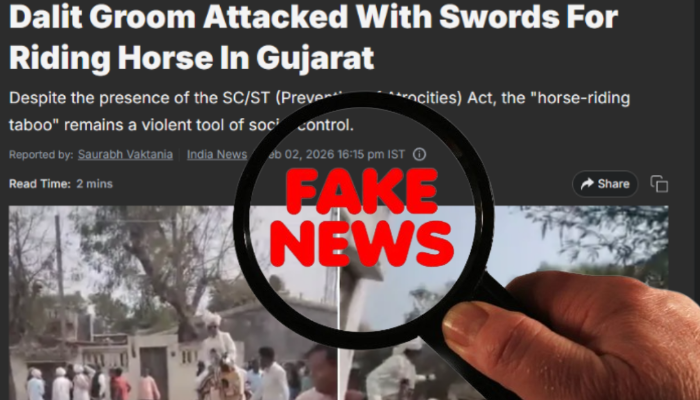
Case Summary
A wedding ceremony in Chadrumana hamlet of Gujarat’s Patan district turned violent on 1 February when the groom was attacked during the festivities. Several media outlets and social media influencers immediately projected the incident as a caste atrocity, claiming that a Dalit groom was assaulted by members of a “dominant” or “upper” caste for riding a horse. NDTV ran a report headlined “Dalit Groom Attacked With Swords For Riding Horse In Gujarat,” while Zee 24 Kalak and others echoed a similar caste-driven narrative. Social media personalities also amplified this framing. Radio jockey Sayema mocked Hindus by suggesting that upper castes never face discrimination, while other users falsely claimed that the groom was attacked for breaking caste barriers. Some even used the incident to push ideological agendas and policy demands, presenting it as proof of entrenched caste oppression within Hindu society. However, police investigations soon revealed that this narrative was misleading. Authorities clarified that the clash occurred between members of the Dalit community and the Thakor community, which is classified as Other Backward Class in Gujarat and not a dominant or general category caste. The Thakors are part of the Koli caste group and form one of the largest OBC communities in the state. According to Deputy Superintendent of Police Paresh J Renuka, the trigger for the violence was a dispute over DJ music during the wedding procession. Members of the accused family had requested that the music be stopped due to a death in their community. Tensions escalated because both parties already had a long standing land dispute, which had previously led to clashes and even a case under the Atrocities Act in 2022. Police stated that Dalit wedding processions had taken place peacefully in the village earlier and no caste based motive was established in this case. While an FIR was registered and arrests were made under applicable laws, the central claim that a Dalit groom was attacked by dominant caste Hindus for riding a horse was found to be false. Despite this, sections of the media and social media users continued to push the distorted narrative, using the incident as an opportunity to attack Hindu society under the guise of caste justice. The episode once again highlights how personal disputes are deliberately reframed as caste oppression to fuel mistrust, inflame social divisions, and advance ideological agendas, even after official findings contradict such claims.
Why it is Hate Crime ?
The primary category selected is Hate speech against Hindus. While the sub-category selected under it is Anti-Hindu slurs, mocking faith. Anti-Hindu slurs and the deliberate mocking of the Hindu faith owing to religious animosity involve the usage of derogatory terms, stereotypes, or offensive references to religious practices, symbols, or figures. One of the common anti-Hindu slurs used against Hindus is “cow-worshipper” and “cow piss drinker”. The intention of using this term is to demean and mock Hindus as a group and their religious beliefs since Hindus consider the cow holy. Additionally, some symbols and the slurs attached to them have a historical context that exacerbates the insult, hate, stereotyping, dehumanisation and oppression against Hindus. Cow worship has been used for centuries to denigrate Hindus, insult their faith and oppress Hindus specifically as a religious group. There has been overwhelming documentation about how cow slaughter has been used to persecute Hindus, with cow meat being thrown in temples and places of worship. There has also been overwhelming documentation where cow meat (beef) has been force-fed to Hindus to either forcefully convert them to Islam or denigrate their faith. Apart from cow worship, the Swastika – which holds deep religious significance for the Hindus – has also been misinterpreted and distorted to use as a slur against Hindus. Similarly, the worship of the Shivling has been used by supremacist ideologies and religions to denigrate Hindus owing to religious animosity. Such slurs and denigration stem from inherent animosity and hate towards Hindus and their faith; therefore, it is categorised as hate speech targeted at Hindus specifically owing to their religious identity. The other sub-category included is: Anti-Hindu subversion and prejudice. Hate speech is defined as any speech, gesture, conduct, writing, or display that is prejudicial against a specific individual and/or group of people, which leads to or may lead to violence, prejudicial action or hate against that individual and/or group. Media plays a specific and overarching role in perpetuating prejudicial attitudes towards a community owing to unfair, untrue coverage and/or misrepresentation/misinterpretation, selective coverage and/or omission of facts of/about issues affecting a specific religious group. This type of bias can dehumanise the victim group, making it easier for others to justify harmful actions against them, which aligns with the objectives of hate speech laws aimed at preventing such harm. It is often observed that the media takes a prejudicial stand against the Hindu community, driven by their need to shield the aggressor community, which happens to be a numeric minority; however, that is the one perpetrating violence against Hindus. For example, the media is often quick to contextualise religiously motivated crimes against Hindus, omit or misrepresent facts that point towards religiously motivated hate crimes, justify and/or downplay religiously motivated hate crimes, or simply present fake news to stereotype Hindus. Such media bias leads to the denial of persecution and is often used to dehumanise Hindus, leading to justification for violence against them. For example, the media covered several fake allegations of Hindus targeting Muslims and forcing them to chant Jai Shree Ram. Most of these cases were proved false and fabricated after police investigation. These fake news reports were subsequently never retracted or clarified. Such fake news led to the justification of violence and dehumanisation of Hindus based on the argument that since Hindus targeted Muslims and forced them to chant Jai Shree Ram, the dehumanisation of Hindus and violence against them was par for the course and merely a retaliation. Such media bias leads to prejudicial portrayals of Hindus and offers a justification for violence against them and, therefore, is considered hate speech under this category. This case became Hinduphobic not because of the original clash, but because of how it was deliberately reframed and weaponised by sections of the media and social media to vilify the Hindu community as a whole. Hindus were falsely projected as collective perpetrators despite police confirmation that no caste motive existed. Media outlets framed the incident as “dominant caste Hindus attacking a Dalit groom,” creating a false impression of inherent Hindu violence and oppression. This attribution imposed collective guilt on Hindus and damaged their social dignity. A fabricated caste narrative was then sustained by erasing key facts. The conflict was between Dalit and OBC communities within the Hindu fold, yet the accused were repeatedly described as “dominant caste” to invoke an upper caste oppression trope. This selective omission distorted reality to portray Hindu society as irredeemably hostile and divided. Ordinary Hindu cultural practices such as wedding processions and music were negatively framed as symbols of caste aggression, while the actual trigger, a long-standing land dispute, was sidelined. This portrayal further reinforced negative stereotypes about Hindu traditions. The narrative escalated into open ridicule. Influential social media figures mocked Hindus through sarcastic remarks and dismissive hashtags, normalising contempt and framing Hindu grievances as imaginary or laughable. Even after police clarification, the misleading narrative remained uncorrected, showing that reputational harm to Hindus was prioritised over factual accuracy. Fake news that perpetuates the claim that “upper caste” Hindus are tyrannical towards disadvantaged sections of Hindu society is inherently anti-Hindu in nature due to the intent behind such disinformation. Although it is often argued that such narratives cannot be anti-Hindu since both the alleged victim and aggressor belong to the Hindu community, the real objective is to discredit Hindu society and Sanatan Dharma by branding it oppressive and tyrannical. These narratives seek to project Hinduism as a faith meant only for a privileged class while dehumanising its followers and delegitimising the religion itself. The direct consequence of this false atrocity literature is increased hostility and violence against sections of Hindus and pressure on others to alienate themselves from their own faith by portraying Hinduism as inherently discriminatory. This sustained misrepresentation deepened internal divisions, reinforced hostile stereotypes, and contributed to an environment of normalised Hindu targeting. The harm was collective, reputational, and patterned rather than incidental. Therefore, this case is recorded as Hindu phobia driven by narrative manipulation rather than the incident itself.


Case Status
Unknown


Perpetrators Details
Perpetrators
Others
Perpetrators Range
From 5 to 10
Perpetrators Gender
unknown
 Sources




