Sacred Hindu temple vandalised, idols broken and worship disrupted in Faridpur, Bangladesh
 Faridpur District, Bangladesh
  2 February, 2026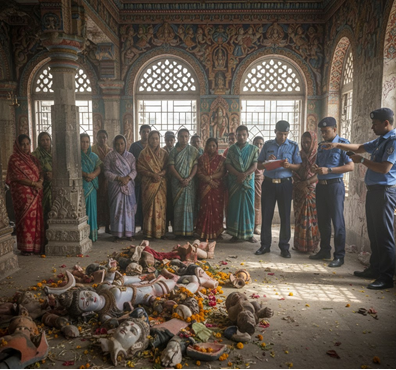
Case Summary
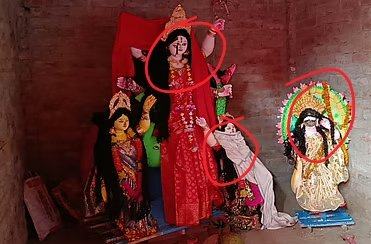
In the Faridpur district of Bangladesh, a sacred Hindu temple was vandalised, and five idols were broken. The attack occurred at the Malopara Sarbojanin Sri Sri Ma Kali Temple in the Bhatilakshipur area, sometime between 12:30 am and 4:30 am on February 3, 2026. After receiving information about the incident, police personnel, along with a team from the army, visited the temple in the morning. Members of the temple committee stated that a seven-day religious programme had been conducted at the temple and concluded the previous day. Devotees and local residents returned to their homes around midnight, after which the vandals struck the shrine. During the attack, the hands of the idol of Goddess Saraswati were broken, the face of the idol of Goddess Ganga was damaged, and the hands of two adjacent idols were also smashed. Additionally, an idol of Gour Nitai made of thermacol and placed within the temple premises was completely destroyed. Nimai Chandra Malo, president of the temple committee, said that nearly 70 Hindu families reside in the surrounding area. He pointed out that idols at the same temple had been vandalised on the same date last year as well. At that time, the culprits were identified because CCTV cameras were functional. This year, despite three cameras being installed, technical issues rendered them non operational, preventing identification of the attackers. Expressing fear and concern, he called for immediate action against those responsible. Faridpur Kotwali Police Station Officer in Charge Md Shahidul Islam stated that he personally visited the site with a police team after learning of the incident. He said they spoke with temple committee members and local residents and documented the damage through photographs. Police have launched an investigation to identify those behind the vandalism and assured that the perpetrators would be brought to justice at the earliest. A fresh wave of anti-Hindu violence prevailed across Bangladesh following the death of Sharif Osman Bin Hadi. This escalation occurred against the backdrop of ongoing anti-Hindu violence that had persisted since the ouster of the Sheikh Hasina government in August 2024, during which Hindu homes, temples, and religious spaces were repeatedly attacked, and the Hindu community faced intimidation, arson, and mob attacks. In the aftermath of Hadi’s death, Hindu homes were selectively targeted and set ablaze in multiple localities by Muslim mobs, forcing families to flee and rendering many homeless. The violence was not sporadic but patterned, with Muslim mobs targeting Hindu neighbourhoods, properties, and religious symbols with impunity. One of the many victims of this wave of violence was a Hindu man named Dipu Chandra Das, who was brutally lynched by a Muslim mob over false allegations of blasphemy. Such targeting of innocent Hindus over fabricated charges illustrated the vulnerability of the Hindu minority under conditions of rising communal hostility. Posters and written materials calling for the extermination of Hindus were displayed in public spaces, signalling an alarming normalisation of genocidal rhetoric. Combined with acts of physical violence, arson, and vandalism, these developments demonstrated a coordinated campaign designed to terrorise the Hindu community and assert Islamic dominance. Notably, Sharif Osman Bin Hadi was a Muslim political activist and student leader known for his anti-Hindu and anti-India stance. He was actively involved in the political unrest that followed the fall of Sheikh Hasina’s government and was killed in Dhaka in December 2025 during clashes, after which Hindus were blamed and subsequently targeted.
Case Images
Why it is Hate Crime ?
The primary category in this case is: Attack on Hindu religious representations. The subcategory selected is- Desecration of Hindu religious symbol. Icons and symbols or a religious representation of a spiritual ideal are widely revered in Hinduism. Iconography is of vital significance in the Hindu milieu. It helps connect people’s spiritual beliefs with the real world. Iconography within the Hindu faith takes several shapes and forms. Murtis are of most significance to Hindus, to which daily rituals, prayers and offerings are done. Besides the murtis, there are several other symbols which have deep significance in the Hindu faith – the Om and Swastika for example. Since these Hindu religious symbols hold paramount importance in Hinduism, any desecration of symbols, icons, murtis, religious representations and manifestations, is driven by animosity towards the faith itself which manifests itself through these murtis, icons and symbols. Therefore, any desecration of these Hindu religious symbols and representations is considered religiously motivated hate crimes under this category. The other subcategory selected is- Attack on Temples. In Hinduism, a temple is the abode of the Deity. The Deity in the Temple is consecrated, thereby, making it a real, breathing entity. Hindus believe that not just the Deity but the temple premises itself are sacred to Hindus since Hindus hold the faith that the entire Temple space is an amalgamation of the divine energy of the deity. Given the central significance of Temples in Hindu Dharma, any attack against a Hindu Temple or its peripheral premises is an attack on the faith itself and is born out of animosity towards the faith, of which, the Temple is a central tenet. Any manner of attack against a Temple and/or its premises would therefore be considered a religiously motivated hate crime. This incident qualifies as a hate crime because it involved the deliberate destruction of sacred Hindu idols and the desecration of a place of worship. The temple was a central religious space for the local Hindu community, where devotees gathered for prayer, festivals, and spiritual activities. By entering the temple and damaging religious symbols, the perpetrators showed clear disrespect toward Hindu beliefs and traditions. The idols that were broken represent deities and spiritual values that are deeply revered by worshippers. Damaging them directly harms the religious sentiments of believers and violates their right to practice faith peacefully. The act disrupted regular worship and created fear and insecurity among devotees. The crime targeted a Hindu religious institution and focused on sacred elements inside the temple. This shows religious targeting rather than random destruction. The temple was chosen because of its religious identity, and the damage was directed at symbols of the Hindu faith. Therefore, this case was recorded in the Hinduphobia Tracker as a hate crime. This incident cannot be viewed in isolation. It forms part of a growing pattern of violence against Hindu temples, religious symbols, and Hindu individuals across Bangladesh that has intensified following Hadi’s death and the ouster of Sheikh Hasina. In the absence of firm political restraint and effective accountability, anti-Hindu elements have increasingly acted with impunity, targeting not only places of worship but also Hindu homes, devotees, and ordinary civilians. The vandalism in Faridpur mirrors a wider climate of fear where Hindus are attacked, intimidated, and made to feel unsafe for openly practising their faith. Together, these repeated assaults on temples and Hindus themselves point to a deepening crisis of minority security, where religious hatred is being normalised, and Hindu identity is being systematically targeted in the current socio-political environment.


Case Status
Complaint filed


Perpetrators Details
Perpetrators
Unknown
Perpetrators Range
Unknown
Perpetrators Gender
unknown
 Sources




