Hindu men and women brainwashed for Christian conversion by pastor in Bilaspur, Chhattisgarh
 Bilaspur, Chhattisgarh, India
  1 February, 2026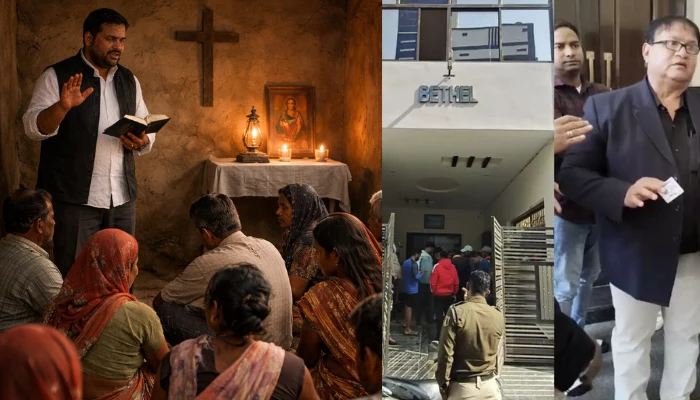
Case Summary
In a house in Chantidih, Bilaspur, Chhattisgarh, Hindu men and women were brainwashed to convert to Christianity by Pastor James Singh under the guise of a prayer meeting. According to media reports, upon receiving a complaint of religious conversions taking place in a house, Bajrang Dal, a Hindu organisation, along with the police, arrived at the scene. After reaching the scene, the Hindu organisation activists filed a complaint with the Sarkanda Police Station. In the complaint, it was stated that Pastor James Singh brainwashed Hindu men and women under the guise of prayer meetings by teaching Christianity. He conducted illegal religious conversions. Further, it was also stated that around 20-25 Hindu men and women were present in the room. The room was locked from the outside, and the Pastor conducted a meeting inside. The police registered a case against Pastor James Singh, and the matter was investigated.
Why it is Hate Crime ?
The primary category in this case is: Predatory Proselytisation. The subcategory selected under this is: Proselytisation by grooming, brainwashing, manipulation or subtle indoctrination. Further, the tertiary category included is: Pattern of targeting Hindus. Religious brainwashing essentially means the often subtle and forcible indoctrination to induce someone to give up their religious beliefs to accept contrasting, regimented ideas. Religious grooming or brainwashing also involves propaganda and manipulation. It involves the systematic effort, driven by religious malice and indoctrination, to persuade “non-believers’ to accept allegiance, command, or doctrine to and of a contrasting faith. Cases of such grooming or brainwashing are far more nuanced than direct threats, coercion, inducement and violence. In such cases, it is often seen that there is repeated, subtle and continual manipulation of the victim to induce disaffection towards their own faith and acceptance of the contrasting faith of the perpetrator. While subtle indoctrination is widely acknowledged as predatory, an element which is often understated in such conversions or the attempts of such conversion is the role of loyalty and trust which might develop between the perpetrator and the victim. Fiduciary relationships are often abused to affect such religious conversion. For example, an educator transmitting religious doctrine of a competing faith to a Hindu student. The Hindu student is likely to accept what the teacher is transmitting owing to the existence of the fiduciary relationship. The exploitation of the fiduciary relationship to religiously indoctrinate victims would also be included in this category. Since the underlying animosity towards the victim’s faith forms the basis of predatory proselytisation, such cases are considered religiously motivated hate crimes. This case constituted a clear instance of an anti-Hindu hate crime because Hindu men and women were deliberately targeted for religious conversion by Pastor James Singh under the false pretext of a prayer meeting. The term "prayer meeting" generally implied a spiritual gathering for sincere worship and reflection. However, Pastor James Singh exploited it as a deceptive tool to lure Hindu men and women into a locked room. Instead of genuine spiritual engagement, he manipulated the event to brainwash and indoctrinate them with Christian theology, aiming to convert them against their will. This deliberate exploitation and targeting of Hindus underlined the religiously motivated nature of the hate crime. The selection of Hindu participants was deliberate, exploiting their specific religious identity as vulnerable to interfaith poaching. Brainwashing here involved manipulative tactics like isolation (locking the room from outside), repetitive religious propaganda, and psychological pressure during the closed-door session, all hallmarks of coercive conversion. Such actions express animosity towards Hinduism, disregarding its customs and seeking to diminish Hindu presence in the community, amounting to a hate crime. In essence, this went beyond personal persuasion; it was a calculated assault on Hindu religious freedom, mirroring hate crime patterns where one group preys on another's faith for dominance, violating the victims' religious autonomy and fundamental rights, making it a hate crime. Targeting not one but 20-25 Hindu men and women in the locked Chantidih house for brainwashing and conversion by Pastor James Singh elevates this from an isolated incident to a clear pattern of anti-Hindu hate crime, demonstrating organised religious animosity. By assembling a group under the deceptive guise of a prayer meeting and isolating them for indoctrination, the pastor revealed intent to systematically erode the Hindu community's presence in Bilaspur, exploiting collective vulnerability rather than individual persuasion. These instances of targeted proselytisation activities stem from inherent hostility towards the victims' professed faith since Abrahamic faiths believe that any non-adherent to their faith is subject to being dehumanised till they convert, making it a religiously motivated crime against Hindus. Therefore, this case is being added to the hate crime database of the Hinduphobia Tracker. Disclaimer: The Hinduphobia Tracker records the dates of incidents based on when the crime occurs rather than when it is reported by the media. In this case, media reports have not stated the exact date when the crime occurred. Hence, the date the media report was published, 2 February 2026, has been selected as the indicative incident date. This is recorded for documentation purposes only. Media reports stated that around 25 Hindu individuals, including men and women, were targeted for conversion in a house in Chantidih, Bilaspur, Chhattisgarh, but no gender-wise breakdown was provided. For documentation clarity, the Hinduphobia Tracker has applied a proportional demographic estimate based on India’s Census 2011 and NFHS-5 (2019–21) rural population data. Accordingly, the 25 participants are estimated as 13 men (52%) and 12 women (48%), reflecting a near-equal gender distribution consistent with typical rural family demographics.
Victim Details
Total Victim
25
Deceased
0
Gender
- Male 13
- Female 12
- Third Gender 0
- Unknown 0
Caste
- SC/ST 0
- OBC 0
- General 0
- Unknown 25
Age Group
- Minor 0
- Adult 25
- Senior Citizen 0
- Unknown 0


Case Status
Complaint registered


Perpetrators Details
Perpetrators
Christian Extremists
Perpetrators Range
One Person
Perpetrators Gender
male
 Sources




