Hindu sentiments outraged as 'leftist-feminist' celebrity equates Hindu saints and bhajans to Jeffrey Epstein
 Delhi, Delhi, India
  31 January, 2026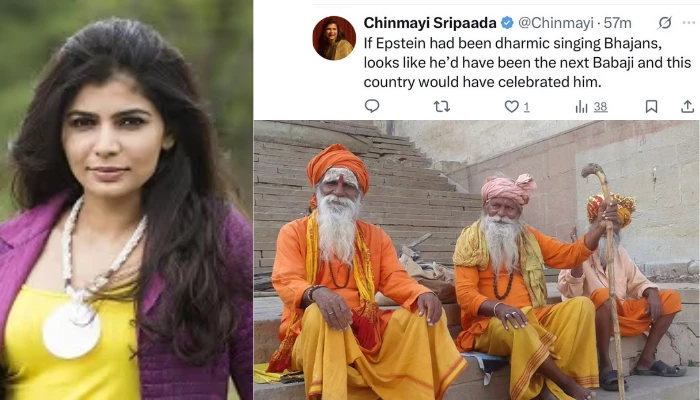
Case Summary
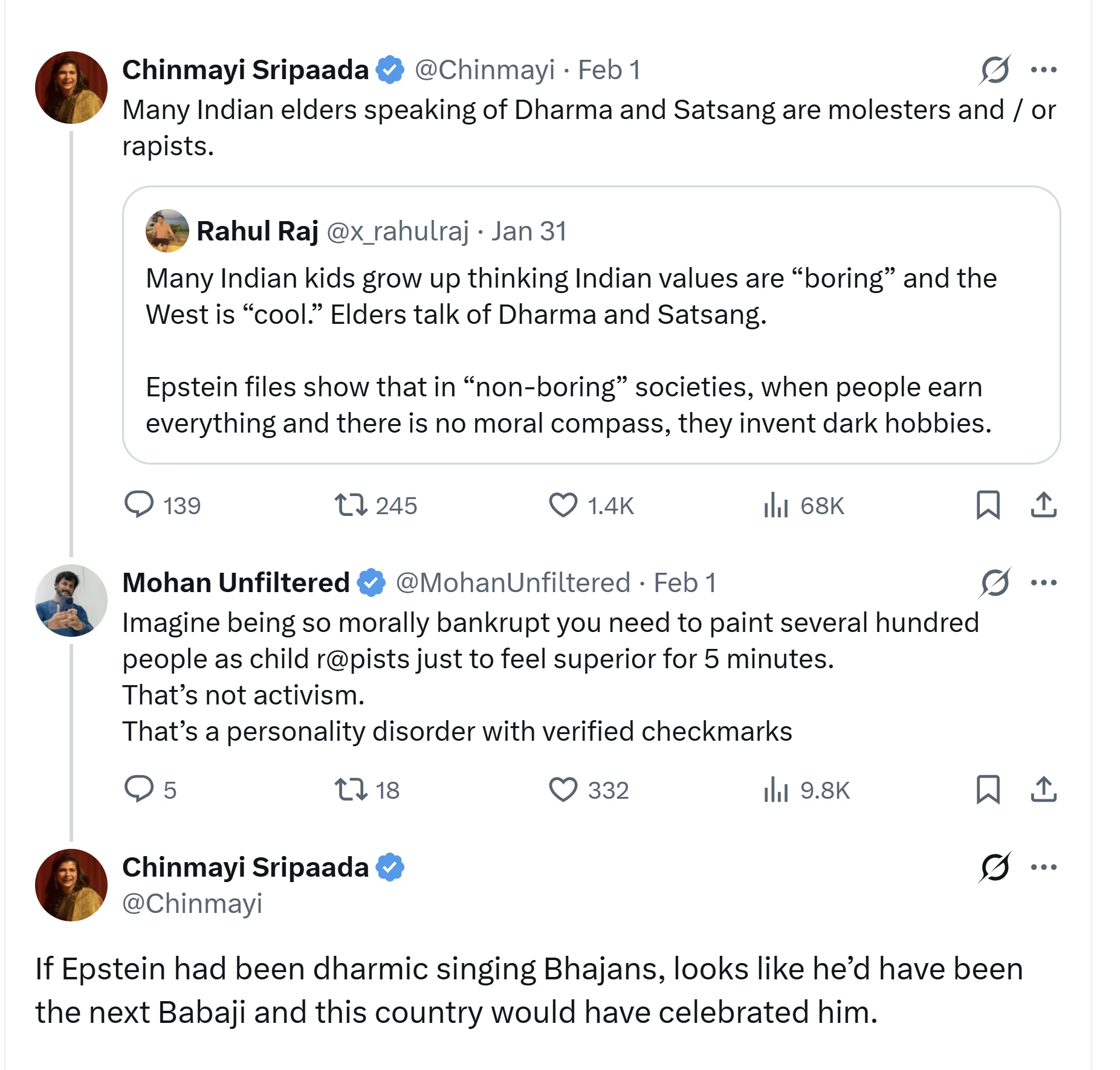
The Hindu faith was deliberately mocked and denigrated by a leftist, woke feminist celebrity named Chinmayi Sripada, a singer by profession. She ridiculed Hindu sadhus and sacred bhajans by comparing them with the derogatory Epstein files and Jeffrey Epstein on social media. Notably, Jeffrey Epstein was a notorious American financier and convicted sex offender who sexually abused dozens of underage girls, often luring them to his mansions and private island for assaults disguised as massages. He secured a lenient 2008 plea deal in Florida, serving minimal jail time despite overwhelming evidence, and was rearrested in 2019 on federal sex trafficking charges before dying by suicide in custody. On 1 February 2026, in a post on her X handle, Chinmayi Sripada wrote, "If Epstein had been dharmic singing Bhajans, looks like he'd have been the next Babaji and this country would have celebrated him." This derogatory tweet against Hindu sadhus and bhajans caused massive outrage and backlash. Members of the Hindu IT Cell lodged a complaint against her for making derogatory comments on Hindu faith. According to the complaint, the matter was registered under the category of Online and Social Media Related Crime. The crime was listed in the sub-category as Provocative Speech for unlawful acts. The complaint was filed on 2 February 2026 and included screenshots of the post as supporting evidence. In the complaint submitted to the authorities, the complainant stated that the tweet was "extremely insulting to Hindu dharma" and that Chinmayi had deliberately compared Hindu devotional singers and religious figures to a convicted sex offender. The complainant sought immediate intervention and action against the accused, describing the post as a case of purposeful insult to the Hindu community. Members of the Hindu IT Cell stated that they had invoked provisions under the Bharatiya Nyaya Sanhita (BNS), citing Sections 299 and 302, which deal with deliberate and malicious acts intended to outrage religious feelings and promote enmity. The Hindu IT Cell also tagged Maharashtra Chief Minister Devendra Fadnavis and Deputy Chief Minister Eknath Shinde, urging the state machinery to take cognisance of what they described as a pattern of repeated provocation under the guise of “progressive commentary.”
Case Images
Why it is Hate Crime ?
The primary category selected in the case is Hate speech against Hindus. The chosen sub-category is- Anti-Hindu slurs/mocking faith. Anti-Hindu slurs and the deliberate mocking of the Hindu faith owing to religious animosity involve the usage of derogatory terms, stereotypes, or offensive references to religious practices, symbols, or figures. One of the common anti-Hindu slurs used against Hindus is “cow-worshipper” and “cow piss drinker”. The intention of using this term is to demean and mock Hindus as a group and their religious beliefs since Hindus consider the cow holy. Additionally, some symbols and the slurs attached to them have a historical context that exacerbates the insult, hate, stereotyping, dehumanisation and oppression against Hindus. Cow worship has been used for centuries to denigrate Hindus, insult their faith and oppress Hindus specifically as a religious group. There has been overwhelming documentation about how cow slaughter has been used to persecute Hindus, with cow meat being thrown in temples and places of worship. There has also been overwhelming documentation where cow meat (beef) has been force-fed to Hindus to either forcefully convert them to Islam or denigrate their faith. Apart from cow worship, the Swastika – which holds deep religious significance for the Hindus – has also been misinterpreted and distorted to use as a slur against Hindus. Similarly, the worship of the Shivling has been used by supremacist ideologies and religions to denigrate Hindus owing to religious animosity. Such slurs and denigration stem from inherent animosity and hate towards Hindus and their faith; therefore, it is categorised as hate speech targeted at Hindus specifically owing to their religious identity. The second sub-category chosen for the case is- Mocking/denigrating Hindu leaders. Hate speech is defined as any speech, gesture, conduct, writing, or display that is prejudicial against a specific individual and/or group of people, which is leading to or may lead to violence, prejudicial action or hate against that individual and/or group. Religious leaders are often seen as representatives of the community, especially, the community’s religious faith and beliefs. Mocking or denigrating a religious leader specifically owing to his religious identity and/or the religious rituals he observes can be considered hate speech because the motivating factor of the speech is animosity and/or dislike for what he represents – the religious beliefs and faith of the community. It is important to note that mere insulting words against an individual do not constitute hate speech. It is entirely possible that insulting words are used for an individual, however, the specific speech is not the result of religious hate and/or animosity towards the professed faith of the religious leader, but the individual himself. For the speech to be considered hate speech, the speech itself or the motivating factor behind the speech has to be religious in nature. Such speech which denigrates Hindu religious leaders specifically owing to animosity towards the faith they profess and the community faith they represent will be treated as hate speech under this category. This case was included in the hate crime tracker because the Hindu faith was deliberately mocked and denigrated through derogatory comparisons and repeated hostility by the accused, Chinmayi Sripada. Hindu beliefs were ridiculed by connecting them to the Epstein files, which were deeply offensive and anti-Hindu in nature. Notably, Epstein was globally infamous for sexual exploitation, trafficking, and abuse of minors, and linking such criminality to Hindu spirituality was an attempt to portray the Hindu religion as corrupt and immoral. Such a comparison could not be justified under any terms. Revered Hindu sadhus represent holiness and renunciation, while Epstein symbolised exploitation and depravity. Hindus held sadhus in the highest place in their lives, looking up to them for guidance and spiritual meaning. They were religious leaders with the highest level of spiritual knowledge of Hindu traditions. Sadhus renounce worldly life to pursue moksha through penance, meditation, and austerity, and they embody the spiritual essence of Hinduism. To mock sadhus was not just to insult individuals but to shake the very base of Hindu identity, since the spiritual connection was central to keeping Hindus rooted in their faith. Such mockery and denigration of Hindu religious leaders is motivated by deep-seated religious animosity, amounting to hate speech. Bhajans also form an important part of Hindu practice. They are devotional songs sung in praise of deities, reminding society of the great works and virtues of the divine. Bhajans provide guidance, spread peace, and strengthen the spiritual bond of the Hindu community. They uplift the mind and soul, keeping Hindus connected to their traditions. Denigrating bhajans in such a bad light was outrageous to Hindus, as it was an attack on a religious practice they held sacred. In conclusion, the deliberate comparison of Hindu sadhus and bhajans to a convicted sex offender caused deep hurt to the Hindu community. It was not only insulting but also harmful, as it attempted to equate revered spiritual figures and sacred practices with criminality and abuse. This deliberate act of denigration outraged Hindu sentiments and was an attack on the dignity of the entire faith community. Such speech resulted from deep-seated animosity and hatred towards Hinduism and the Hindu community, making it a religiously motivated crime. It is important to mention here that the accused, Chinmayi Sripada, had been known for her recurring anti-Hindu dialogues and sentiments. This was not the first time she mocked Hindu practices; she had repeatedly expressed strong positions against rituals, worship of deities, and even ridiculed the wearing of the mangalsutra. By calling Hindu practices meaningless and sneering at sacred traditions, she had deliberately targeted the faith. Her latest remark, connecting Hindu spirituality to Epstein’s crimes, was therefore seen as a continuation of her hostility towards Hinduism. Given that this case met the parameters of a religiously motivated hate speech, it was added to the hate crime database of the tracker.


Case Status
Complaint filed


Perpetrators Details
Perpetrators
Others
Perpetrators Range
One Person
Perpetrators Gender
female
 Sources




