Hindu villagers targeted, offered inducements, and coerced for religious conversion by Christian missionaries
 Jaunpur, Uttar Pradesh, India
  31 January, 2026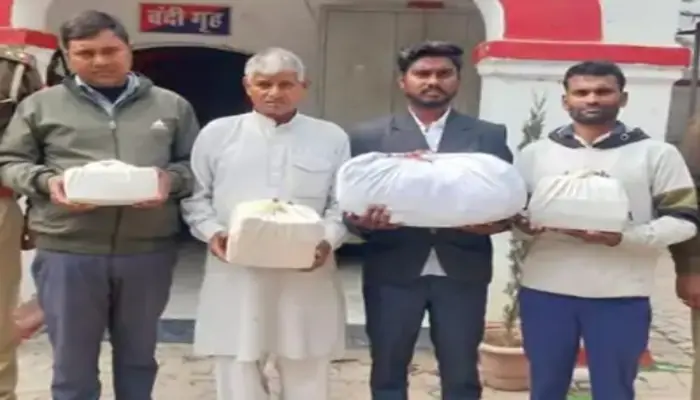
Case Summary
In the Tariyari village of Jaunpur district, Uttar Pradesh, Hindu villagers were targeted, offered inducements, and coerced for religious conversion by Christian missionaries. According to reports, around 40 Hindu villagers, including men and women, were gathered at the house of a resident named Puspha Devi. The primary accused, Ajay Kumar, invited Diwakar, Awadhesh, and Rajbali Ram to the house, who were all involved in converting Hindu villagers to Christianity. The accused were luring and brainwashing Hindus by telling them that Christianity would provide them with all kinds of benefits, would cure their illnesses, would help them gain respect, prestige and money. They also attempted to threaten Hindus by saying that if they did not convert to Christianity, their entire family would be afflicted with illness. Sant Ram Janam Nagar Baba, a resident of Narhan village and a local Vishwa Hindu Parishad functionary, filed a complaint with the police that religious conversion activities were going on in the village. Acting on the complaint, the police team raided the house of Pushpa Devi, where the conversion activities were taking place, on 1 February 2026. Police arrested the four accused, Ajay Kumar, Diwakar, Awadhesh, and Rajbali Ram, and registered a case against them under Sections 3 and 5(1) of the Uttar Pradesh Prohibition of Unlawful Religious Conversion Act. Police also recovered religious propaganda posters, pamphlets, 26 religious books, multiple collections, and Christian scriptures from the site. The investigation revealed that poor and vulnerable Hindu residents, including slum dwellers, were targeted under the guise of religious meetings and participants were lured to convert by assurances of miraculous healing from illnesses, financial assistance, social respect, and improved prospects. As of the date of writing this report, the investigation was ongoing.
Why it is Hate Crime ?
The primary category selected is Predatory Proselytisation. The sub-category selected is- Conversion/ attempts to convert by inducement. Predatory Proselytisation is not just limited to threat, harassment, force and violence, but it also has contours of stealth. In several cases, the Hindu victim is exploited to convert, with non-Hindus taking advantage of their poverty. In such cases, the Hindu victim who is suffering financially is offered monetary benefits, including lucrative offers for jobs, health treatment, education, etc, to induce the victim into changing his/her religion. In such cases, the religious identity of the victim and the aim to disenfranchise him from his faith form the heart of the crime. Also, taking advantage of and exploiting an individual’s economic vulnerabilities is widely acknowledged as exploitation, forms of which are often penalised by law. Such cases, therefore, are considered religiously motivated hate crimes since the victim’s religious identity forms the very heart of the crime itself. The other sub-category selected here is - Harassment, threats, coercion for conversion. Harassment covers a wide range of behaviours of an offensive nature. It is commonly understood as behaviour that demeans, humiliates, and intimidates a person, including threats and coercion. Harassment and threats, in this case, find their root on discriminatory grounds which has the effect of nullifying a person’s rights or infringing upon his freedom to exercise his right specifically owing to the victim’s religious identity. Verbal and physical threats and psychological or physical harassment are often used against Hindu victims because they choose to practice their professed religion. Religious harassment also includes forced and involuntary conversions by harassment, threats or coercion. Coercion includes intimidatory tactics like force-feeding a Hindu victim beef to convert to another religion, forceful circumcision etc. In several cases documented, non-Hindu perpetrators or those who harbour specific animosity towards Hinduism, harass victims simply based on their religious identity. Such cases often also include harassment to ensure the Hindu victim abandons his/her professed religion and adopts the religion of the perpetrator. Such cases where Hindu victims are harassed to convert to the perpetrator’s religion are rooted in animosity towards the victim’s religious identity and are therefore documented as religiously motivated hate crimes. The other sub-category selected here is - Proselytisation by grooming, brainwashing, manipulation or subtle indoctrination, with the tertiary categories selected being- Pattern of targeting Hindus. Religious brainwashing essentially means the often subtle and forcible indoctrination to induce someone to give up their religious beliefs to accept contrasting regimented ideas. Religious grooming or brainwashing also involves propaganda and manipulation. It involves the systematic effort, driven by religious malice and indoctrination, to persuade “non-believers’ to accept allegiance, command, or doctrine to and of a contrasting faith. Cases of such grooming or brainwashing are far more nuanced than direct threats, coercion, inducement and violence. In such cases, it is often seen that there is repeated, subtle and continual manipulation of the victim to induce disaffection towards their own faith and acceptance of the contrasting faith of the perpetrator. While subtle indoctrination is widely acknowledged as predatory, an element which is often understated in such conversions or the attempts of such conversion is the role of loyalty and trust which might develop between the perpetrator and the victim. Fiduciary relationships are often abused to affect such religious conversion. For example, an educator transmitting religious doctrine of a competing faith to a Hindu student. The Hindu student is likely to accept what the teacher is transmitting owing to existence of the fiduciary relationship. The exploitation of the fiduciary relationship to religiously indoctrinate victims would also be included in this category. Since the underlying animosity towards the victim’s faith forms the basis of predatory proselytization, such cases are considered religiously motivated hate crimes. This case has been added to the tracker because Hindu villagers were targeted, offered inducements, and coerced for religious conversion by Christian missionaries. Firstly, the victims were lured for conversion under the guise of a prayer/religious meeting. What was presented as a religious prayer gathering inside a house was in reality a covert attempt at religious conversion. These were not genuine community prayers but calculated efforts to exploit the trust of Hindus and manipulate them into abandoning their faith. By conducting such gatherings, the Christian missionaries sought to manipulate vulnerable Hindus, taking advantage of their emotional and social circumstances to push them towards conversion. Secondly, those present at the meeting were promised cures for illnesses. The structure and messaging of the gathering reflected the Changai Sabha model, a format commonly used in organised Christian proselytisation, where faith-healing narratives, emotionally charged prayers, and testimonies are deployed to influence vulnerable individuals. These methods deliberately appeal to emotional distress and personal hardship, drawing participants into religious instruction without openly disclosing the underlying objective of conversion. Individuals attend seeking relief or support, only to be gradually exposed to messaging that undermines their existing religious identity Thirdly, Hindus were offered inducements such as money, prestige, respect and healing benefits in order to convert them. Offering incentives or making false promises, especially when directed at vulnerable individuals in need, shows that these incentives are not acts of kindness or charity. Instead, they are calculated moves to exploit vulnerable Hindus because of their religion. By providing inducements or promising healing in exchange for conversion, the accused were effectively blackmailing those who might have been desperate for assistance or hope. Such instances are seen in many cases where members of Christian missionary groups target socially and economically vulnerable Hindus to further their agenda of religious conversions. This form of coercion strips people of their agency and dignity and results in coerced conversions. These are not random or isolated incidents, but rather cases deeply rooted in religious animosity towards Hindu victims Fourth, when inducements failed, the perpetrators attempted to convert Hindus by pressuring Hindus and threatening them that entire family would be afflicted with illness. Pressuring a Hindu individual to discard his religious faith and embrace another is a direct attack on his religious identity and dignity. It is not a matter of personal choice; it is coercion rooted in hostility towards the victim's Hindu identity. Such an attempt reflects religious animosity because the act is not simply about personal differences but about erasing the victim’s Hindu faith, making it a religiously motivated crime. Fifth, police recovered religious propaganda posters, pamphlets, 26 religious books and Christian scriptures, including Psalms and Proverbs from the site. Therefore, the Christian perpetrators were also actively attempting to indoctrinate the Hindu victims by using Christian religious texts and literature. Using the scriptures or literature of one faith to deliberately target and manipulate members of another, with the clear intention of religious conversion, represents a direct attack on the Hindu faith. Such actions are designed to violate and undermine the beliefs of Hindu victims and are clear indicators of religious hostility towards Hindus and their religious identity. Such actions further demonstrate that this was not an isolated incident of evangelism, but rather part of a broader, organised operation to further religious conversions. When Christian religious material is used to exploit trust, sow doubt, and misrepresent the beliefs of Hindus to coerce conversion, particularly in a systematic manner, it constitutes a religiously motivated offence. Sixth, the perpetrators specifically targeted poor and vulnerable Hindu residents, including slum dwellers, for religious conversion. Thus, the nature of the conversion efforts and the wider impact on the Hindu community all indicate a targeted action against Hindus as a collectivity. When individuals or groups focus their efforts on converting members of a particular religion, in this case, Hindus, then it demonstrates a fundamental disregard for the Hindu faith. Conversion, especially when not based on personal conviction but rather on external persuasion or pressure, is not simply about sharing a different belief system. It is an attempt to undermine the values, traditions, and identity of the Hindu community. In this context, the Christian perpetrators specifically targeted Hindus, which demonstrates a lack of respect for Hinduism and its followers. Such actions are carried out to strip Hindu victims of their faith, making it a religiously motivated crime. The Christian faith, by its very theological foundations, places a strong emphasis on proselytisation. In pursuit of conversion objectives, Christian evangelists often employ unethical means, ranging from psychological pressure and misinformation to inducements such as money or jobs. This systematic attempt to erode the religious foundation of individuals and replace it with allegiance to another faith reflects deep religious malice and animus against the Hindu identity. Because the core motivation of the act stems from hostility toward the victim’s religion, it meets the threshold of a hate crime. Disclaimer: Media reports stated that around 40 Hindu villagers, including men and women, were converted to Christianity, but no gender-wise breakdown was provided. For documentation clarity, the Hinduphobia Tracker has applied a proportional demographic estimate based on India’s Census 2011 and NFHS-5 (2019–21) rural population data. Accordingly, the 40 participants are estimated as 20 men (50%) and 20 women (50%), reflecting an equal gender distribution consistent with typical rural family demographics.
Victim Details
Total Victim
40
Deceased
0
Gender
- Male 20
- Female 20
- Third Gender 0
- Unknown 0
Caste
- SC/ST 0
- OBC 0
- General 0
- Unknown 40
Age Group
- Minor 0
- Adult 40
- Senior Citizen 0
- Unknown 0


Case Status
Arrested


Perpetrators Details
Perpetrators
Christian Extremists
Perpetrators Range
From 2 To 5
Perpetrators Gender
male
 Sources




