Attack on Hindu sentiments: Muslims throw beef and anti-Hindu notes inside four temples in West Bengal
 Howrah, West Bengal, India
  27 January, 2026
Case Summary
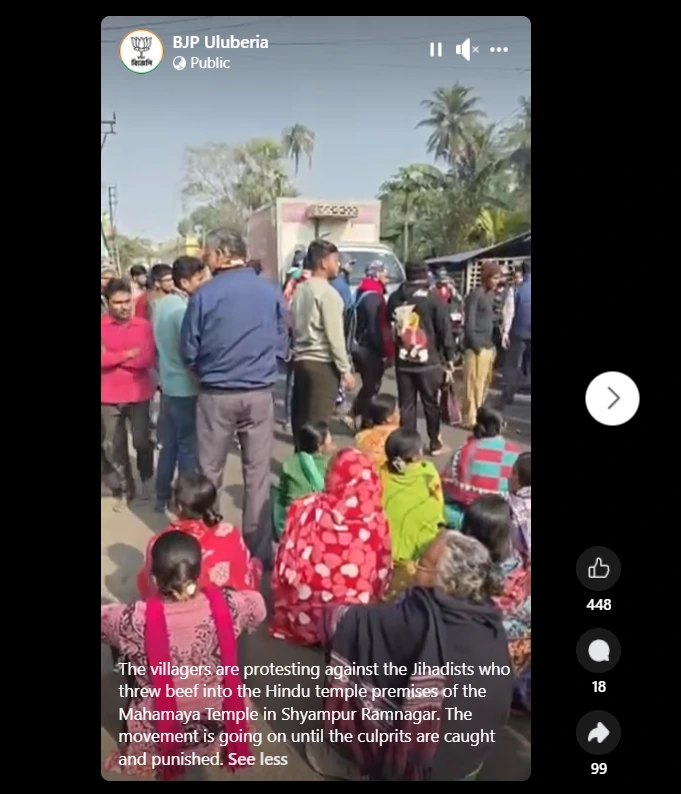
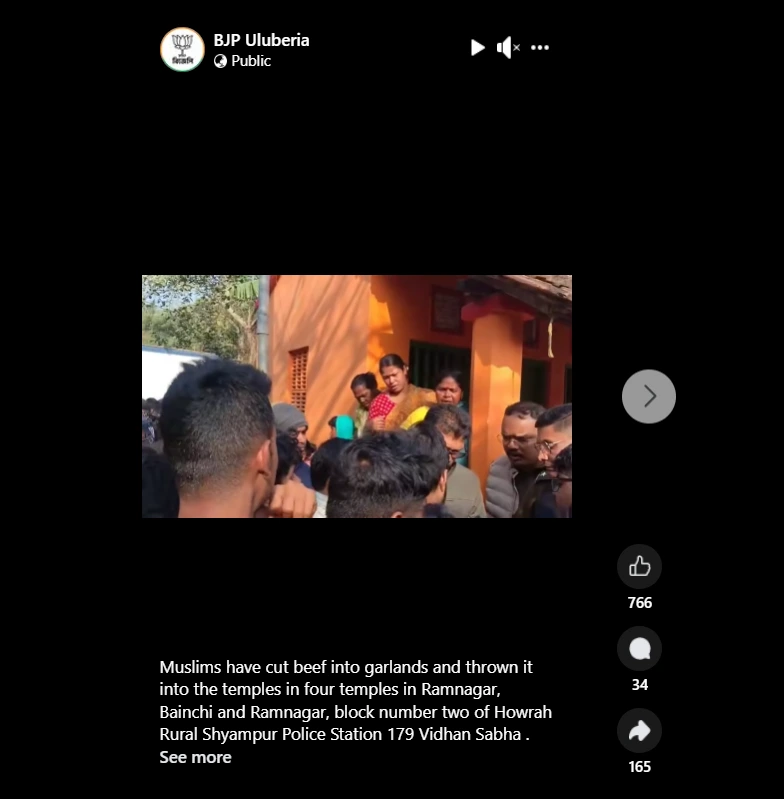
In Ramnagar village, located in the Howrah district of West Bengal, four Hindu temples were defiled by Muslims who threw beef inside their premises. The accused also threw notes with anti-Hindu and pro-Muslim remarks inside the temples. This incident came to light when the Bharatiya Janata Party Uluberia official Facebook page posted about it on 28 January 2026. The BJP Facebook page posted videos of the incident and wrote that: "Beef was thrown into the Hindu temple at Shampur Ramnagar Mahamaya temple building. Villagers protested. The agitation continued, demanding punishment of the guilty until they were caught." In another post, they wrote: "Muslims cut beef, garlanded it, wrote a Jihadi conversation on paper and threw it inside four Hindu temples. Beef was thrown into a Hindu temple at the Shampur Ramnagar Mahamaya temple building. Villagers protested. The agitation continued, demanding punishment of the guilty until they were caught." As per the video posted by Bharatiya Janata Party page, a man was heard saying: "Cow meat had been thrown inside Hindu temples and paper chits were also thrown which had writings beginning with, 'in the name of Allah'."
Case Images
Why it is Hate Crime ?
This case has been added to the tracker under the primary category- Attack on Hindu religious representations. The subcategory selected is- Desecration of Hindu religious symbol. Icons and symbols or a religious representation of a spiritual ideal are widely revered in Hinduism. Iconography is of vital significance in the Hindu milieu. It helps connect people’s spiritual beliefs with the real world. Iconography within the Hindu faith takes several shapes and forms. Murtis are of most significance to Hindus, to which daily rituals, prayers and offerings are done. Besides the murtis, there are several other symbols which have deep significance in the Hindu faith – the Om and Swastika for example. Since these Hindu religious symbols hold paramount importance in Hinduism, any desecration of symbols, icons, murtis, religious representations and manifestations, is driven by animosity towards the faith itself which manifests itself through these murtis, icons and symbols. Therefore, any desecration of these Hindu religious symbols and representations is considered religiously motivated hate crimes under this category. The other subcategory selected is- Attack on Temples. In Hinduism, a temple is the abode of the Deity. The Deity in the Temple is consecrated, thereby, making it a real, breathing entity. Hindus believe that not just the Deity but the temple premises itself are sacred to Hindus since Hindus hold the faith that the entire Temple space is an amalgamation of the divine energy of the deity. Given the central significance of Temples in Hindu Dharma, any attack against a Hindu Temple or its peripheral premises is an attack on the faith itself and is born out of animosity towards the faith, of which, the Temple is a central tenet. Any manner of attack against a Temple and/or its premises would therefore be considered a religiously motivated hate crime. The other subcategory selected is- Defiling religious customs. Sanatan Dharma is not a religion of one book, which is to say that while it has religious scriptures that form the central tenets of the faith, there are several traditions followed through thousands of years, mostly passed from generation to generation orally. There are several such customs and traditions that are followed by various Hindus and Hindu sects. Defiling of these traditions and customs is a breach of an individual or group’s religious practices. Such practices can range from dietary restrictions like not eating non-vegetarian food for a certain period of the year, not eating non-vegetarian food at all, not eating beef since the cow is considered holy in Hinduism, the sanctity of religious customs followed in the house (like many ISCKON devotees), etc. Any malicious action leading to the breach of such traditions or defilement of these traditions owing to animosity towards the faith or for the sake of activism stems not only from the lack of faith in the religion itself but also from disregard for the faith of the devotees who follow the customs/traditions and implicit bias against the faith, the tradition itself. Since these specific traditions are central to the faith of the devotees of that specific sect of Hindus, any non-compliance with these traditional rules would be considered a religiously motivated hate crime. Another primary category selected is- Hate Speech against Hindus. The subcategory selected is- Anti-Hindu slurs, mocking faith. Anti-Hindu slurs and the deliberate mocking of the Hindu faith owing to religious animosity involve the usage of derogatory terms, stereotypes, or offensive references to religious practices, symbols, or figures. One of the common anti-Hindu slurs used against Hindus is “cow-worshipper” and “cow piss drinker”. The intention of using this term is to demean and mock Hindus as a group and their religious beliefs since Hindus consider the cow holy. Additionally, some symbols and the slurs attached to them have a historical context that exacerbates the insult, hate, stereotyping, dehumanisation and oppression against Hindus. Cow worship has been used for centuries to denigrate Hindus, insult their faith and oppress Hindus specifically as a religious group. There has been overwhelming documentation about how cow slaughter has been used to persecute Hindus with cow meat being thrown in temples and places of worship. There has also been overwhelming documentation where cow meat (beef) has been force-fed to Hindus to either forcefully convert them to Islam or denigrate their faith. Apart from cow worship, the Swastika – which holds deep religious significance for the Hindus – has also been misinterpreted and distorted to use as a slur against Hindus. Similarly, the worship of the Shivling has been used by supremacist ideologies and religions to denigrate Hindus owing to religious animosity. Such slurs and denigration stem out of inherent animosity and hate towards Hindus and their faith, therefore, it is categorised as hate speech targeted at Hindus specifically owing to their religious identity. This incident constituted a hate crime, as Muslims threw beef and anti-Hindu notes inside four Hindu temples in Ramnagar village, Howrah, West Bengal. For Hindus, temples serve as sacred spaces of worship where deities are manifested through murtis, receiving deep reverence from devotees. These institutions anchor spiritual life, hosting rituals like puja, festivals, and community gatherings that foster devotion and cultural continuity. Similarly, cows are regarded as sacred in Hinduism, and killing a cow is considered a sin among Hindus. Therefore, in this case, the act of throwing beef inside Hindu temples amounted to deliberate defilement and desecration of sacred Hindu shrines. This act reflected profound disregard for Hindu faith and practices, rooted in animosity towards Hinduism. The incident exemplified intentional insult to religious sentiments, warranting recognition as a serious hate-motivated offence. It transcended mere law and order breach, representing calculated dishonour to Hindu customs and sacred symbols, particularly temple purity and rituals. Even historically, Muslim extremists have used cow slaughter in India to insult Hindus, desecrate temples, and force conversions, echoing patterns of asserting religious supremacy. This case mirrored that contempt for Hindus and their faith, driven by hatred to demean customs and defile sacred shrines. Furthermore, the anti-Hindu notes bearing hateful remarks against Hindus and pro-Islamist remarks were thrown inside the temple, which became a potent symbolic gesture of profound religious antagonism. The Muslim perpetrators did not stop at physical desecration; they amplified the assault by littering temples with these notes, explicit hate speech that denigrated Hindus while asserting the supremacy of Islam. This combination wounded religious sentiments deeply, asserted Islamic dominance in explicitly sacred sites, and sought to intimidate the Hindu community. Far from insensitivity, the behaviour constituted a conscious affront to Hindu sentiments, embodying religious supremacism and communal intimidation. Scattering such provocative messages qualifies as hate speech motivated by religious animosity, designed to provoke fear, division, and submission. Paired with the beef dumping, it formed a clear instance of a religiously motivated hate crime. Another point to highlight is that not one, but four Hindu temples were targeted by the perpetrators. This coordinated assault across multiple sacred sites reveals not an isolated random crime but a deliberate pattern of desecrating Hindu places of worship. The scale and uniformity underscore clear religious motivations, aimed at maximising communal hurt and intimidation, making it a hate-driven crime. Given that this case met the parameters of a hate crime, it was added to the hate crime database of the Hinduphobia Tracker. Disclaimer: The Hinduphobia Tracker records an incident date based on when the crime occurs rather than when the media reports it. In this case, since the exact date of the crime remained unknown and only the date when the Bharatiya Janata Party official Facebook handle posted about the incident, 28 January 2026, is available, that date served as the indicative incident date for documentation purposes.


Case Status
Unknown


Perpetrators Details
Perpetrators
Muslim Extremists
Perpetrators Range
Unknown
Perpetrators Gender
unknown
 Sources




