Hindu woman deceived, coerced to convert to Islam and offer namaz by Muslim man pretending to be Hindu
 Gurgaon, Haryana, India
  25 January, 2022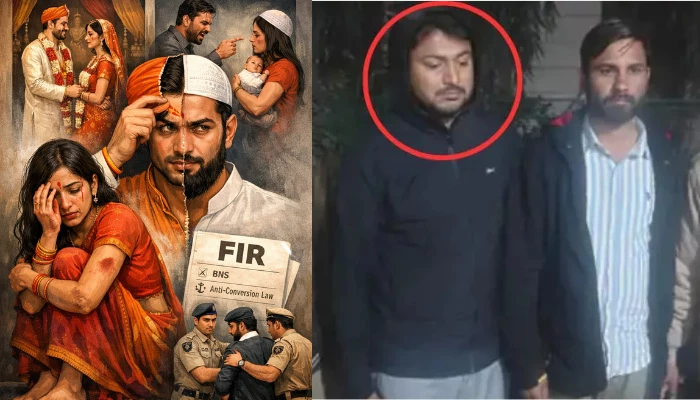
Case Summary
In Gurugram, Haryana, a Hindu woman was deceived into marriage by a Muslim man who posed as a Hindu and later threatened and pressured her to convert to Islam. The woman was subjected to severe physical assault and was also pressured to perform namaz by the accused man and his family. The accused was identified as Mohammad Arif, who concealed his Muslim identity and introduced himself to the victim as "Aarav", a Hindu man. With the help of his Muslim friend Tarif Khan, he lured the Hindu woman into a relationship and married her in a Hindu temple to gain her trust. The victim stated that this was not an isolated act of deception but part of a planned conspiracy. Media reports also revealed that the accused intended to sell the Hindu woman in Dubai and had obtained her passport for this purpose. According to the victim, in 2022, she was working at an insurance company when she met Tarif Khan. He introduced her to his friend Arif, who presented himself as a Hindu transport businessman named Aarav from Gurugram. Under the pretext of purchasing insurance, Arif gradually drew her into a romantic relationship. He persistently pressured her to marry him and arranged a temple wedding to reinforce the false impression that he shared her Hindu faith. After the marriage, the woman became pregnant. Arif forced her to undergo an abortion despite medical advice clearly warning that terminating the pregnancy at six months posed a serious risk to her life. When the doctor refused, Arif began assaulting and torturing her. The woman later gave birth to a baby boy in hospital. At this stage, Arif's friend Tarif revealed his Muslim identity to the victim. The disclosure left her traumatised, but she was compelled into silence due to her vulnerable physical and emotional condition following childbirth. Tarif also informed her that Arif was already married and had three children. In 2023, Arif, also known as Aarav, took the woman to his home in Nuh. There, his mother Zaitoon, first wife Arshida, and brothers Irshad, Nomen, and Momen assaulted her and pressured her to participate in Islamic prayers (namaz). Arif informed the woman that she would have to live as his second wife and forcibly changed her name to Zia Khan. When the woman refused to convert to Islam, Arif began blackmailing her by recording nude videos. While resisting conversion, she endured severe physical and psychological abuse, including beatings, hair-pulling, and unlawful confinement. She escaped once and approached the police, but mediation resulted in her being sent back. Fearing for her safety, the woman fled to Bihar with her child. She later returned alone to Gurugram and resumed work to sustain herself. On 26 January 2026, Arif Khan, along with his family members, broke into her rented accommodation in Rajiv Nagar, Gurugram. They assaulted her brutally and threatened to kill her and her child if she did not convert to Islam. She was admitted in an injured condition to Sector-10A government hospital, where she recorded her statement. Based on the victim's complaint, Sector-14 police station registered a First Information Report on 28 January 2026 against Arif Khan and six relatives under relevant sections of the Bharatiya Nyaya Sanhita for cheating, assault, and criminal intimidation, along with Section 12(1) of the Haryana Prohibition of Unlawful Conversion of Religion Act, 2022. This became Gurugram's first case registered under the anti-conversion law. Subsequently, the police arrested Arif and Tarif. During police interrogation, the accused confessed to the crime and stated that the attack was planned and deliberately executed. The police proceeded to present the accused before the court.
Why it is Hate Crime ?
The primary category selected in the case is- Crimes against women in relationships and other sexual crimes. The sub- category selected is- Man pretends to be Hindu, under it the tertiary categories are Name Changed and Marries as per Hindu rituals. When a non-Hindu man pretends to be a Hindu to deceive a Hindu woman into a relationship, the act is seen as triggered by malicious intentions. In some cases, the woman eventually accepts the man’s original religious identity and converts after the man’s identity is revealed. These cases could be argued as cases of religious brainwashing and a result of the pressure a woman feels after getting into a relationship with a man. The woman, it can be argued, also changed her religious identity because of the stigma she believes she might face if she chooses to walk out of a deceptive relationship. However, for the purpose of documenting hate crimes, the cases in this subcategory are limited to those where there is explicit violence aimed at religious conversion against the wishes of the victim (force-feeding beef, blackmailing with intimate videos, rape on refusal to convert, etc), or if the woman herself complains of the man’s religious deception. In such cases, it is established that the deception of the non-Hindu man had a specific aim of religious conversion or targeting of the victim due to her Hindu religious identity, therefore, making it a religiously motivated hate crime. The other sub-category is- Brainwashed and/or groomed. The tertiary category included in this is- Rape and sexual assault/harassment. In our database, we have not added incidents where women have converted to another religion of their free will, and no allegations of forced/involuntary conversion have been made. However, there are certain cases of conversion where the consent itself is a result of the brainwashing or grooming of a minor by the non-Hindu perpetrator trying to victimise a woman for her Hindu religious identity. The phenomenon of grooming points to non-Hindu perpetrators identifying their Hindu victims’ vulnerabilities and exploiting them over months and sometimes years, to extract the supposed ‘consent’ to convert their religion. In most cases of grooming, the victims are minors, or the grooming started when the victim was a minor. In other cases of grooming, the non-Hindu perpetrator brainwashes and grooms a minor victim to extract their trust and then proceeds to rape them repeatedly with the intent of converting them to their faith. It is pertinent to understand here that when the victim is a minor, the ‘consent’ to convert or enter into a romantic relationship with an adult itself is redundant – addressed by POCSO. While every case of conversion of a minor and incidents of establishing a physical relationship with a minor by an adult are crimes, for this database, a case would be considered a hate crime only if there is a distinct religious angle to the grooming. For example, in the UK, if a Hindu minor is targeted by Pakistani grooming gangs, it would be considered a hate crime because the victims are specifically targeted owing to their non-Muslim religious identity, with the perpetrators being Muslim. In other cases, if a Hindu minor is brainwashed into entering a physical relationship with the non-Hindu adult perpetrator and the family alleges grooming/brainwashing of the minor to convert her religion, it would form a part of this database. If the victim is a Hindu adult, the case would form a part of this database only if the victim herself says that she was brainwashed/groomed to convert her religion. However, if the victim is deceased (murdered or otherwise), the case would form a part of this database if her family/friends provided testimony that the victim was brainwashed/groomed to convert her religion. Since these crimes have a distinct religious angle where the victim is being targeted owing to her Hindu religious identity, these cases are considered hate crimes. The other sub-category selected is- Forced conversion after marriage. In such cases, a non-Hindu man marries a Hindu woman, and the force/pressure to convert to any Abrahamic faith, like Islam, begins after marriage. In such cases, typically, two patterns emerge. First, when the relationship is consensual, and the religious identity of the perpetrator is known to the Hindu woman in the relationship. The marriage could be under the Special Marriages Act, where neither parties are required to convert their religion for the marriage to be considered legitimate. While the victim in such cases enters matrimony assuming that religious identity is not a barrier, the non-Hindu man starts to pressure the woman to convert her religion after marriage. The second is when the woman gets into a marriage with the man, pretending to share her faith. Later, when the truth is revealed, the man starts pressuring the woman to convert her religion and give up her religious identity. In both situations, there is application of force by the perpetrator, including the denial of the woman’s religious rights. Some of the means by which the woman is forced/pressured to convert include force-feeding beef, being forced to read the Kalma, being forced to wear a hijab, forced to undergo Halala, etc. There are several instances where, after marriage, the woman voluntarily converts to Islam. Such cases are often argued to be a result of religious brainwashing, however, for the purpose of documenting religiously motivated hate crimes, in the absence of the victim complaining of forced conversion, such cases do not form a part of the database. The other subcategory selected is- Blackmailed to convert. When Hindu women are in a relationship with non-Hindu men, there are cases where the woman is blackmailed to convert her religion, owing to her religious identity of being a Hindu. Such relationships may be consensual with the religious identity of the non-Hindu man known to the victim, however, there could be cases where the relationship is not consensual and the non-Hindu man starts blackmailing a Hindu woman to convert her religion. In these cases, it is often seen that the Hindu woman is blackmailed with intimate photos and/or videos, threats of harm to her or her family, threats of violence etc. Such cases are driven by specific religious motivations and against the religious identity of the victim and are therefore qualified as hate crimes. The other sub-category is- Assault or threat upon refusal to convert. When Hindu women are in a relationship with non-Hindu men, there are cases where the woman faces threats or assault after she refuses to convert and change her religious identity owing to pressure/force by the non-Hindu man. Such relationships may be consensual with the religious identity of the non-Hindu man known to the victim. Somewhere along the relationship, the non-Hindu man starts pressurising the Hindu woman to convert to Islam and upon her refusal, assaults or threatens the victim. Such cases are driven by specific religious motivations and against the religious identity of the victim and are therefore qualified as hate crimes. Cases where the Hindu woman converts to Islam and does not file a complaint about the force or threat are not considered a part of the hate tracker, even though it may be argued that the woman was brainwashed or threatened to convert to Islam. Another primary category selected is- Attack not resulting in death. The subcategory selected is- Attacked for refusal to convert. When there is pressure, threat or coercion employed upon the Hindu victim to convert to a different religion, in several cases, the victim refuses to succumb to the pressure/threats. Once the victim refuses, the perpetrator proceeds to attack/assault the victim owing to his/her refusal to convert. In such cases, the pressure/threat/intimidation/coercion/violence itself is driven by animosity towards the victim’s Hindu faith. The violence then is another hate crime driven by the victim’s refusal to abandon his professed faith, Hinduism, and convert to the religion of a non-Hindu perpetrator. Since the victim’s faith is at the heart of the pressure to convert and the ensuing violence towards the victim, such cases are considered religiously motivated hate crimes. The other subcategory selected is- Attacked for Hindu identity. In several cases, Hindus are attacked merely for their Hindu identity without any perceived provocation. A classic example of this category of religiously motivated hate crime is a murder in 2016. 7 ISIS terrorists were convicted for shooting a school principal in Kanpur because they got ‘triggered’ seeing the Kalava on his wrist and tilak that he had put. In this, the Hindu victim had offered no provocation except for his Hindu religious identity. The motivation for the murder was purely religious, driven by religious supremacy. Such cases where Hindus are targeted merely for their religious identity would be documented as a hate crime under this category. In this case, a Hindu woman endured unimaginable betrayal when a Muslim man concealed his identity, posed as a Hindu named Aarav, and lured her into a relationship and temple marriage, only to sexually exploit her afterwards. Once his true identity surfaced, he and his family subjected her to relentless physical torture and coercion to perform namaz and convert to Islam, shattering her trust and life. Firstly, the Muslim perpetrator's act of deception by posing as a Hindu demonstrated clear bias and malicious intent towards the victim's religion. By hiding his true identity, the Muslim man manipulated the Hindu woman's trust and targeted her under false pretences, indicating a premeditated effort to exploit her based on her religious background. This constituted a direct violation of her right to informed consent regarding whom she chose to marry, as well as an infringement upon her religious beliefs. Thus, the perpetrator's deliberate decision to hide his religious identity strongly underscored the religious motive behind this crime. In such instances, identity concealment is not just a deceptive tactic for personal reasons but a calculated strategy rooted in religious profiling and targeting. The accused knew that the victim, being Hindu, would likely refuse his advances if she knew his real identity, and he circumvented this by lying, which directly pointed to a religiously driven intent. This deception reflected a larger pattern where Hindu women are specifically singled out using false identities by Muslim men, often with coercion or conversion in mind. Such targeted victimisation based on religion demonstrated a fundamental disregard for Hinduism and exposed a deeper animosity toward Hindus and their beliefs. The accused deepened this deception by marrying her in a Hindu temple, solemnising their union before her and her community under the pretence of shared devotion, which amplified the betrayal's cruelty. This calculated charade trapped the vulnerable woman in a false sense of security, showcasing his religious animosity through intent to exploit her Hindu identity for personal gain. By desecrating the sanctity of a temple wedding, a joyous Hindu milestone, he mocked her beliefs, proving the crime stemmed from hatred for her faith rather than mere romance gone wrong. Secondly, after the marriage, unaware of his true identity, the Hindu woman endured repeated sexual exploitation under his fabricated Hindu persona, resulting in pregnancy and robbing her of informed consent in the most profound betrayal. Even as a consenting adult, the depth of this manipulation left her utterly powerless, framing the assaults as religiously driven attacks on her Hindu identity. These acts transcended mere sexual gratification; they sought to exploit, demean, and dominate her specifically for being Hindu. This predatory targeting of her faith transformed violation into hate, preying on her devotion to entrap and degrade her. When pregnancy advanced, the accused unleashed physical assaults despite doctors' warnings of life-threatening risks, revealing the utter dehumanisation of the Hindu victim he once pretended to love. Beating a woman carrying his child underscores the contempt for her as a Hindu, escalating from deception to brutality rooted in religious animosity. Upon revealing his Muslim identity, the accused and his family intensified coercion to obliterate her Hindu faith, forcing namaz, a new name, Zia Khan, and full conversion to Islam, acts that exposed their deep-seated animosity towards the victim's Hindu roots. Forcing namaz demanded she abandon Hindu worship for Islamic submission; changing her name erased her Hindu identity entirely; conversion aimed to destroy her spiritual autonomy completely. Trapping a Hindu woman through temple marriage only to demand she renounce Hinduism violated her right to religious freedom, replacing her faith practices with alien rituals through brutal force, not persuasion, but calculated annihilation of her Hindu self. This assault on her devotion, name, and beliefs constituted spiritual murder, targeting her specifically for being Hindu. Ordinary Hindu women cherish their rituals and identity passed through generations; coercing her to discard everything symbolised existential hatred. Forced conversions like this epitomise religiously motivated hate crimes, weaponising dominance to demean and eradicate Hindu identity through namaz, name changes, and total faith destruction. Before full conversion, the victim also endured vicious blackmail with nude videos, threats to viralise them across social media, combined with savage beatings, brutal hair-pulling, and prolonged unlawful confinement, all unleashed solely because she resisted converting to Islam and clung to her Hindu faith. This merciless escalation revealed the accused's fanatical willingness to cross every boundary, deploying blackmail, psychological terror and physical brutality to shatter her spirit and forcibly obliterate her Hindu identity as a terrified young mother protecting her child. Each beating marked her refusal to abandon her beliefs; each confinement trapped her in fear, stripping away dignity while threats loomed to publicly shame her forever. Such multi-layered torment, triggered exclusively by her devout stand for Hinduism, screamed raw religious hatred, transforming resistance into a trigger for intensified dehumanisation. Even after she fled to Bihar for safety with her young child, desperately seeking refuge from years of torment, and later rebuilt her life alone in Gurugram through sheer resilience, the accused and his family shattered her fragile peace by breaking into her rented home in Rajiv Nagar on 26 January 2026. They launched a brutal assault, raining blows on her body while issuing chilling death threats to kill both her and the innocent boy unless she immediately converted to Islam, leaving her battered and bleeding before admitting her to the hospital. This second unprovoked vicious attack, years after the initial deception, underscored their obsessive, unrelenting drive to annihilate her Hindu identity at any cost, targeting a lone Hindu woman who only sought to protect her child and preserve her faith against overwhelming odds. Such attacks are clearly rooted in animosity towards Hinduism and its adherents, making it a hate-driven crime. Overall, this harrowing ordeal targeted the Hindu woman purely for her faith identity. From the initial deception and sexual violation, through forced abortion attempts amidst pregnancy, relentless blackmail with nude videos, savage beatings, hair-pulling, confinement, namaz coercion, and name changes, to the final home invasion with murder threats, all because she remained steadfastly Hindu. Subjecting a Hindu woman to such dehumanising horrors qualifies unequivocally as a hate crime driven by anti-Hindu animosity, matching every parameter of faith-based persecution. Another point to highlight is that this crime unfolded as a calculated operation by multiple perpetrators. Arif, aided by Tarif in deceiving and trapping the Hindu woman, then his mother Zaitoon, wife Arshida, and brothers Irshad, Noman, and Momin, enforced conversion, namaz, and assaults. Their coordinated effort aimed solely to strip her of her Hindu faith through systematic humiliation and coercion, marking it as a religiously motivated hate crime. Furthermore, the plan to sell her in Dubai revealed dehumanising contempt for her as a Hindu, reducing her to a trafficked commodity after faith erasure, amplifying the anti-Hindu animosity at the crime's core. Overall, since this case meets every criterion of a hate crime, it is being added to the hate crime database of the Hinduphobia Tracker. Disclaimer: The Hinduphobia Tracker records the dates of incidents based on when the victim's ordeal begins rather than when it is reported by the media. However, in this case, the media reports did not state the exact date when the victim's ordeal began. They only mentioned that she met the accused in 2022. Apart from that, the specific date provided was 26 January 2026, when the accused and his family members broke into her rented accommodation in Rajiv Nagar, Gurugram. Henceforth, based on this information, an indicative date of 26 January 2022 has been selected as the incident date. This is recorded for documentation purposes only. In this case, the total perpetrator count is recorded as 7. This includes the main accused, Arif, his friend Tarif, his mother Zaitoon, his first wife Arshida, and his three brothers Irshad, Noman, and Momin, all actively involved in the deception, assaults, coercion, and threats against the Hindu victim.
Victim Details
Total Victim
1
Deceased
0
Gender
- Male 0
- Female 1
- Third Gender 0
- Unknown 0
Caste
- SC/ST 0
- OBC 0
- General 0
- Unknown 1
Age Group
- Minor 0
- Adult 1
- Senior Citizen 0
- Unknown 0


Case Status
Case sub-judice


Perpetrators Details
Perpetrators
Muslim Extremists
Perpetrators Range
From 5 to 10
Perpetrators Gender
both
 Sources




