Hindu sentiments outraged as Islamic cleric makes objectionable remark against Hindu schools in Muzaffarnagar, Uttar Pradesh
 Muzaffarnagar, Uttar Pradesh, India
  24 January, 2026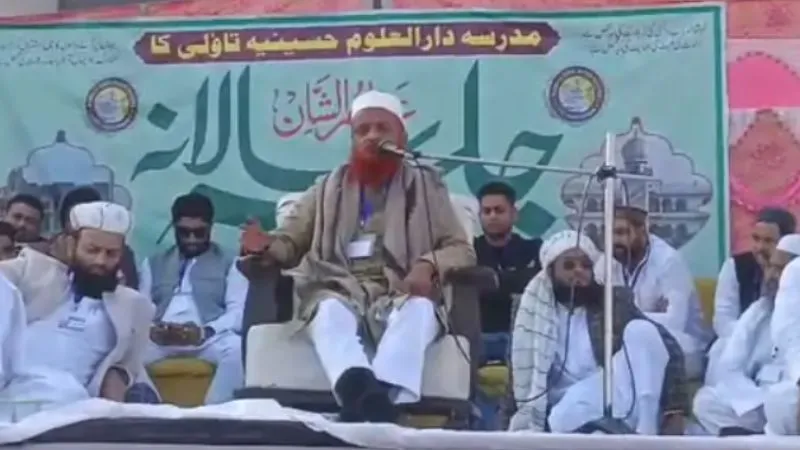
Case Summary
In Shahpur, Muzaffarnagar, Uttar Pradesh, an anti-Hindu hate speech was made by a Muslim cleric, Maulana Mumsad. He spewed venom against Hindu schools. The accused publicly apologised after facing police pressure and widespread backlash for his speech. According to media reports, this occurred at a gathering in Madrasa Mahmoodia in Shahpur on 25th January 2026. Maulana Mumsad denigrated Hindu schools by stating that Muslim children studying in Hindu schools became "Mushrik" (polytheists) and that their faith was in danger. He appealed to Muslim parents to remove their children from such schools. A video of the madrasa gathering went viral on social media, after which a police investigation was launched. Hindu organisations strongly objected to the accused's statement, and the police, taking cognisance of the viral video, intensified the investigation. Following this, the accused Maulana, who ran the FD Islamia Inter College, retracted his statement and declared himself a "nationalist." Maulana Mumsad claimed that he did not intend to hurt anyone's sentiments and that he supported national unity.
Why it is Hate Crime ?
This case is being added to the tracker under the primary category- Hate Speech against Hindus. The subcategory selected is- Anti-Hindu slurs, mocking faith. Anti-Hindu slurs and the deliberate mocking of the Hindu faith owing to religious animosity involve the usage of derogatory terms, stereotypes, or offensive references to religious practices, symbols, or figures. One of the common anti-Hindu slurs used against Hindus is “cow-worshipper” and “cow piss drinker”. The intention of using this term is to demean and mock Hindus as a group and their religious beliefs since Hindus consider the cow holy. Additionally, some symbols and the slurs attached to them have a historical context that exacerbates the insult, hate, stereotyping, dehumanisation and oppression against Hindus. Cow worship has been used for centuries to denigrate Hindus, insult their faith and oppress Hindus specifically as a religious group. There has been overwhelming documentation about how cow slaughter has been used to persecute Hindus with cow meat being thrown in temples and places of worship. There has also been overwhelming documentation where cow meat (beef) has been force-fed to Hindus to either forcefully convert them to Islam or denigrate their faith. Apart from cow worship, the Swastika – which holds deep religious significance for the Hindus – has also been misinterpreted and distorted to use as a slur against Hindus. Similarly, the worship of the Shivling has been used by supremacist ideologies and religions to denigrate Hindus owing to religious animosity. Such slurs and denigration stem out of inherent animosity and hate towards Hindus and their faith, therefore, it is categorised as hate speech targeted at Hindus specifically owing to their religious identity. This case was a clear instance of anti-Hindu hate speech, as the Muslim cleric, Mumsad, spread venom against Hindu schools by declaring that Muslim children studying there became "Mushrik" (polytheists). He portrayed Hindu schools as dangerous places that corrupted the Islamic faith, directly denigrating them as institutions promoting polytheism, a core tenet he deemed antithetical to Islam. This rhetoric sowed animosity by framing Hindu educational spaces as existential threats to Muslim identity, urging parents to withdraw children and isolate communities along religious lines. Maulana Mumsad's statements fostered a deeply negative view of Hindus, equating their schools with moral and spiritual pollution that turned Muslim youth away from their faith. By labelling Hindu-run educational institutions as a pathway to polytheism, he reinforced stereotypes of Hindus as insidious influencers who undermine Islam, breeding suspicion and prejudice. This narrative vilified Hindu societal contributions, particularly in education, and portrayed Hindus as adversaries whose very presence endangered Muslim purity. The cleric's words revealed an Islamic supremacist mindset prioritising religious segregation over coexistence, insisting that interaction with Hindu institutions posed irreversible faith risks. He appealed to Muslim parents to enforce separation, promoting an exclusionary worldview that dismissed Hindu schools' value and amplified communal divides. Such targeted denunciation showcased bias rooted in religious supremacy, aiming to rally Muslims against Hindus while eroding shared civic spaces. This inflammatory rhetoric from the Maulana cultivated deep hatred towards Hindus, directly inciting discrimination and systematic oppression against them. Muslims influenced by this narrative would perceive Hindu identity and practices as an existential threat to Islam, justifying exclusionary actions. Consequently, Hindus would face marginalisation in social, educational, and public spaces. This pattern perpetuates a cycle of animosity, resulting in repeated instances of targeted discrimination and marginalisation of Hindus. Given that this case meets the parameters of a religiously motivated hate speech, it is being added to the hate crime database of the Hinduphobia Tracker.


Case Status
Unknown


Perpetrators Details
Perpetrators
Muslim Extremists
Perpetrators Range
One Person
Perpetrators Gender
male
 Sources




