Hindu woman deceived into relationship by Muslim man posing as Hindu, victim says accused targeted multiple Hindu women
 Ambikapur, Chhattisgarh, India
  25 January, 2026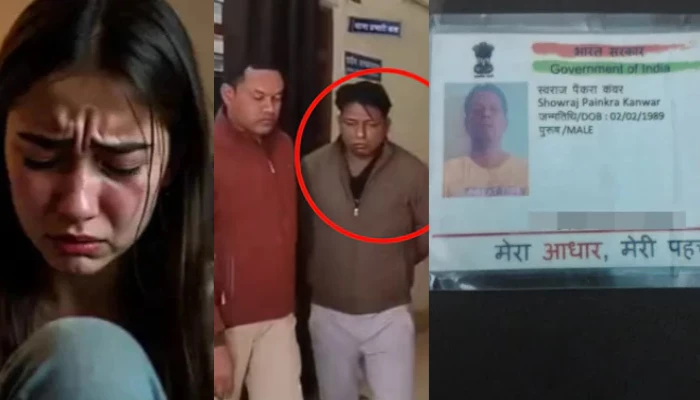
Case Summary
A Hindu tribal woman was targeted and deceived by a Muslim man posing as a Hindu through a fake social media profile. His arrest revealed that the accused had similarly targeted multiple Hindu women. The incident occurred in Ambikapur, Surguja district of Chhattisgarh. Mohammed Mahfooz, a resident of Bihar, posed as a Hindu man using fake names and identities and targeted young Hindu girls. His modus operandi was to befriend them, exploit them while coercing them into relationships, and defraud the young Hindu women. He falsely presented himself as a Hindu railway officer posted in Chhattisgarh and used fabricated identity documents and fake social media profiles to support this claim. This incident came to light when a young Hindu tribal woman was deceived into believing that the accused, Mahfooz Ahmed, was a Hindu railway officer. The Hindu woman grew suspicious due to inconsistencies in his claims and verified his background. Upon discovering his real identity, she approached the police and filed a case at the Gandhi Nagar police station in Ambikapur. In her complaint, she stated that she had befriended a young man through social media whose Facebook account was named Tarun Paikra. After their friendship developed, the young man told her his name was Swaraj Paikra, a resident of Bilaspur. As their conversation progressed, the young man proposed marriage to her. Following this, the woman arrived in Ambikapur on January 25 and went to meet him at a hotel. After spending some time together, the accused man asked the woman to check his mobile phone, to which she agreed. While they were checking each other’s mobile phones, the woman discovered photographs and conversations with other Hindu women on his social media accounts. When she questioned him about this, he refused to respond and apologised. The woman stated that she then asked the man to drop her off at the bus stand. When he left the hotel to check bus timings, she searched his bag and belongings and found an Aadhaar card bearing the name Mohammed Mahfooz. She immediately informed her acquaintances and contacted the Gandhi Nagar police station. Meanwhile, the accused stopped responding to her calls. Speaking to the media, the victim stated that it was her first meeting with the young man. She said she found two to three mobile phones and SIM cards registered under different names in the accused man’s bag. She further stated that the man deliberately targeted Hindu girls. The woman also said that on January 17 2026, the accused had brought another girl to the same hotel where she was later taken. The young man used his Facebook account to specifically target Hindu girls and send them messages. Based on the victim’s complaint, the accused was arrested from a hotel in Ambikapur, and fake identity documents and digital evidence were seized. An FIR was registered, and further investigation was initiated. As per the police, Mahfooz worked at a clothing store in Patna. At night, he contacted young women through social media, posed as a railway official posted in Bilaspur, and lured them with promises of marriage. Using this false identity, the accused contacted multiple Hindu girls, including those from tribal (Janjatiya) communities, through social media platforms. He developed personal and intimate relationships with them by misrepresenting his religion, name, and occupation. In at least one instance, he stayed with a woman in a hotel in Ambikapur under this false identity. During the course of these interactions, the accused exploited the trust of the victims for physical intimacy and financial gain. One of the victims was defrauded of a significant amount of money after being misled about his background and employment. Police recovered several photographs of different women from the accused’s mobile phone, indicating that multiple Hindu girls were targeted using the same method. Police seized the accused’s mobile phone during the investigation, which revealed that he had also defrauded two other girls from Ambikapur. He defrauded one woman, who worked at a microfinance company, of ₹54,000. As news of the incident spread, members of Hindu organisations visited the police station and demanded strict action against the accused. At the time of reporting, the investigation was ongoing. Police examined digital evidence, social media communications, and witness statements.
Why it is Hate Crime ?
This case has been documented under the selected primary category: Crimes against women in relationships and other sexual crimes. Under this, the selected secondary category is: Man pretends to be Hindu. Under this, the selected tertiary category is: name changed and pattern of targeting Hindus. When a non-Hindu man pretends to be a Hindu to deceive a Hindu woman into a relationship, the act is seen as triggered by malicious intentions. In some cases, the woman eventually accepts the man’s original religious identity and converts after the man’s identity is revealed. These cases could be argued as cases of religious brainwashing and a result of the pressure a woman feels after getting into a relationship with a man. The woman, it can be argued, also changed her religious identity because of the stigma she believes she might face if she chooses to walk out of a deceptive relationship. However, for the purpose of documenting hate crimes, the cases in this subcategory are limited to those where there is explicit violence aimed at religious conversion against the wishes of the victim (force-feeding beef, blackmailing with intimate videos, rape on refusal to convert, etc), or if the woman herself complains of the man’s religious deception. In such cases, it is established that the deception of the non-Hindu man had a specific aim of religious conversion or targeting of the victim due to her Hindu religious identity, therefore, making it a religiously motivated hate crime. Another category is: Brainwashed/ or Groomed, wherein the tertiary category is: Victim says was brainwashed/groomed. In our database, we have not added incidents where women have converted to another religion of their free will, and no allegations of forced/involuntary conversion have been made. However, there are certain cases of conversion where the consent itself is a result of the brainwashing or grooming of a minor by the non-Hindu perpetrator trying to victimise a woman for her Hindu religious identity. The phenomenon of grooming points to non-Hindu perpetrators identifying their Hindu victims’ vulnerabilities and exploiting them over months and sometimes years, to extract the supposed ‘consent’ to convert their religion. In most cases of grooming, the victims are minors, or the grooming started when the victim was a minor. In other cases of grooming, the non-Hindu perpetrator brainwashes and grooms a minor victim to extract their trust and then proceeds to rape them repeatedly with the intent of converting them to their faith. It is pertinent to understand here that when the victim is a minor, the ‘consent’ to convert or enter into a romantic relationship with an adult itself is redundant – addressed by POCSO. While every case of conversion of a minor and incidents of establishing a physical relationship with a minor by an adult are crimes, for this database, a case would be considered a hate crime only if there is a distinct religious angle to the grooming. For example, in the UK, if a Hindu minor is targeted by Pakistani grooming gangs, it would be considered a hate crime because the victims are specifically targeted owing to their non-Muslim religious identity, with the perpetrators being Muslim. In other cases, if a Hindu minor is brainwashed into entering a physical relationship with the non-Hindu adult perpetrator and the family alleges grooming/brainwashing of the minor to convert her religion, it would form a part of this database. If the victim is a Hindu adult, the case would form a part of this database only if the victim herself says that she was brainwashed/groomed to convert her religion. However, if the victim is deceased (murdered or otherwise), the case would form a part of this database if her family/friends provided testimony that the victim was brainwashed/groomed to convert her religion. Since these crimes have a distinct religious angle where the victim is being targeted owing to her Hindu religious identity, these cases are considered hate crimes. This case is a clear example of an anti-Hindu hate crime rooted in religious targeting. When a Hindu woman was approached by a Muslim man with the intention to hide his real religious identity, it was only to gain the trust of that Hindu woman in furtherance of his illegal motives. This was not an innocent mistake. The accused knew that revealing his true identity would have stopped the relationship from forming, so he chose deception as a way to access the victim. By pretending to be Hindu, the accused took advantage of the woman’s trust and her comfort in believing she was interacting with someone from her own faith. This deception denied her the right to make an informed choice about her relationship and showed clear bias, as the accused relied on a false religious identity to manipulate and exploit a Hindu woman. Although the initial interaction involved no conflict, provocation, or religious dispute. What followed was a sharp and unfair escalation, where ordinary social contact turned into emotional pressure, exploitation, and financial abuse. This escalation showed intent to control rather than form a genuine relationship. The victim was not targeted by chance, but because her Hindu identity made her vulnerable to this form of deception. The recovery of conversations and images of multiple Hindu women from the accused’s devices showed that this was not a one-time act. It pointed to a repeated method where Hindu women, including tribal Hindu women, were deliberately selected, approached, and exploited in the same way. This pattern confirmed that religion played a central role in choosing victims and carrying out the abuse. By hiding his real religious identity and systematically targeting Hindu women, the accused violated not only the emotional and personal autonomy of the victims but also exploited their faith and cultural trust. This form of harm does not rely on open threats or public violence, yet it causes deep psychological trauma, breaks trust, and creates fear within the wider Hindu community. This case fits the definition of a religiously motivated hate crime because every stage of the abuse depended on concealing religious identity and exploiting Hindu faith. The accused’s actions showed hostility and disregard towards Hindu identity, making this a clear instance of Hinduphobia. It is also important to note that this is not an isolated case. The Hinduphobia Tracker has documented many similar incidents where Hindu women and minors were targeted by Muslim men who changed their names, adopted Hindu identities, and later defrauded, exploited, or pressured victims to convert. The repeated use of the same method across cases shows a wider and ongoing pattern of religiously targeted exploitation.
Victim Details
Total Victim
1
Deceased
0
Gender
- Male 0
- Female 1
- Third Gender 0
- Unknown 0
Caste
- SC/ST 0
- OBC 0
- General 0
- Unknown 1
Age Group
- Minor 0
- Adult 1
- Senior Citizen 0
- Unknown 0


Case Status
Complaint filed


Perpetrators Details
Perpetrators
Muslim Extremists
Perpetrators Range
One Person
Perpetrators Gender
male
 Sources




