Hindu temple vandalised, sacred idols desecrated, and religious items set on fire by miscreants in Begusarai, Bihar
 Begusarai, Bihar, India
  25 January, 2026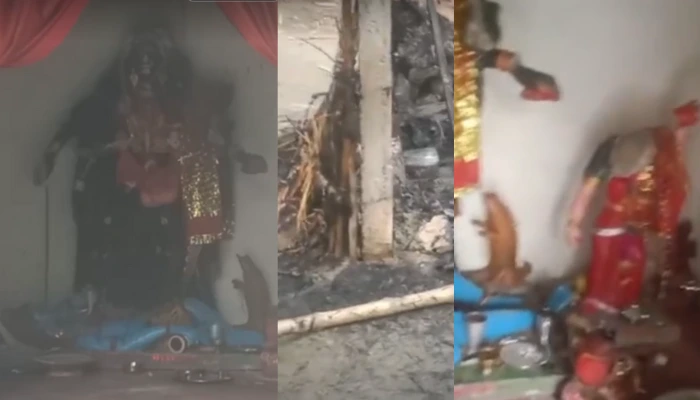
Case Summary
In Begusarai, Bihar, a Hindu temple of Goddess Kali was vandalised, its sacred idols were desecrated and beheaded by miscreants. Even the temple donation box was robbed, and religious items inside the temple were set on fire. According to media reports, the attack took place late on Monday, 26 January 2026, in Ward No. 3 of Shahpur Panchayat, under the Chaurahi police station area. The miscreants had entered the temple premises and damaged the permanent idol of Kali Mata. Additionally, the head of another idol of Goddess Kali installed in the temple was beheaded. They also broke open the donation box and stole cash, Kali Mata's jewellery, and other valuables. During the incident, miscreants set fire to the storeroom of the temple. Worship materials, clothing, utensils, and other items worth approximately one lakh rupees were completely destroyed in the blaze. The burned items and scattered remains throughout the temple premises demonstrated the severity of the incident. Upon receiving information about the incident, the administration swung into action. The Sub-Divisional Magistrate of Manjhaul, Deputy Superintendent of Police, Chaurahi Circle Officer, and a police team from Chaurahi police station arrived at the scene with their forces and took stock of the situation. Additional police forces were deployed in the village to prevent any untoward incident, and the scene was cordoned off. The administration appealed to the public to maintain peace. The villagers were deeply angry about this incident, saying their sentiments had been hurt by such an incident and that the culprits should be arrested soon. The temple priest, Jyoti Devi, and her husband, Pachu Mahato, also urged authorities to arrest and punish the perpetrators as soon as possible. Station House Officer Jitendra Kumar stated that police forces were deployed and the perpetrators would be arrested soon.
Why it is Hate Crime ?
This case has been added to the tracker under the primary category- Attack on Hindu religious representations. The subcategory selected is- Attack on Temples. In Hinduism, a temple is the abode of the Deity. The Deity in the Temple is consecrated, thereby, making it a real, breathing entity. Hindus believe that not just the Deity but the temple premises itself are sacred to Hindus since Hindus hold the faith that the entire Temple space is an amalgamation of the divine energy of the deity. Given the central significance of Temples in Hindu Dharma, any attack against a Hindu Temple or its peripheral premises is an attack on the faith itself and is born out of animosity towards the faith, of which, the Temple is a central tenet. Any manner of attack against a Temple and/or its premises would therefore be considered a religiously motivated hate crime. The other subcategory selected is- Desecration of Hindu religious symbol. Icons and symbols or a religious representation of a spiritual ideal are widely revered in Hinduism. Iconography is of vital significance in the Hindu milieu. It helps connect people’s spiritual beliefs with the real world. Iconography within the Hindu faith takes several shapes and forms. Murtis are of most significance to Hindus, to which daily rituals, prayers and offerings are done. Besides the murtis, there are several other symbols which have deep significance in the Hindu faith – the Om and Swastika for example. Since these Hindu religious symbols hold paramount importance in Hinduism, any desecration of symbols, icons, murtis, religious representations and manifestations, is driven by animosity towards the faith itself which manifests itself through these murtis, icons and symbols. Therefore, any desecration of these Hindu religious symbols and representations is considered religiously motivated hate crimes under this category. This case stands as a clear instance of a religiously motivated hate crime because miscreants targeted a Hindu temple of Goddess Kali in Begusarai, Bihar, a sacred institution embodying profound religious significance for the Hindu community. Hindu temples function not merely as buildings but as revered spaces where Hindus believe divine deities reside, serving as their true abode through consecrated idols and continuous worship. Such attacks involving vandalism, arson on religious items, idol desecration and beheading, and robbery of the donation box deliberately undermined this Kali temple, fuelled by hatred that struck at the core of Hinduism and eroded the community's protected religious shrines and practices. The torching of worship materials alongside the desecration and beheading of Kali idols cements this as a hate crime, as the miscreants showed complete disdain for these sacred objects. For Hindus, idols carry profound religious weight as manifestations of the divine, acting as essential mediums for worship and devotion, while storeroom contents like puja items, clothing, and utensils enable vital rituals. By setting them ablaze, severing idol heads, and looting offerings, the perpetrators trampled Hindu sentiments and assaulted Hinduism outright, exposing profound religious animosity towards the Hindu community that drove such targeted destruction of irreplaceable symbols of faith. Even though the religious identity of the perpetrators remained unknown, these acts proved their hatred targeted Hinduism, the Hindu community, and their sacred shrines. The selective violence against temple idols, structures, ritual items, and donation resources revealed bias beyond ordinary crime. Therefore, this case warranted addition to the Hate Crime Database of the Hinduphobia Tracker.


Case Status
Unknown


Perpetrators Details
Perpetrators
Unknown
Perpetrators Range
Unknown
Perpetrators Gender
unknown
 Sources




