Hindu devotees targeted in bomb attack during Saraswati Puja immersion over minor DJ scuffle in Jharkhand
 Jharkhand, India
  23 January, 2026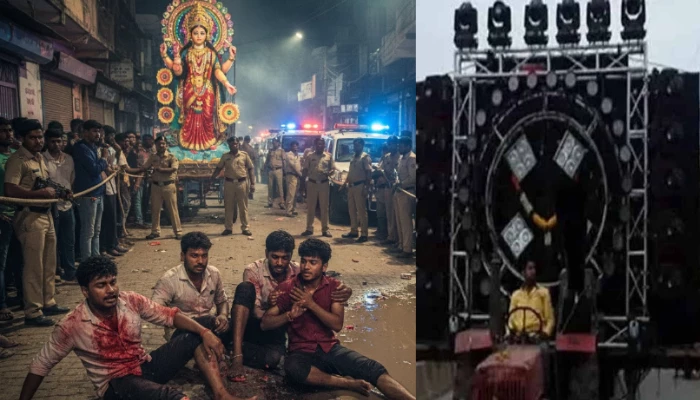
Case Summary
Hindu devotees were bombed by miscreants while performing Saraswati Puja in Jharkhand. The attack was initiated after a dispute arose over playing music during the immersion procession. The incident occurred late on 24th January in Ward Number 14 of Gohariyon village, Bhagalpur, under the Lodipur police station area. The injured included Neeraj Kumar, aged 22, Gautam Kumar, aged 25, Meghu Mandal, aged 55, and Chhotu Kumar, aged 18. The condition of the injured remained serious. Neeraj Kumar’s leg was completely damaged, while Gautam Kumar suffered a severe back injury. Meghu Mandal sustained serious burns on his back and legs, and Chhotu Kumar’s face was badly damaged. After receiving first aid, all the injured were admitted to Mayaganj Hospital, where they continued to receive medical treatment. Meanwhile, the injured Gautam Kumar informed the police that a disc jockey system was being played during the immersion of the Saraswati Puja idol. During this time, a dispute broke out between two groups over an issue, which soon turned into a violent clash. On witnessing the fight, the disc jockey driver parked the vehicle nearby. Subsequently, the driver began returning home with his brother and uncle. In the course of events, two bombs were suddenly thrown, as a result of which he, his brother, and his uncle were injured in the bombing incident. Following the two explosions, people in the vicinity began running in all directions, creating a situation of panic. Upon receiving information about the incident, Senior Superintendent of Police Pramod Kumar Yadav reached Mayaganj Hospital and met the injured, enquiring about their condition. He also reviewed the treatment being provided by the doctors and requested that the injured receive the best possible care. Thereafter, a large police force, including the City Superintendent of Police Shailendra Singh, the Deputy Superintendent of Police, and the Lodipur police station chief, camped in the village to bring the situation under control. The accused were verified, and Senior Superintendent of Police Pramod Kumar Yadav assured that strict action would be taken against those responsible.
Why it is Hate Crime ?
There are two primary categories selected in this case. The first primary category is - Attack not resulting in death. The first subcategory selected within this is- Attack on a religious procession. The outward celebration and display of religious symbols is an intrinsic part of Hinduism. Religious processions on various festivals are age-old traditions and a way to manifest faith and form a part of the religious practices of Hindus. On several occasions, such religious processions come under attack by non-Hindu mobs, in a manifestation of their animosity towards Hinduism and its practices. The reasons cited for such violent attacks are many and range from crossing a non-Hindu resident-dominated area to playing loud music, crossing from an area where there is a religious structure of another faith, etc. The violent attacks are triggered by the outward display of religiosity by Hindus. The attacks are mainly a manifestation of religious supremacist doctrine, which believes that idolatry, essentially the Hindu faith, deserves to be annihilated since the very tenets of Hinduism, its practices and traditions are considered a sin in those doctrines. Since these attacks emanate from intrinsic and doctrinal animosity towards Hindus and Hinduism, it is considered a religiously motivated hate crime under this category. The other subcategory selected is- Attack against Hindu devotees. Hindu devotees are a few of the easiest targets of religiously motivated hate crimes because, during the festival/procession/puja, etc., for non-Hindus, it is easy to profile their victims based on religion. Hindu devotees come under attack on several occasions by individual non-Hindus or mobs of non-Hindus owing to their animosity against Hinduism, its symbols and tradition/practices. There are several instances of Hindu devotees being attacked while they worship in temples or temporary religious structures, during religious processions, doing bhajan/kirtan/puja in their own homes, in the residential society, etc. These attacks are perpetrated by non-Hindus primarily because of their animosity towards Hindus and their faith. In some cases, the trigger for the violence may be non-religious; however, two elements make these hate crimes. First, the Hindus who come under attack are attacked violently while indulging in religious activity. Whether they are in a place of worship or not is immaterial to the crime. When individuals are attacked while indulging in religious practices, the attack in itself is a hindrance to their freedom to practice religion and therefore constitutes a hate crime. Secondly, religious supremacist doctrines and ideologies deem religious practices of Hindus to be offensive ab initio since they are considered “sinful” by these ideologies, worthy to be annihilated by force or coercion. Driven by these religious supremacist ideologies and doctrines, the attacks against Hindu devotees stem from intrinsic animosity towards Hinduism. In some cases, the trigger for the violence may be non-religious; however, it develops into a religiously motivated crime during the course of the violence. Since these attacks stem from animosity towards Hindus and Hinduism, they are considered religiously motivated hate crimes under this category. The other category selected here is- Attack on Hindu religious representations. Within this, the sub-category selected is- Defiling religious customs. Sanatan Dharma is not a religion of one book, which is to say that while it has religious scriptures that form the central tenets of the faith, there are several traditions followed through thousands of years, mostly passed from generation to generation orally. There are several such customs and traditions that are followed by various Hindus and Hindu sects. Defiling of these traditions and customs is a breach of an individual or group’s religious practices. Such practices can range from dietary restrictions like not eating non-vegetarian food for a certain period of the year, not eating non-vegetarian food at all, not eating beef since the cow is considered holy in Hinduism, the sanctity of religious customs followed in the house (like many ISCKON devotees), etc. Any malicious action leading to the breach of such traditions or defilement of these traditions owing to animosity towards the faith or for the sake of activism stems not only from the lack of faith in the religion itself but also from disregard for the faith of the devotees who follow the customs/traditions and implicit bias against the faith, the tradition itself. Since these specific traditions are central to the faith of the devotees of that specific sect of Hindus, any non-compliance with these traditional rules would be considered a religiously motivated hate crime. This incident is recorded as a hate crime because the violence was directed at a Hindu religious ritual at the precise moment of worship, and it involved actions that defiled and desecrated the sanctity of the religious observance itself. A core religious marker is the timing and setting. The attack occurred during the immersion of the Saraswati Puja idol, a sacred culmination of Hindu worship. Targeting devotees at this moment shows that the religious procession was deliberately singled out. Violence introduced into a ritual space transforms worship into terror and signals rejection of the faith being practised. The presence and use of explosives adds a distinct element of religious defilement. Carrying bombs into a sacred procession is not merely violent conduct. It contaminates a holy act with instruments of destruction. Religious processions are meant to be spaces of purity, devotion, and reverence. Introducing explosives into that space constitutes a symbolic violation of the ritual itself, turning an act of worship into a site of desecration. Claims of a spontaneous dispute over music do not withstand scrutiny when examined against this conduct. Explosives are not carried for accidental confrontations. Their presence demonstrates prior intent and preparation. This indicates that the procession was approached not as a shared civic moment but as an opportunity to violate, disrupt, and defile a Hindu religious custom through extreme violence. Another key marker is concealment. The perpetrators hid among devotees while carrying explosives. No genuine participant in a religious ritual brings weapons designed to maim and kill. This deception confirms that the devotees and the ritual environment were the intended targets, and that the alleged dispute functioned only as a cover for executing a pre-planned attack on a sacred gathering. The severity of the injuries further reinforces the hate-driven nature of the act. The use of explosives during a religious ritual shows an intent to cause maximum harm and fear while dishonouring the sanctity of the event. This level of escalation reflects entrenched hostility toward Hindu religious practice rather than a momentary loss of control. Finally, this incident aligns with a wider pattern in which Hindu religious processions are disrupted through violence that both harms devotees and desecrates rituals. By turning a sacred ceremony into a scene of panic and injury, the perpetrators sought to undermine the right of Hindus to practise their faith openly and with dignity. Taken together, the targeting of a Hindu ritual, the premeditated use of explosives, the concealment among worshippers, and the defilement of a sacred custom establish that the incident was driven by religious animosity. The act, therefore, constitutes a hate crime against Hindus, marked by both physical violence and deliberate desecration of religious practice.
Victim Details
Total Victim
4
Deceased
0
Gender
- Male 4
- Female 0
- Third Gender 0
- Unknown 0
Caste
- SC/ST 0
- OBC 0
- General 0
- Unknown 4
Age Group
- Minor 0
- Adult 4
- Senior Citizen 0
- Unknown 0


Case Status
Unknown


Perpetrators Details
Perpetrators
Unknown
Perpetrators Range
Unknown
Perpetrators Gender
unknown
 Sources




