Saraswati puja immersion procession stone-pelted, devotees attacked by Muslims over playing 'Jai Shri Ram' on DJ in Darbhanga, Bihar
 Darbhanga, Bihar, India
  24 January, 2026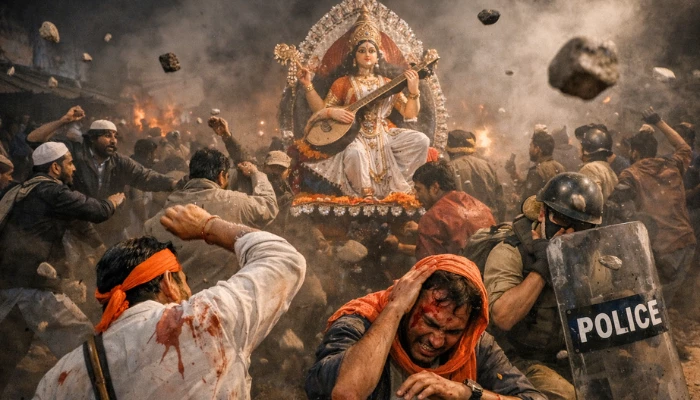
Case Summary
In Alinagar, Darbhanga, Bihar, a Saraswati Puja idol immersion procession was attacked by members of the Muslim community. The accused stone-pelted the Hindu devotees and the procession. The dispute began over the playing of "Jai Shri Ram" on a DJ. According to media reports, the local Hindu community stated that the dispute began on Sunday (25 January 2026) over the playing of "Jai Shri Ram" hymns on a DJ, which escalated into violence during the immersion ceremony on 26 January 2026. Meanwhile, the Darbhanga Senior Superintendent of Police downplayed the initial communal nature of the incident by claiming that the entire dispute began over a motorcycle and later took a communal turn. As the immersion procession passed through Jayantipur village on 26 January, stone-pelting by members of the Muslim community began. According to eyewitnesses, the sudden attack caused panic and left three Hindu devotees severely injured. Following the incident, a heavy police presence was deployed in the area. The Benipur Sub-Divisional Police Officer personally monitored the situation to prevent a recurrence of violence. To defuse the tension, the police administration took action and convened a peace committee meeting with dignitaries from both sides. The Senior Superintendent of Police stated in an official statement that the situation was now completely under control and peace had been restored. Police examined video footage to identify the culprits and closely monitored social media to prevent the spread of rumours.
Why it is Hate Crime ?
The primary category selected in this case is- Attack not resulting in death. The subcategory selected is- Attack on religious procession. The outward celebration and display of religious symbols in an intrinsic part of Hinduism. Religious processions on various festivals are age-old traditions and a way to manifest faith and form a part of the religious practices of Hindus. On several occasions, such religious processions come under attack by non-Hindu mobs, in a manifestation of their animosity towards Hinduism and their practices. The reasons cited for such violent attacks are many and range from crossing a non-Hindu resident-dominated area to playing loud music, crossing from an area where there is a religious structure of another faith etc. The violent attacks are triggered by the outward display of religiosity by Hindus. The attacks are mainly a manifestation of religious supremacist doctrine which believes that idolatry, essentially the Hindu faith, is one that deserves to be annihilated since the very tenets of Hinduism, its practices and traditions are considered a sin in those doctrines. Since these attacks emanate from intrinsic and doctrinal animosity towards Hindus and Hinduism, it is considered a religiously motivated hate crime under this category. The other subcategory selected is- Attack against Hindu devotees. Hindu devotees are a few of the easiest targets of religiously motivated hate crimes because during the festival/procession/puja etc, for non-Hindus it is easy to profile their victims on the basis of religion. Hindu devotees come under attack on several occasions by individual non-Hindus or mobs of non-Hindus owing to their animosity against Hinduism, its symbols and tradition/practices. There are several instances of Hindu devotees being attacked while they worship in temples or temporary religious structures, during religious processions, doing bhajan/kirtan/puja in their own homes, in the residential society etc. These attacks are perpetrated by non-Hindus primarily because of their animosity towards Hindus and their faith. In some cases, the trigger for the violence may be non-religious, however, there are two elements that make these hate crimes. First, the Hindus who come under attack are attacked violently while indulging in religious activity. Whether they are in a place of worship or not is immaterial to the crime. When individuals are attacked while indulging in religious practices, the attack in itself is a hindrance to their freedom to practice religion and therefore constitutes a hate crime. Secondly, religious supremacist doctrines and ideologies deem religious practices of Hindus to be offensive ab initio since they are considered “sinful” by these ideologies, worthy to be annihilated by force or coercion. Driven by these religious supremacist ideologies and doctrines, the attacks against Hindu devotees stem from intrinsic animosity towards Hinduism. In some cases, the trigger for the violence may be non-religious, however, it develops into a religiously motivated crime during the course of the violence. Since these attacks stem from animosity towards Hindus and Hinduism, they are considered religiously motivated hate crimes under this category. The other subcategory selected is- Attacked for Hindu identity. In several cases, Hindus are attacked merely for their Hindu identity without any perceived provocation. A classic example of this category of religiously motivated hate crime is a murder in 2016. 7 ISIS terrorists were convicted for shooting a school principal in Kanpur because they got ‘triggered’ seeing the Kalava on his wrist and tilak that he had put. In this, the Hindu victim had offered no provocation except for his Hindu religious identity. The motivation for the murder was purely religious, driven by religious supremacy. Such cases where Hindus are targeted merely for their religious identity would be documented as a hate crime under this category. The other subcategory selected is- Communal Clash/Attack. Communal clash is a form of collective violence that involves clashes between groups belonging to different religious identities. For a communal clash between Hindus and non-Hindus to qualify as a religiously motivated hate crime, the trigger of the violence itself would have to be anti-Hindu in essence. For example, if there is a Hindu religious procession that comes under attack from a non-Hindu mob and after the initial attack, Hindus retaliate in self-defence, leading to a communal clash between the two religious communities. While at a later stage, both communities are involved in the clash/violence, the initial trigger of the violence was by the non-Hindu mob against the Hindus and therefore, it could safely be termed as an anti-Hindu violence. Further, the trigger would also have to be religiously motivated. In the cited example, the attack by the non-Hindu mob was against religious processions and therefore, can be concluded to be religiously motivated. In some cases, the trigger may be non-religious, however, it develops into religious violence against Hindus at a later stage. In such cases too, the foundational animosity towards Hindus becomes the motivating factor of the crime and therefore, it would be classified as a religiously motivated hate crime against Hindus under this category. In this case, from Alinagar, Darbhanga, Bihar, the attack on a Saraswati Puja idol immersion procession constitutes a clear instance of a religiously motivated hate crime. The Saraswati Puja idol immersion procession holds profound religious significance as a sacred Hindu ritual marking the ceremonial conclusion of the Saraswati Puja festival. The Hindu community carries the consecrated clay idol of Goddess Saraswati, symbolising knowledge, wisdom, arts, and learning, through vibrant streets with chants and prayers, before immersing it in water to signify her return to the divine realm and life's impermanence. In this incident, the members of the Muslim community targeted and pelted stones at this Hindu religious procession itself, showcasing raw hostility towards Hindu rituals and faith. Assaulting a sacred procession, a vibrant expression of Hindu devotion and communal unity, violates the faithful's fundamental right to practise their traditions undisturbed. This violence desecrates the spiritual essence of the procession, timed and executed to humiliate and disrupt Hindu worship, proving the perpetrators' deep religious animosity. Furthermore, attacking Hindu devotees participating in the procession deepens the religious motivation of this hate crime. Stone-pelting injured three devotees right in the midst of their procession, transforming the sacred celebration into sheer terror. This brutal targeting of individuals engaged in worship exposes the perpetrators' intent to physically harm and psychologically terrorise people based solely on religious participation. It inflicts lasting physical wounds and emotional trauma, aiming to deter Hindus from future processions through instilled fear, a hallmark of religiously fuelled hostility. Reports confirm that Hindus endured explicit targeting for their religious identity when playing "Jai Shri Ram" hymns on a DJ, underscoring clear religious animosity. The dispute with Muslims began a day before the Saraswati idol immersion procession over this chant, escalating into a stone-pelting attack on the Saraswati Puja procession the following day. This violent reaction from the Muslims demonstrates profound hatred towards "Jai Shri Ram", a sacred Hindu slogan symbolising devotion to Lord Ram and the community's faith. The perpetrators showed utter contempt for the procession's sanctity, assaulting devotees solely for their religious expression, which reveals raw prejudice and animosity. Such targeted violence against Hindus for voicing their sacred chant, Jai Shri Ram, marks this as a clear, religiously motivated crime. This incident represented an overall communal attack against Hindus, their procession, and their faith, driven by unmistakable religious animosity. What began with objections to a religious chant exploded into stone-pelting that wounded devotees and ignited communal tension, all designed to shatter Hindu traditions and impose Islamic dominance. Far from a random clash, it systematically struck at Hindu religious life, showcasing perpetrators' intent to marginalise and intimidate the entire Hindu community through targeted violence. In this case, police downplayed the initial communal nature of the crime by falsely claiming the dispute started over a motorcycle, ignoring the fact that Hindus stated they were targeted for playing "Jai Shri Ram" hymns on a DJ a day before the procession. The police, in many such cases, where the motive behind the crime is obvious but not explicitly mentioned, deny that the crime committed was in any way motivated by a religious bias or say that there was ‘no communal angle’ to the crime. Several factors are generally at play here. Many a time, the police downplay incidents of low-level communal crime because it is their jurisdiction that comes under question. The police also often say that there was ‘no communal angle’ to a crime when there was one because they wish to ensure that, owing to the crime already committed, there is no further flare-up in the area. However, a police statement cannot be enough to determine whether there is a communal angle present in the crime that has been committed. In fact, to determine whether the crime is communal in nature or not, we need to give emphasis to the ground realities. For example, in the case of Rinku Sharma, the Bajrang Dal activist who was mercilessly stabbed in his house in front of his family members in Delhi’s Mangolpuri area in the year 2021, the leftist media and the leftist ecosystem had tried to peddle that there was no communal angle to the crime. Even the police denied that the crime was communal in nature. However, news portals like Opindia spoke to several people who were on the ground with the family of Rinku Sharma, and they were told that the communal tension in the area is palpable. The family of Rinku Sharma stated that the Muslims of the area held a grudge against Rinku ever since he celebrated the Ram Mandir verdict. Like the case of Rinku Sharma, those cases where even if the police have denied a communal angle or the leftist media have gone on an overdrive to peddle the ‘no communal angle’ trope, the ground reality, like the victim’s family or relative's testimonies, make it clear that there was an obvious religious bias that led to the crime, will be documented in this tracker. Following the same logic, in this case, the Hindu side clearly stated that the dispute stemmed directly from playing "Jai Shri Ram" hymns on a DJ, not from any trivial non-religious matter like a dispute over a motorcycle. This account directly contradicts the police narrative that downplayed the incident by claiming a non-religious trigger for the attack. By pushing this false motorcycle story, authorities deliberately shifted focus away from the religious trigger. Such deliberate misrepresentation exposes a malicious intent to minimise the intensity of religious hostility in cases where Hindus are victims of hate crimes. In summary, this case satisfies multiple clear parameters of a hate-driven offence. Therefore, it has been added to the Hate Crime Database of the Hinduphobia Tracker.
Victim Details
Total Victim
3
Deceased
0
Gender
- Male 0
- Female 0
- Third Gender 0
- Unknown 3
Caste
- SC/ST 0
- OBC 0
- General 0
- Unknown 3
Age Group
- Minor 0
- Adult 0
- Senior Citizen 0
- Unknown 3


Case Status
Unknown


Perpetrators Details
Perpetrators
Muslim Extremists
Perpetrators Range
Unknown
Perpetrators Gender
unknown
 Sources




