Hindu students denied permission to celebrate Saraswati Puja in missionary school despite being the majority, Tripura
 Dharmanagar, Tripura, India
  22 January, 2026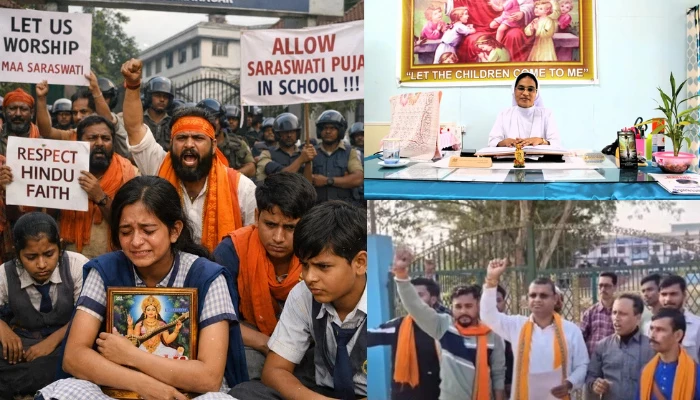
Case Summary
In Sakhaibari, Dharmanagar, Holy Cross Convent School denied Hindu students the opportunity to celebrate Hindu religious rituals associated with Saraswati Puja. Activists from the Vishwa Hindu Parishad approached Holy Cross Convent School on 16 January seeking permission to observe Basant Panchami on the school premises on behalf of Hindu students enrolled at the institution. The VHP visited the school again on 22 January to reiterate the request. At the time, more than 70 per cent of the students enrolled at the school belonged to the Hindu community and wished to observe the festival. The request was made to respect the religious faith and cultural traditions of the students and was not intended to create religious divisions. The school administration rejected the request, thereby prohibiting Hindu students from performing their religious rituals on the school campus. Following the denial of permission, members of the Vishwa Hindu Parishad organised a demonstration in front of Holy Cross Convent School in Sakhaibari, Dharmanagar, demanding that Saraswati Puja, the Hindu festival dedicated to the goddess of knowledge, be permitted on campus. Parents of Hindu students also joined the protest and requested that the school authorities allow Saraswati Puja celebrations within the school. During the protest, parents surrounded the principal to press their demand. Despite this, the school administration continued to deny permission for the celebration, which escalated the situation. As tensions rose, police forces were deployed. The police intervened, and the situation was eventually stabilised through discussions between the school administration and local authorities. The incident highlighted the ongoing tension between institutional policies, religious sentiments, and administrative decision-making within educational institutions.
Why it is Hate Crime ?
There are two primary categories selected in the case, the first is: Restriction/ban on Hindu practices. The sub-category selected is: Restriction on expression of Hindu identity. An example of the state-affected prejudicial and targeted orders against the Hindu community would be a government denying the right of a Hindu or a group of Hindus to hold a religious procession owing to the animosity of non-Hindu groups. Denial of the religious right of the Hindus to assuage the non-Hindu group, which harbours animosity to a point where it could lead to violence against Hindus, is not only a failure of law and order but is a prejudicial order against Hindus, denying them their fundamental rights to express their religious identity. An example of a hate crime against Hindus by a non-Hindu would be a non-Hindu institution forcing its Hindu employees to abandon religious symbols that a Hindu would wear as an expression of faith owing to inherent prejudice against the faith professed by the victim or a non-Hindu group of people restricting a Hindu group from constructing a place of worship simply because the demography of the area in which the temple is being built is dominated by non-Hindus. Such actions are driven by religious animosity and/or prejudice against Hindus and their faith and would therefore be categorised as a hate crime. The second primary category selected is: Predatory proselytisation. The sub-category selected is - Proselytisation by grooming, brainwashing, manipulation or subtle indoctrination. Tertiary is: a pattern of targeting Hindus. Religious brainwashing essentially means the often subtle and forcible indoctrination to induce someone to give up their religious beliefs to accept contrasting, regimented ideas. Religious grooming or brainwashing also involves propaganda and manipulation. It involves the systematic effort, driven by religious malice and indoctrination, to persuade “non-believers’ to accept allegiance, command, or doctrine to and of a contrasting faith. Cases of such grooming or brainwashing are far more nuanced than direct threats, coercion, inducement and violence. In such cases, it is often seen that there is repeated, subtle and continual manipulation of the victim to induce disaffection towards their own faith and acceptance of the contrasting faith of the perpetrator. While subtle indoctrination is widely acknowledged as predatory, an element which is often understated in such conversions or the attempts of such conversion is the role of loyalty and trust which might develop between the perpetrator and the victim. Fiduciary relationships are often abused to affect such religious conversion. For example, an educator transmitting religious doctrine of a competing faith to a Hindu student. The Hindu student is likely to accept what the teacher is transmitting owing to the existence of the fiduciary relationship. The exploitation of the fiduciary relationship to religiously indoctrinate victims would also be included in this category. Since the underlying animosity towards the victim’s faith forms the basis of predatory proselytisation, such cases are considered religiously motivated hate crimes. In this case, the refusal went beyond a routine administrative choice and directly interfered with the ability of Hindu students to practise their faith. Saraswati Puja is not a cultural pastime but a central religious observance closely tied to learning, students, and worship. By denying permission to observe it within the school, the institution effectively blocked Hindu students from engaging in a core expression of their religion in the very space where they spend most of their formative hours. For minor students, religious practice within a school environment depends entirely on institutional permission. When that permission is withdrawn, the consequence is not symbolic but practical. It functions as a complete ban on religious expression during school hours. Hindu students were placed in a situation where their faith had to be kept out of sight in order to continue their education, sending a message that their religious identity was unwelcome or inconvenient. Schools play a powerful role in shaping identity, especially for children. Saraswati Puja has traditionally been observed in educational institutions across India because of its direct connection to learning and reverence for the goddess of knowledge. In this instance, the proposed celebration was peaceful, student-led, and reflective of the beliefs of the majority of students, with more than seventy per cent being Hindu. There was no evidence of coercion, disruption, or imposition on others. Despite this, the administration enforced a blanket prohibition. The effect was collective and unequal. Hindu students, as a group, were denied the dignity of practising their faith in a setting where other aspects of their identity were permitted. Being told that their religious observance could not exist within the school environment caused distress, exclusion, and a sense of humiliation, particularly because these students were minors dependent on authority figures. Such restrictions at a young age have long-term consequences. When children are repeatedly prevented from practising their faith or made to feel that their beliefs are problematic or unacceptable, they begin to disengage. Over time, this enforced distancing weakens their connection to their religious identity. In vulnerable settings, this loss of attachment can later make children more susceptible to external influence, pressure, or inducement to abandon their faith altogether. Although the decision was framed as administrative, its real impact was the suppression of Hindu religious practice within an educational institution. The denial, its collective effect on Hindu students, and the psychological pressure it created establish that this incident was not neutral. It involved discriminatory restriction of Hindu religious expression and therefore warranted inclusion in the Hinduphobia Tracker.


Case Status
Unknown


Perpetrators Details
Perpetrators
Christian Extremists
Perpetrators Range
One Person
Perpetrators Gender
unknown
 Sources




