Saraswati Puja celebration disrupted by TMC factional fight in Cooch Behar; devotees forced to flee for their safety
 Cooch Behar, West Bengal, India
  22 January, 2026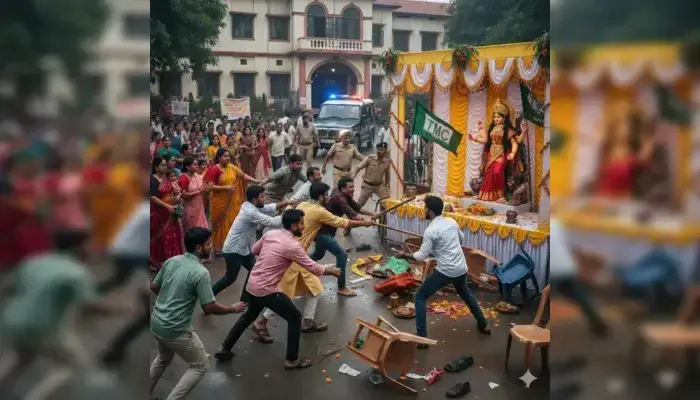
Case Summary
A Saraswati Puja celebration was disrupted at the Dinhata College in the Cooch Behar district of West Bengal by Trinamool Congress (TMC) factions fighting with each other. This resulted in Hindu devotees fleeing for their lives and desecrating the festival's sanctity as a whole. According to media reports, this incident occurred on Friday, 23 January 2026. The Saraswati Puja Mandap was abandoned after infighting broke out between two factions of the ruling Trinamool Congress party. Hindu devotees, who went to attend the Puja festivities, were forced to flee for their safety and security. Visuals captured from the site showcased how the college campus was turned into a battlefield by the ruling Trinamool Congress goons. The police were later called in to maintain law and order. On learning about the matter, the in-charge of Dinhata police station and the Sub-Divisional Police Officer reached the college campus. Notably, Saraswati Puja, also known as Vasant Panchami, is one of the most celebrated Hindu festivals that honours Goddess Saraswati, the Hindu deity of knowledge, wisdom, music, arts, and learning. This festival, marking spring's arrival, symbolises renewal, intellectual growth, and new educational beginnings, with rituals like placing books and instruments before her idol for blessings. It holds deep cultural importance in India, especially for students and artists seeking success, often featuring the Aksharabhyasa rite to initiate children into learning.
Why it is Hate Crime ?
This case is being added to the tracker under the primary category- Attack on Hindu religious representations. The subcategory selected is- Defiling religious customs. Sanatan Dharma is not a religion of one book, which is to say that while it has religious scriptures that form the central tenets of the faith, there are several traditions followed through thousands of years, mostly passed from generation to generation orally. There are several such customs and traditions that are followed by various Hindus and Hindu sects. Defiling of these traditions and customs is a breach of an individual or group’s religious practices. Such practices can range from dietary restrictions like not eating non-vegetarian food for a certain period of the year, not eating non-vegetarian food at all, not eating beef since the cow is considered holy in Hinduism, the sanctity of religious customs followed in the house (like many ISCKON devotees), etc. Any malicious action leading to the breach of such traditions or defilement of these traditions owing to animosity towards the faith or for the sake of activism stems not only from the lack of faith in the religion itself but also from disregard for the faith of the devotees who follow the customs/traditions and implicit bias against the faith, the tradition itself. Since these specific traditions are central to the faith of the devotees of that specific sect of Hindus, any non-compliance with these traditional rules would be considered a religiously motivated hate crime. This case constituted a clear instance of a religiously motivated hate crime, as Trinamool Congress party members' internal fights led to the disruption of a Saraswati Puja celebration at the Dinhata College in Cooch Behar, forcing devotees to flee for their lives and desecrating the festival's sanctity. Saraswati Puja ranks among Hinduism's most revered festivals, dedicated to Goddess Saraswati, the embodiment of knowledge, wisdom, music, arts, and learning. Devotees invoke her blessings through solemn rituals, prayers, and offerings in sacred temples, mandaps and pandals, seeking intellectual growth, creative inspiration, and prosperity for their families, particularly children embarking on education. Any act disrupting this festival directly denies Hindus their right to worship, assaults the sanctity of the festival and its rituals, and inflicts profound emotional pain on the Hindu community, who cherish this auspicious occasion as a cornerstone of their faith. The violent clashes turned the college campus into a battlefield, forcing Hindu devotees to flee the mandap in fear, robbing them of spiritual solace and religious joy during one of their holiest celebrations. Hindu families gathered for veneration found themselves scattered and traumatised, their devotional fervour shattered by the chaos caused by the TMC. This deliberate transformation of a sacred space into a political warzone can be equated to a vicious attack on Hindu religious practice, humiliating devotees through targeted desecration of worship and manifesting as a hate crime. Even though the incident stemmed from internal Trinamool Congress feuds, the deliberate choice to target a Saraswati Puja celebration raised important questions about institutional bias. Why did political rivals within the Trinamool Congress select a sacred Hindu festival as their battleground, rather than neutral venues? Why did the ruling party in West Bengal allow a revered religious event to become collateral damage in their power struggle? This selective targeting exposed the internal feud and fight as a mere pretext for disrupting Hindu worship, revealing entrenched animosity against Hindu festivals. As the state's governing party, Trinamool Congress bore responsibility for this institutionalised prejudice, transforming political squabbling into religiously motivated hostility that demanded accountability. Additionally, over the past several years, a disturbing pattern emerged in West Bengal where Hindus, their festivals, and their faith were targeted under Trinamool Congress rule. This targeting is institutionalised under the leadership of Chief Minister Mamata Banerjee, whose government stood accused of deliberately shielding anti-Hindu elements while clamping down on Hindu rights. Increasing instances arose where the state actively suppressed Hindu religious expression. Hindus were arrested simply for chanting "Jai Shri Ram", a phrase vilified by the administration and the ruling party. Permission for Hindu processions, especially during festivals like Ram Navami or Hanuman Jayanti, was routinely denied on grounds of "law and order concerns", while Muslim religious gatherings faced no such hurdles. Moreover, over the years, the Mamata-led government issued numerous prejudicial directives, such as orders restricting Durga Puja immersions citing Muharram processions. Inaction followed anti-Hindu mob violence in areas like Dhulian, Islampur, Murshidabad and Kaliachak. Public endorsements and appeasement of radical Muslim clerics and Islamist leaders occurred, while concerns raised by Hindu groups were dismissed as "communal provocation". The systematic suppression of Hindu voices and faith, and criminalisation of Hindu identity expressions such as "Jai Shri Ram", reflected not just administrative failure but deeper ideological hostility towards the Hindu community. Altogether, this showcased that this attack, disrupting a Hindu festival, Saraswati Puja, and forcing Hindu devotees to flee in fear, amounted to a clear instance of a religiously motivated offence. Therefore, this case was added to the hate crime database of the Hinduphobia Tracker.


Case Status
Unknown


Perpetrators Details
Perpetrators
State and Establishment
Perpetrators Range
Unknown
Perpetrators Gender
unknown
 Sources




