Saraswati Puja banned by school authorities over application of abir in Katihar, Bihar
 Katihar, Bihar, India
  23 January, 2026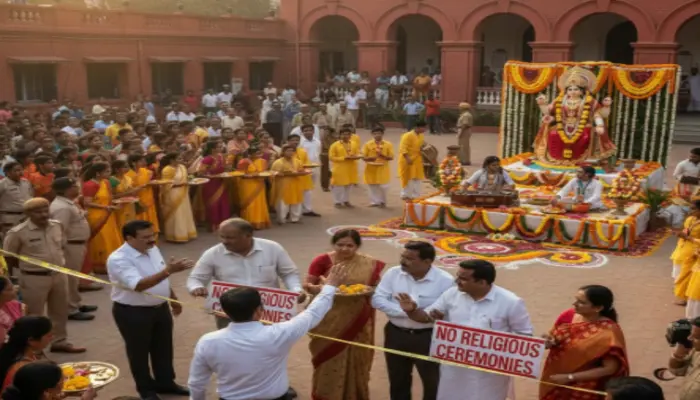
Case Summary
In Bindtoli of Katihar district, Bihar, Saraswati Puja celebrations were prohibited by the school authorities after a teacher named Shahil Kumar objected to the ritual application of abir to him. Saraswati Puja had been a recurring annual practice at the upgraded middle school in Bindtoli, located under Sohtha Southern Panchayat in the Falaka police station area. In 2026, the school authorities prohibited the Saraswati puja celebration following an incident during the 2025 Saraswati idol immersion, when a teacher, Shahil Kumar, had abir (traditional coloured powder used in Hindu religious rituals) applied to him by students. Subsequently, at his request, the school staff and the principal, Laxman Mandal, decided to ban the observance of Saraswati Puja at the institution. This decision resulted in Hindu devotees facing difficulty in offering prayers to Goddess Saraswati, forcing many to travel to nearby locations to perform the ritual. The situation escalated into protests near the school premises, prompting intervention by Falaka Police Station officer Ravi Kumar Rai and village head representative Amit Gupta. They arrived at the site and worked to calm the agitated crowd. Local representatives, including deputy head Pawan Kumar Singh and ward member Upendra Mandal, along with villagers Shyamlal Mahato, Tuntun Sah, Shekhon Mahato and Jairam Mahato, demanded that the school administration ensure the proper organisation of Saraswati Puja every year. The school’s principal, Laxman Mandal, acknowledged fault in the handling of the matter and assured the gathering that formal worship of Goddess Saraswati would resume annually from the following year, after which tensions subsided.
Why it is Hate Crime ?
This case is being added to the tracker under the primary category- Restriction/ban on Hindu practices. The subcategory selected is- Restriction on expression of Hindu identity. An example of the state-affected prejudicial and targeted orders against the Hindu community would be a government denying the right of a Hindu or a group of Hindus to hold a religious procession owing to the animosity of non-Hindu groups. Denial of the religious right of the Hindus to assuage the non-Hindu group which harbours animosity to a point where it could lead to violence against Hindus is not only a failure of law and order but is a prejudicial order against Hindus, denying them their fundamental rights to express their religious identity. An example of a hate crime against Hindus by a non-Hindu would be a non-Hindu institution forcing its Hindu employees to abandon religious symbols that a Hindu would wear as an expression of faith owing to inherent prejudice against the faith professed by the victim or a non-Hindu group of people restricting a Hindu group from constructing a place of worship simply because the demography of the area in which the temple is being built is dominated by non-Hindus. Such actions are driven by religious animosity and/or prejudice against Hindus and their faith and would therefore be categorized as a hate crime. The other sub-category selected is- Administration restricting religious practice. In several cases, it is seen that the administration/state disallows a religious practice owing to prejudicial orders and concerns, targeted specifically against the Hindu community. Such restriction/prohibition would be considered documented as a hate crime because the orders are often a result of pressure by groups that harbour animosity towards Hinduism and Hindus. Often, the restriction by the authorities is driven by bias, hostility, or prejudice against the specific community being stopped from holding a religious practice, by pressure groups that harbour animosity towards Hindus, intrinsic to their faith. Since practices are intrinsic to the faith of the Hindus, such prejudicial restriction is considered a curtailing of the fundamental rights of the Hindu community. In several cases, for example, the authorities ban a Hindu religious practice due to pressure from groups opposed to the religion. In other instances the prohibition is selectively enforced against one religious group (Hindus) while others are allowed to proceed. There are still other cases where the authorities preemptively restrict a religious practice by Hindus because those who hold animosity towards Hindus may get “provoked” leading to them being violent, thereby assuaging the sentiments of those who hold animosity towards Hindus by curtailing the religious rights of Hindus. Such acts and orders are prejudiced, indicating discriminatory motives owing to the capitulation to groups that harbour animosity towards Hindus and therefore, would be categorized as a religiously motivated hate crime since the original pressure leading to the order itself is a result of hatred/bias/prejudice/religious hate against Hindus. This incident constituted a clear instance of religiously motivated discrimination against Hindu students and devotees, as the celebration of Saraswati Puja was entirely prohibited at the upgraded middle school because of the personal displeasure of a teacher. Saraswati Puja is a sacred Hindu festival dedicated to Goddess Saraswati, the deity of knowledge, wisdom, learning, music, and the arts, and is especially significant in educational institutions where students traditionally seek divine blessings for academic growth. It holds deep cultural importance in India, especially for students and artists seeking success, often featuring the Aksharabhyasa rite to initiate children into learning. The outright prohibition of this festival disrupted a long-standing religious practice and directly interfered with the public expression of Hindu faith within the school. The prohibition stemmed from an incident during the 2025 Saraswati idol immersion, when some students applied abir, a traditional coloured powder used as part of ritualistic celebration in Hindu festivals, to teacher Shahil Kumar. The application of abir is a customary and benign religious gesture symbolising reverence, festivity, and communal participation, particularly during Saraswati Puja. However, rather than addressing the issue through proportionate or reasonable measures, such as instructing students not to apply abir to staff members, setting clear boundaries, the teacher chose to escalate the matter by banning the Saraswati puja entirely. The teacher could have attempted to find a middle ground that respected both personal comfort and the religious practice of devotees and teachers alike, but the teacher escalated the minor issue. This decision to ban Saraswati puja went far beyond resolving a minor interpersonal discomfort and instead resulted in the collective punishment of Hindu students and devotees, depriving them of their right to observe a religious festival. The complete prohibition of the celebration reflected a disproportionate response that effectively erased Hindu religious expression from the school space. The manner in which the festival was prohibited demonstrated religious animosity, as the school staff chose suppression and prohibition over accommodation. If the concern was genuinely about personal boundaries or professional decorum, a limited and reasonable restriction would have sufficed. Instead, the blanket ban on Saraswati Puja revealed an intolerance towards the festival itself, rather than any specific act associated with it. Such an approach conveyed the message that Hindu rituals were unwelcome and that the sentiments of Hindu students were secondary to administrative convenience. Taken together, the facts of this case demonstrated that the discontinuation of Saraswati Puja was not a neutral administrative decision but one that stemmed from intolerance towards a Hindu religious tradition. The refusal to seek a reasonable compromise and the decision to prohibit the festival entirely amounted to discriminatory treatment of Hindu religious expression. Therefore, this case has been added to the hate crime database. Disclaimer: Although school authorities were involved in the banning of Saraswati Puja, only two individuals, the principal and the teacher, were explicitly named in available reports. Accordingly, the number of perpetrators has been recorded as two, based solely on identifiable individuals mentioned by name. Disclaimer: The Hinduphobia Tracker records incidents based on when an event occurred or when the victim's ordeal began. It is important to clarify that none of the media sources covering this case has specified the exact date when the Sarawasti puja was banned. Therefore, for documentation purposes, we have recorded the date based on when the incident was reported in the media, 24 January 2026.


Case Status
Unknown


Perpetrators Details
Perpetrators
Others
Perpetrators Range
From 2 To 5
Perpetrators Gender
male
 Sources




