Saraswati Puja disrupted in Hajipur, Bihar; police intervened, banned the DJ and halt the Aarti
 Hajipur, Bihar, India
  23 January, 2026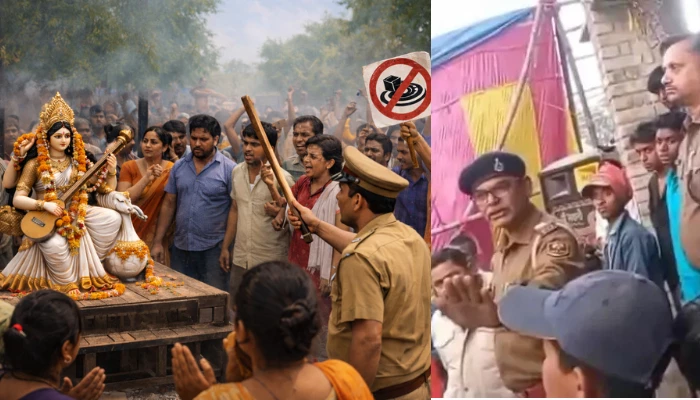
Case Summary
In Hajipur, Bihar, religious observance during Saraswati Puja was disrupted following the intervention of the local police station chief, leading to protests by villagers. According to reports, in Ward No. 7 of Teknari Panchayat in Vaishali district, the police station chief arrived at the Saraswati Puja pandal during the aarti and ordered that the DJ be stopped. Committee members and Hindu devotees stated that no DJ was playing at the time; however, the police action resulted in the aarti being halted, causing distress and anger among those present. The incident triggered strong resentment among local residents, following which hundreds of villagers gathered at the pandal and surrounded the police personnel in protest. Villagers held the police station chief responsible for escalating the situation through what they described as unnecessary interference in a religious ceremony. As a mark of protest, villagers announced that they would not proceed with the immersion of the Saraswati idol until their grievances were addressed. Amid the growing crowd and rising tension, the police vehicle eventually left the scene. While the administration cited the government-imposed ban on DJs as the rationale for the action, villagers maintained that the enforcement was unjustified in this instance and amounted to an unwarranted disruption of a peaceful religious observance.
Why it is Hate Crime ?
This case is selected under the primary category of Restriction/ban on Hindu practices, the sub-category selected is: 'Administration disallows religious procession', and the tertiary category selected is: 'Religious procession'. In several cases, it is seen that the administration/state disallows a religious procession owing to prejudicial orders and concerns, targeted specifically against the Hindu community. Such restriction/prohibition would be considered documented as a hate crime because the orders are often a result of pressure by groups that harbour animosity towards Hinduism and Hindus. Often, the restriction by the authorities is driven by bias, hostility, or prejudice against the specific community being stopped from holding a religious procession, by pressure groups that harbour animosity towards Hindus, intrinsic to their faith. Since the religious procession is inherent to the faith of the Hindus, such prejudicial restriction is considered a curtailing of the fundamental rights of the Hindu community. In several cases, for example, the authorities ban a Hindu religious procession due to pressure from groups opposed to the religion. In other instances, the prohibition is selectively enforced against one religious group (Hindus) while others are allowed to proceed. There are still other cases where the authorities preemptively restrict a religious process by Hindus because those who hold animosity towards Hindus may get “provoked”, leading to them being violent, thereby assuaging the sentiments of those who hold animosity towards Hindus by curtailing the religious rights of Hindus. Such acts and orders are prejudiced, indicating discriminatory motives owing to the capitulation to groups that harbour animosity towards Hindus and therefore, would be categorised as a religiously motivated hate crime since the original pressure leading to the order itself is a result of hatred/bias/prejudice/religious hate against Hindus. The second sub-category selected is: 'Restriction on expression of Hindu identity' An example of the state-affected prejudicial and targeted orders against the Hindu community would be a government denying the right of a Hindu or a group of Hindus to hold a religious procession owing to the animosity of non-Hindu groups. Denial of the religious right of the Hindus to assuage the non-Hindu group, which harbours animosity to a point where it could lead to violence against Hindus, is not only a failure of law and order but is a prejudicial order against Hindus, denying them their fundamental rights to express their religious identity. An example of a hate crime against Hindus by a non-Hindu would be a non-Hindu institution forcing its Hindu employees to abandon religious symbols that a Hindu would wear as an expression of faith owing to inherent prejudice against the faith professed by the victim or a non-Hindu group of people restricting a Hindu group from constructing a place of worship simply because the demography of the area in which the temple is being built is dominated by non-Hindus. Such actions are driven by religious animosity and/or prejudice against Hindus and their faith and would therefore be categorised as a hate crime. This case was included in the Hinduphobia Tracker because Hindu devotees’ religious observance during Saraswati Puja was disrupted through disproportionate police intervention, resulting in the denial of the Hindu community’s right to peacefully practise and complete a Hindu religious ceremony. During aarti, the use of a loudspeaker or sound system is integral to the ritual, as it allows the aarti hymn to be heard clearly by all devotees present in the pandal. This enables collective participation, synchronised prayer, and the proper performance of the ritual. The playing of the aarti through speakers is a functional and devotional necessity rather than a form of entertainment. In this instance, the police station chief arrived at the Saraswati Puja pandal during the aarti and ordered that the DJ be stopped. Committee members and Hindu devotees stated that no DJ was playing at the time the police chief arrived. Despite this clarification, the aarti was halted by the Police chief. The decision to stop the ritual without verification or consideration of the devotees’ explanations conveyed a conclusive approach that prioritised interruption over engagement. The conduct created the impression that the objective was the cessation of the aarti itself, irrespective of the factual situation on the ground. Regulatory enforcement is ordinarily addressed through verification, dialogue, or proportionate instruction. Instead, the intervention escalated directly into the suspension of a sacred ritual, causing distress and anger among devotees engaged in worship. The response bore no proportion to the stated concern and resulted in the immediate disruption of Hindu religious practice. The disruption produced collective harm to the community. Hundreds of villagers gathered at the pandal in protest and held the police station chief responsible for unnecessary interference in a religious ceremony. As a mark of protest, devotees refused to proceed with the immersion of the Saraswati idol, an essential and inseparable component of Saraswati Puja. Although the administration cited a general ban on DJs as justification, the enforcement in this case obstructed a peaceful Hindu religious observance that was already in progress. The action effectively penalised the community for conducting a public religious ceremony and created a chilling effect on the free and safe expression of the Hindu faith. By halting the aarti, triggering unrest, and preventing the timely immersion of the idol, the intervention denied devotees the full observance of a major Hindu festival. The impact extended beyond individual inconvenience and amounted to collective interference with religious life. In conclusion, the use of a routine enforcement rationale to interrupt a core Hindu ritual, the refusal to accommodate or verify devotees’ explanations, and the disproportionate escalation that led to the suspension of worship collectively demonstrated institutional insensitivity towards Hindu religious practice. The incident met the criteria for classification as a hate-motivated interference with Hindu religious expression and was therefore included in the Hinduphobia Tracker.


Case Status
Unknown


Perpetrators Details
Perpetrators
State and Establishment
Perpetrators Range
From 2 To 5
Perpetrators Gender
male
 Sources




