Hindu devotees attacked during Saraswati Puja procession by Muslim mob; houses vandalised in Jharkhand
 Lohardaga, Jharkhand, India
  24 January, 2026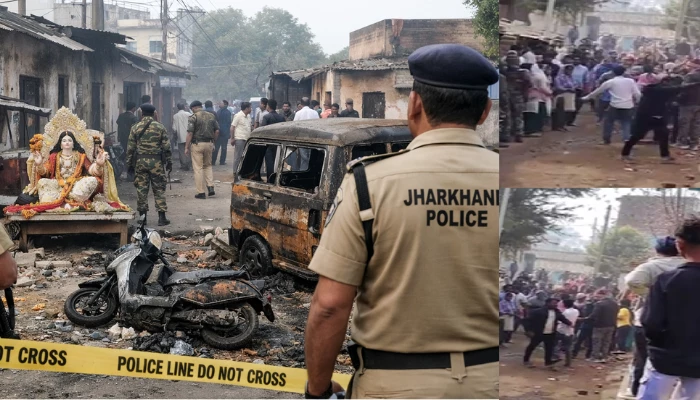
Case Summary
Hindu devotees were attacked during the immersion of the Saraswati puja procession by a Muslim mob in Baridih village, under the Kudu police station area of Lohardaga, Jharkhand. Violence erupted after the vehicle carrying the Saraswati idol slightly touched the roof of the house of a Muslim family. As per reports, on 25th January, Hindu devotees were taking out the jhanki (idol procession) of Maa Saraswati through the village. Unknowingly, the vehicle carrying the idol slightly touched the roof of a Muslim house. Following this, the Muslim family and their local co-religionists gathered and assaulted the driver. By early morning, the situation escalated into widespread clashes, with Hindu residents and their houses coming under attack. Three people were injured during the ensuing violence and were undergoing treatment at a local hospital at the time of documenting this incident. Upon receiving the information, police from the Kudu police station and a bike squad from the Border Security Force arrived at the scene, successfully bringing the situation under control. Authorities stated that strict monitoring and additional forces were deployed to prevent further escalation.
Why it is Hate Crime ?
This case has been added under the primary category of Attack not resulting in death. The subcategory selected under this is 'Attack against Hindu devotees'. Hindu devotees are a few of the easiest targets of religiously motivated hate crimes because, during the festival/procession/puja, etc., for non-Hindus, it is easy to profile their victims based on religion. Hindu devotees come under attack on several occasions by individual non-Hindus or mobs of non-Hindus owing to their animosity against Hinduism, its symbols and tradition/practices. There are several instances of Hindu devotees being attacked while they worship in temples or temporary religious structures, during religious processions, doing bhajan/kirtan/puja in their own homes, in the residential society, etc. These attacks are perpetrated by non-Hindus primarily because of their animosity towards Hindus and their faith. In some cases, the trigger for the violence may be non-religious; however, two elements make these hate crimes. First, the Hindus who come under attack are attacked violently while indulging in religious activity. Whether they are in a place of worship or not is immaterial to the crime. When individuals are attacked while indulging in religious practices, the attack in itself is a hindrance to their freedom to practice religion and therefore constitutes a hate crime. Secondly, religious supremacist doctrines and ideologies deem religious practices of Hindus to be offensive ab initio since they are considered “sinful” by these ideologies, worthy to be annihilated by force or coercion. Driven by these religious supremacist ideologies and doctrines, the attacks against Hindu devotees stem from intrinsic animosity towards Hinduism. In some cases, the trigger for the violence may be non-religious; however, it develops into a religiously motivated crime during the course of the violence. Since these attacks stem from animosity towards Hindus and Hinduism, they are considered religiously motivated hate crimes under this category. The second sub-category selected is : Attack on religious procession The outward celebration and display of religious symbols in an intrinsic part of Hinduism. Religious processions on various festivals are age-old traditions and a way to manifest faith and form a part of the religious practices of Hindus. On several occasions, such religious processions come under attack by non-Hindu mobs, in a manifestation of their animosity towards Hinduism and their practices. The reasons cited for such violent attacks are many and range from crossing a non-Hindu resident-dominated area to playing loud music, crossing from an area where there is a religious structure of another faith etc. The violent attacks are triggered by the outward display of religiosity by Hindus. The attacks are mainly a manifestation of religious supremacist doctrine which believes that idolatry, essentially the Hindu faith, is one that deserves to be annihilated since the very tenets of Hinduism, its practices and traditions, are considered a sin in those doctrines. Since these attacks emanate from intrinsic and doctrinal animosity towards Hindus and Hinduism, it is considered a religiously motivated hate crime under this category. This case was included in the Hinduphobia Tracker because Hindu devotees were attacked while peacefully participating in a Saraswati Puja immersion procession. The violence was triggered by a minor, inadvertent mistake, the vehicle carrying the idol briefly touching the roof of a nearby house. Such a routine mishap would normally be resolved through apology, compensation, or local mediation. Instead, it was treated as a pretext for mob aggression, revealing that the underlying driver was not the small incident itself but hostility toward Hindu religious expression. Devotees were injured, homes were assaulted, and the vehicle carrying the idol of Maa Saraswati was damaged. These facts demonstrate an effort to intimidate and disrupt Hindu religious practice. The escalation from an accidental touch to an assault on the driver, followed by wider attacks on Hindu residents and houses, shows disproportionate retaliation and collective punishment of the Hindu community for the public conduct of a Hindu festival. This pattern, where a trivial trigger is used to unleash violence against Hindu worship and Hindu neighbourhoods, reflects entrenched disrespect for Hindu faith and the readiness to respond to Hindu religious activity with force. Saraswati Puja, also known as Vasant Panchami, honours Goddess Saraswati, the Hindu deity of knowledge, wisdom, music, arts, and learning. The festival, which marked the arrival of spring, symbolised renewal, intellectual growth, and new educational beginnings. Devotees performed rituals such as placing books, musical instruments, and educational tools before the idol to seek her blessings. Across India, the festival held deep cultural importance, particularly for students and artists seeking success, and often included the Aksharabhyasa rite, where children were initiated into learning. The immersion of Maa Saraswati’s idol formed an essential part of the celebration, carried out with devotion and reverence, reflecting the community’s commitment to both spiritual and intellectual growth. The attack during the procession directly targeted Hindu religious life at the moment of public worship. Further, the shift from a minor accident to violence against Hindu homes and devotees indicates that the procession itself, and the assertion of Hindu faith in public space, was being challenged through intimidation. By attacking people engaged in sacred rituals and then expanding violence to Hindu homes, the perpetrators sought to instil fear and discourage future public observance. Such attacks are designed not only to harm individuals but to send a community-wide message that Hindu festivals can be disrupted at will and that even a small, unintentional pretext can be used to justify violence. This incident, therefore, aligns with a broader pattern in which Hindu festivals and processions are targeted and disrupted, creating a chilling effect on Hindu religious practice. Furthermore, the choice of Saraswati Puja as the target underscores the depth of hostility. The festival symbolises cultural, educational, and spiritual development, and attacking its immersion procession is an attempt to undermine both the symbolic and lived practice of the Hindu faith. The disruption of the immersion ceremony and the assault on devotees represent a denial of the right to celebrate a major Hindu festival safely and publicly. In conclusion, the disproportionate mob response to a minor inadvertent incident, the assault on devotees, the targeting of Hindu homes and property, and the disruption of a major Hindu religious ceremony collectively indicate religious animosity and intimidation. The incident meets the criteria for classification as a hate crime against Hindus and is included in the Hinduphobia Tracker to document ongoing patterns of anti-Hindu violence. Disclaimer: Although a large number of Hindu devotees were present and affected during the Saraswati Puja procession, only three people were reported injured. Therefore, for the purposes of the Hinduphobia Tracker, the victim count has been recorded as three.
Victim Details
Total Victim
3
Deceased
0
Gender
- Male 0
- Female 0
- Third Gender 0
- Unknown 3
Caste
- SC/ST 0
- OBC 0
- General 0
- Unknown 3
Age Group
- Minor 0
- Adult 0
- Senior Citizen 0
- Unknown 3


Case Status
Unknown


Perpetrators Details
Perpetrators
Muslim Extremists
Perpetrators Range
Unknown
Perpetrators Gender
unknown
 Sources




