Hindu students barred from performing Saraswati Puja in a Muslim majority school in West Bengal; forced to pray on roadside
 Barasat, West Bengal, India
  22 January, 2026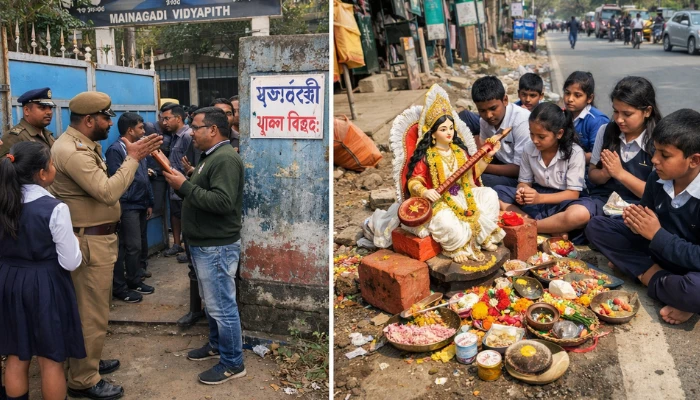
Case Summary
Hindu students were denied entry and barred from performing Saraswati Puja in a Muslim-majority school in West Bengal. According to reports, the school kept the gates closed, barring only Hindu students from entering the premises on the day of Basant Panchami. The incident took place in Moynagadi Free Primary School in West Bengal's North 24 Pargana district. Initially, the Hindu students took permission to celebrate Basant Panchami in the school premises, and the school authorities granted permission to the Hindu students to conduct the puja. However, the following day, the school gates remained closed to the Hindu students, and the permission was withdrawn. The justification provided was that the school had a student population comprising more than 50 per cent Muslims. A video that surfaced on social media showed police officials stopping students from worshipping the deity. Subsequently, Hindu students were compelled to organise Saraswati Puja outside the school premises on the footpath. In the video, a man identified as Pradip Chatterjee was heard saying that the authorities told them the puja could not be conducted because Hindus were considered a minority in the school. Expressing concern over the condition of Hindus in the state, he said there was no difference between the situation faced by Hindus in West Bengal and that of Hindus living in Bangladesh. Condemning the bias on the part of the state authorities, he added that the police had effectively turned away Goddess Saraswati, leaving students with no option but to offer floral tributes to the deity on the roadside. BJP leader Suvendu Adhikari also condemned the incident. In a tweet, he questioned whether West Bengal had turned into Bangladesh and added that the incident illustrated how Hindus would be treated if they became a minority.
Why it is Hate Crime ?
There are two prime categories selected in this case. The first prime category selected in the case is: Restriction /ban on Hindu practices, and the sub-category selected is: Restriction on expression of Hindu identity. An example of the state-affected prejudicial and targeted orders against the Hindu community would be a government denying the right of a Hindu or a group of Hindus to hold a religious procession owing to the animosity of non-Hindu groups. Denial of the religious right of the Hindus to assuage the non-Hindu group, which harbours animosity to a point where it could lead to violence against Hindus, is not only a failure of law and order but is a prejudicial order against Hindus, denying them their fundamental rights to express their religious identity. An example of a hate crime against Hindus by a non-Hindu would be a non-Hindu institution forcing its Hindu employees to abandon religious symbols that a Hindu would wear as an expression of faith owing to inherent prejudice against the faith professed by the victim or a non-Hindu group of people restricting a Hindu group from constructing a place of worship simply because the demography of the area in which the temple is being built is dominated by non-Hindus. Such actions are driven by religious animosity and/or prejudice against Hindus and their faith and would therefore be categorised as a hate crime. The second primary category selected is: Predatory proselytisation. The sub-category selected is - Proselytisation by grooming, brainwashing, manipulation or subtle indoctrination. Religious brainwashing essentially means the often subtle and forcible indoctrination to induce someone to give up their religious beliefs to accept contrasting, regimented ideas. Religious grooming or brainwashing also involves propaganda and manipulation. It involves the systematic effort, driven by religious malice and indoctrination, to persuade “non-believers’ to accept allegiance, command, or doctrine to and of a contrasting faith. Cases of such grooming or brainwashing are far more nuanced than direct threats, coercion, inducement and violence. In such cases, it is often seen that there is repeated, subtle and continual manipulation of the victim to induce disaffection towards their own faith and acceptance of the contrasting faith of the perpetrator. While subtle indoctrination is widely acknowledged as predatory, an element which is often understated in such conversions or the attempts of such conversion is the role of loyalty and trust which might develop between the perpetrator and the victim. Fiduciary relationships are often abused to affect such religious conversion. For example, an educator transmitting religious doctrine of a competing faith to a Hindu student. The Hindu student is likely to accept what the teacher is transmitting owing to the existence of the fiduciary relationship. The exploitation of the fiduciary relationship to religiously indoctrinate victims would also be included in this category. Since the underlying animosity towards the victim’s faith forms the basis of predatory proselytisation, such cases are considered religiously motivated hate crimes. This incident qualified as an act of Hinduphobia, as Hindu students were denied the right to practice their religion within an educational institution solely based on their minority status. It highlighted the exclusion and humiliation of Hindu students during the observance of Saraswati Puja, a sacred Hindu festival dedicated to Goddess Saraswati, the deity of knowledge, learning, and wisdom. The justification provided for the prohibition of Saraswati Puja in the school was explicitly linked to religious demographics. Authorities stated that Hindu students constituted a minority within the school, while more than 50 per cent of the students belonged to the Muslim community. On this basis alone, the performance of Saraswati Puja was not permitted inside the school premises. As a result, the puja was forcibly displaced from the school and ultimately conducted on the roadside pavement adjacent to the institution. By prohibiting Saraswati Puja within the school on the grounds of religious composition, the authorities institutionalised religious discrimination against Hindu students. The denial was not rooted in administrative limitations, public order concerns, or the application of any neutral secular policy. Instead, Hindu religious practice was singled out for exclusion purely because of the students’ minority status within a Muslim-dominated school environment. The involvement of police officials further aggravated the violation, as state machinery was deployed to suppress a peaceful Hindu religious observance. Hindu students, including young children, were compelled to perform Saraswati Puja on a public footpath, an act that amounted to humiliation and symbolic desecration of a revered religious tradition. A sacred ritual associated with learning and reverence was marginalised and publicly displaced, stripping it of dignity. This episode reflected a broader pattern of religious hostility, wherein Hindu practices were delegitimised within institutional and public spaces, reinforcing the notion that Hindu religious expression became unacceptable when Hindus were numerically fewer. Such actions conveyed that Hindu religious rights were conditional rather than equal and protected, thereby undermining the principles of religious equality and freedom. Moreover, for minor students, access to religious practice within an educational setting depended entirely on institutional consent. The refusal, therefore, functioned as an effective ban on the practice of their faith during school hours. Hindu students were placed in a position where their religious identity could not be expressed openly, while being required to continue their education under the same institution. Such restrictions at a young age have long-term consequences. When children are repeatedly prevented from practising their faith or made to feel that their beliefs are problematic or unacceptable, they begin to disengage. Over time, this enforced distancing weakens their connection to their religious identity. In vulnerable settings, this loss of attachment can later make children more susceptible to external influence, pressure, or inducement to abandon their faith altogether. Notably, this was not an isolated incident. A similar targeting occurred in January 2025, when Mohammad Shabbir Ali, then General Secretary of the West Bengal State Trinamool Chhatra Parishad, threatened Hindu students with rape and murder if they attempted to perform Saraswati Puja. The repeated targeting of the same sacred festival, alongside disruptions to other Hindu religious observances, demonstrated a discernible pattern among affiliates of the All India Trinamool Congress aimed at suppressing Hindu religious expression in educational and public spaces. Such acts of intimidation, directed solely at Hindu practices, constituted hate crimes by instilling fear, promoting enmity, and eroding the community’s right to cultural observance. Over several years, a disturbing pattern had emerged in West Bengal, where incidents targeting Hindus, their temples, and festivals were either downplayed or allegedly enabled by the state administration. This targeting appeared increasingly institutionalised under the leadership of Chief Minister Mamata Banerjee, whose government stood accused of shielding anti-Hindu elements while clamping down on Hindu religious rights. Hindus were arrested for chanting “Jai Shri Ram”, permissions for Hindu processions during festivals such as Ram Navami and Hanuman Jayanti were routinely denied on grounds of law and order, while comparable restrictions were not applied to Muslim religious gatherings. Additionally, the state had issued prejudicial directives restricting Durga Puja immersions due to Muharram processions and displayed inaction during anti-Hindu violence in areas such as Dhulian, Islampur, and Kaliachak. Public endorsements of radical clerics and the dismissal of Hindu concerns as “communal provocation” further reinforced perceptions of bias. Communal attacks against Hindus were frequently minimised or reframed as non-religious incidents, reflecting systemic institutional prejudice. A glaring example of this pattern was evident in the handling of violence in Murshidabad, Basirhat, Malda, Midnapore, and Uttar Dinajpur. In the Basirhat incident of March 2025, where a Kali temple was vandalised and the idol desecrated, police authorities prematurely dismissed the communal nature of the attack by attributing it to the alleged mental instability of the perpetrator. Similarly, during widespread anti-Hindu violence in Murshidabad and Malda in April 2025, involving arson, looting, and idol desecration, police narratives described the incidents as minor clashes or local disputes, despite eyewitness accounts and video evidence indicating targeted attacks on Hindu homes and temples. Against this backdrop, the decision to prohibit Saraswati Puja at Balai Beria Primary School was not an isolated administrative action but part of a broader and consistent pattern of discrimination against Hindus in West Bengal. The denial of religious expression constituted a direct infringement of constitutional rights guaranteed under Articles 19 and 25 of the Indian Constitution, which protect freedom of expression and the right to practise religion. The cumulative actions of the Mamata Banerjee-led government indicated a politically and religiously motivated agenda that systematically curtailed Hindu cultural identity, fostering an environment in which Hindus increasingly felt marginalised and treated as second-class citizens.


Case Status
Unknown


Perpetrators Details
Perpetrators
Unknown
Perpetrators Range
Unknown
Perpetrators Gender
unknown
 Sources




