Idol of Hindu goddess desecrated by unidentified miscreants on Saraswati Puja in Bangladesh
 Gopalganj District, Bangladesh
  22 January, 2026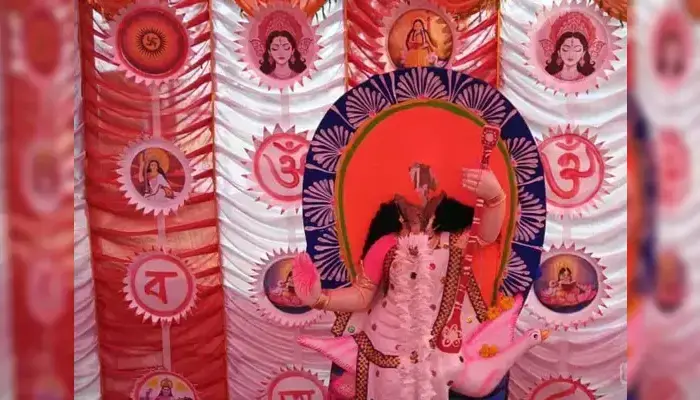
Case Summary
In Muksudpur Upazila of Gopalganj, Bangladesh, an idol of the Hindu goddess Saraswati was desecrated by unknown miscreants. This occurred on 23 January 2026, on the day of the Saraswati Puja, a revered Hindu festival. Saraswati Puja, also known as Vasant Panchami, honours Goddess Saraswati, the Hindu deity of knowledge, wisdom, music, arts, and learning. This festival, marking spring's arrival, symbolises renewal, intellectual growth, and new educational beginnings, with rituals like placing books and instruments before her idol for blessings. It holds deep cultural importance in India, especially for students and artists seeking success, often featuring the Aksharabhyasa rite to initiate children into learning. According to Muksudpur Police Station Officer-in-Charge Abdullah Al Mamun, the incident took place at the public puja pavilion in Paschim Ujan Kandani Para village of Ujani Union of the upazila after the Saraswati Puja. He said that after the Friday (23 January 2026) puja, the worshippers left the temple around midnight. Then some miscreants desecrated the idol by twisting the neck of the Saraswati murti and hanging its head. Locals discovered the matter on 24 January 2026 and informed the police. Upon receiving the news, Muksudpur Circle Assistant Superintendent of Police Nafizur Rahman, Assistant Commissioner (Land) Mohammad Abu Hasnat, along with senior police and administration officials, members of intelligence agencies, and the army, visited the scene. The police official said that the CCTV cameras were removed from the scene before the vandalism. Due to this, the footage was not available. Therefore, it had not been possible to identify those involved in the incident so far. Officer-in-Charge Mamun also said, "The police have taken to the field to identify those involved in this incident. I have asked the temple committee to file a complaint. Once they file a complaint, a case will be filed in this regard." A fresh wave of anti-Hindu violence prevailed across Bangladesh following the death of Sharif Osman Bin Hadi. This escalation occurred against the backdrop of ongoing anti-Hindu violence that had persisted since the ouster of the Sheikh Hasina government in August 2024, during which Hindu homes, temples, and religious spaces were repeatedly attacked, and the Hindu community faced intimidation, arson, and mob attacks. In the aftermath of Hadi’s death, Hindu homes were selectively targeted and set ablaze in multiple localities by Muslim mobs, forcing families to flee and rendering many homeless. The violence was not sporadic but patterned, with Muslim mobs targeting Hindu neighbourhoods, properties, and religious symbols with impunity. One of the many victims of this wave of violence was a Hindu man named Dipu Chandra Das, who was brutally lynched by a Muslim mob over false allegations of blasphemy. Such targeting of innocent Hindus over fabricated charges illustrated the vulnerability of the Hindu minority under conditions of rising communal hostility. Posters and written materials calling for the extermination of Hindus were displayed in public spaces, signalling an alarming normalisation of genocidal rhetoric. Combined with acts of physical violence, arson, and vandalism, these developments demonstrated a coordinated campaign designed to terrorise the Hindu community and assert Islamic dominance. Notably, Sharif Osman Bin Hadi was a Muslim political activist and student leader known for his anti-Hindu and anti-India stance. He was actively involved in the political unrest that followed the fall of Sheikh Hasina’s government and was killed in Dhaka in December 2025 during clashes, after which Hindus were blamed and subsequently targeted.
Why it is Hate Crime ?
This case is being added to the tracker under the primary category- Attack on Hindu religious representations. The subcategory selected is- Desecration of Hindu religious symbols. Icons and symbols or a religious representation of a spiritual ideal are widely revered in Hinduism. Iconography is of vital significance in the Hindu milieu. It helps connect people’s spiritual beliefs with the real world. Iconography within the Hindu faith takes several shapes and forms. Murtis are of most significance to Hindus, to which daily rituals, prayers and offerings are done. Besides the murtis, there are several other symbols which have deep significance in the Hindu faith – the Om and Swastika for example. Since these Hindu religious symbols hold paramount importance in Hinduism, any desecration of symbols, icons, murtis, religious representations and manifestations, is driven by animosity towards the faith itself which manifests itself through these murtis, icons and symbols. Therefore, any desecration of these Hindu religious symbols and representations is considered religiously motivated hate crimes under this category. In this case, the desecration of a revered idol of Goddess Saraswati on Saraswati Puja day by unidentified miscreants reveals the religious motivation behind this hate-driven crime. In Hinduism, idols or murtis are sacred embodiments of the divine, consecrated through elaborate rituals like prana pratishtha to invoke and house the deity's presence, deeply revered by Hindus as tangible links to the divine that inspire devotion, prayer, and spiritual connection in daily worship and festivals. The act of desecrating the sacred idol of Goddess Saraswati during the Saraswati Puja celebration showcases deep-seated religious animosity that the perpetrators held towards the Hindu community and Hindu symbols. Such desecration of sacred symbols is very offensive to the Hindu community and causes deep emotional hurt to them. The fact that this occurred on Saraswati Puja day shows that it was not just a random act of vandalism; the perpetrators intended to desecrate the festival celebrations, target the Hindu community, create disturbance, cause communal tensions, and inflict religious hurt during one of their most revered Hindu festivals. This constitutes a clear instance of an attack on the festival itself, making it a religiously motivated crime. Although the perpetrators' identities remain unknown in this case, the act clearly stems from religious hostility. It demonstrates overt religious animosity, marking it as a hate-driven crime. Consequently, this case has been added to the Hate Crime Database of the Hinduphobia Tracker.


Case Status
Unknown


Perpetrators Details
Perpetrators
Unknown
Perpetrators Range
Unknown
Perpetrators Gender
unknown
 Sources




