Hindu devotees injured after violent stone-pelting during Saraswati idol immersion in Hazaribagh, Jharkhand
 Hazaribag, Jharkhand, India
  23 January, 2026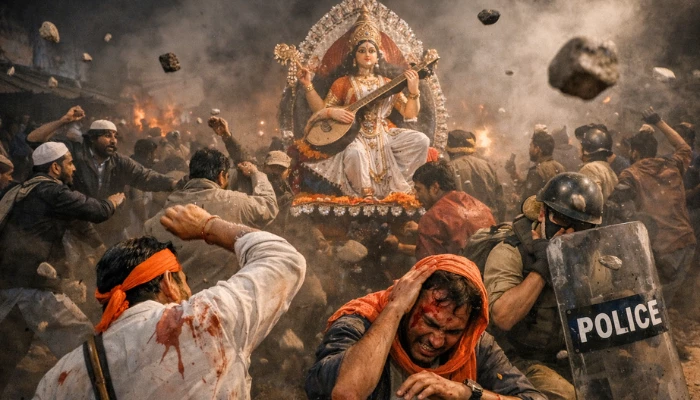
Case Summary
Hindu devotees were attacked with stones by members of the Muslim community while celebrating Saraswati Puja during an idol immersion procession in Beltu village under the Keredari block of Hazaribagh district, Jharkhand. The incident occurred after a scuffle broke out over the playing of music during the procession, which quickly escalated into stone pelting and violence. The incident occurred late on Saturday night, 24 January 2026, when Hindu devotees were engaged in the religious activity and taking out a procession to immerse the idol of Goddess Saraswati. While the procession was passing through the stretch between Beltu Picket and Bazaar Tad, a dispute arose over the playing of Saraswati Puja music. During this time, some members of the Muslim community began pelting stones at the devotees, disrupting the religious event and creating panic. Several Hindu devotees were injured in the initial stone pelting. Some devotees retaliated, following which the situation escalated into a violent clash between the two groups late into the night. The violence resulted in injuries to more than a dozen people, including police personnel who had been deployed to control the situation. Police intervened to bring the unrest under control, and the area was effectively turned into a cantonment. Additional police forces were deployed, and surveillance was intensified to prevent further escalation. Hazaribagh Superintendent of Police Anjani Anjan and Deputy Commissioner Shashi Prakash Singh reached the site late at night to monitor the situation. The injured, including Hindu devotees and policemen, were taken to a local hospital for treatment. After the situation was stabilised, the Deputy Commissioner appealed to the public to ignore rumours and warned that strict action would be taken against those attempting to incite unrest. By the following morning, the situation in Beltu village remained calm. Police continued patrolling the area, and additional security forces remained deployed to ensure peace and prevent any further disturbances.
Why it is Hate Crime ?
The primary category in this case is: Attack not resulting in death. The first subcategory under this is: Attack on a religious procession. The outward celebration and display of religious symbols is an intrinsic part of Hinduism. Religious processions on various festivals are age-old traditions and a way to manifest faith and form a part of the religious practices of Hindus. On several occasions, such religious processions come under attack by non-Hindu mobs, in a manifestation of their animosity towards Hinduism and its practices. The reasons cited for such violent attacks are many and range from crossing a non-Hindu resident-dominated area to playing loud music, crossing from an area where there is a religious structure of another faith, etc. The violent attacks are triggered by the outward display of religiosity by Hindus. The attacks are mainly a manifestation of religious supremacist doctrine, which believes that idolatry, essentially the Hindu faith, deserves to be annihilated since the very tenets of Hinduism, its practices and traditions are considered a sin in those doctrines. Since these attacks emanate from intrinsic and doctrinal animosity towards Hindus and Hinduism, it is considered a religiously motivated hate crime under this category. The Second sub category selected is: 'Attack against Hindu devotees' Hindu devotees are a few of the easiest targets of religiously motivated hate crimes because, during the festival/procession/puja, etc., for non-Hindus, it is easy to profile their victims based on religion. Hindu devotees come under attack on several occasions by individual non-Hindus or mobs of non-Hindus owing to their animosity against Hinduism, its symbols and tradition/practices. There are several instances of Hindu devotees being attacked while they worship in temples or temporary religious structures, during religious processions, doing bhajan/kirtan/puja in their own homes, in the residential society, etc. These attacks are perpetrated by non-Hindus primarily because of their animosity towards Hindus and their faith. In some cases, the trigger for the violence may be non-religious; however, two elements make these hate crimes. First, the Hindus who come under attack are attacked violently while indulging in religious activity. Whether they are in a place of worship or not is immaterial to the crime. When individuals are attacked while indulging in religious practices, the attack in itself is a hindrance to their freedom to practice religion and therefore constitutes a hate crime. Secondly, religious supremacist doctrines and ideologies deem religious practices of Hindus to be offensive ab initio since they are considered “sinful” by these ideologies, worthy to be annihilated by force or coercion. Driven by these religious supremacist ideologies and doctrines, the attacks against Hindu devotees stem from intrinsic animosity towards Hinduism. In some cases, the trigger for the violence may be non-religious; however, it develops into a religiously motivated crime during the course of the violence. Since these attacks stem from animosity towards Hindus and Hinduism, they are considered religiously motivated hate crimes under this category. The third sub-category is: 'Attacked for Hindu identity.' In several cases, Hindus are attacked merely for their Hindu identity without any perceived provocation. A classic example of this category of religiously motivated hate crime is a murder in 2016. 7 ISIS terrorists were convicted for shooting a school principal in Kanpur because they got ‘triggered’ seeing the Kalava on his wrist and the tilak that he had put. In this, the Hindu victim had offered no provocation except for his Hindu religious identity. The motivation for the murder was purely religious, driven by religious supremacy. Such cases where Hindus are targeted merely for their religious identity would be documented as a hate crime under this category. The fourth sub-category is: 'Communal clash/attack.' Communal clash is a form of collective violence that involves clashes between groups belonging to different religious identities. For a communal clash between Hindus and non-Hindus to qualify as a religiously motivated hate crime, the trigger of the violence itself would have to be anti-Hindu in essence. For example, if there is a Hindu religious procession that comes under attack from a non-Hindu mob and after the initial attack, Hindus retaliate in self-defence, leading to a communal clash between the two religious communities. While at a later stage, both communities are involved in the clash/violence, the initial trigger of the violence was by the non-Hindu mob against the Hindus, and therefore, it could safely be termed as an anti-Hindu violence. Further, the trigger would also have to be religiously motivated. In the cited example, the attack by the non-Hindu mob was against religious processions and therefore can be concluded to be religiously motivated. In some cases, the trigger may be non-religious; however, it develops into religious violence against Hindus at a later stage. In such cases, too, the foundational animosity towards Hindus becomes the motivating factor of the crime, and therefore, it would be classified as a religiously motivated hate crime against Hindus under this category. This incident is recorded as a hate crime because the violence was triggered and directed at a Hindu religious activity, with the escalation rooted in hostility toward the public expression of Hindu faith rather than in any neutral dispute. A key religious marker is the context itself. The violence occurred during Saraswati Puja immersion, a sacred Hindu ritual involving collective worship and a public procession. Targeting devotees at the moment of immersion directly interferes with Hindu religious practice and signals intolerance toward Hindu rituals being carried out in shared public spaces. Another critical marker is the nature of the trigger. The dispute arose over the playing of Saraswati Puja music, which is an intrinsic part of the ritual. Objection to devotional music becoming the flashpoint for violence shows that the hostility was tied to the audible and visible presence of a Hindu religious celebration. The immediate resort to stone pelting reflects rejection of the Hindu ritual itself rather than any attempt at peaceful resolution. The escalation also reflects an ideological dynamic in which public display of non-Islamic religious life, particularly Hindu festivals, is treated as provocative. In such environments, assertions of religious dominance operate by policing public space and reacting aggressively to visible Hindu worship. The fact that a routine religious element like festival music triggered violence indicates an underlying belief that Hindu religious expression should be curtailed or subordinated in public life. The communal nature of the clash developed after the initial attack. It is important to note that Hindu devotees responded only after being targeted and did so in self-defence. Their actions were reactive and aimed at protecting themselves from ongoing assault, not at initiating violence. This establishes that the communal escalation was the outcome of an initial, targeted attack on a Hindu religious activity. Stones were hurled at devotees as a group engaged in worship, converting a local disagreement into communal targeting where Hindu identity and participation in a religious ritual became the basis for attack. The resulting injuries, disruption of immersion rites, and heavy police deployment create a chilling effect on Hindu religious life by signalling that public celebration can invite violent reprisal. For these reasons, the case is documented as religiously motivated violence against Hindus. The objection to Saraswati Puja music, the initial stone pelting, the rapid communal escalation, the need for Hindu self-defence, and the ideological hostility toward visible Hindu worship together establish that the violence was driven by animus toward Hindu religious expression and an assertion of religious dominance, rather than by a mere law and order issue.


Case Status
Unknown


Perpetrators Details
Perpetrators
Muslim Extremists
Perpetrators Range
From 10 to 100
Perpetrators Gender
unknown
 Sources




