Hindu villagers lured and converted under the guise of prayer meetings by Christian evangelists in Unnao, Uttar Pradesh.
 Unnao, Uttar Pradesh, India
  21 January, 2026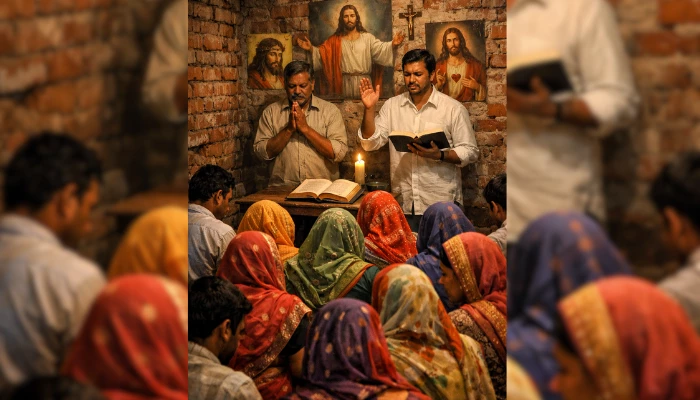
Case Summary
In Maswasi village of Unnao district, innocent Hindu villagers were induced to convert during gatherings presented as prayer meetings organised by Christian evangelists. Incidents relating to the conversion of Hindu villagers surfaced in Maswasi village, Unnao, prompting concern among local residents. Upon receiving information of the incident the Bajrang Dal activists reached at the spot and staged a protest, which led to tension in the area. The activists stated that certain individuals in Maswasi village were attempting to lure Hindu families into religious conversion. They said that such activities had been taking place secretly in the village for a considerable period of time. As per reports, a man named Purushottam filed a complaint in this regard at the Kotwali Sadar police station. In his complaint, he stated that systematic attempts were being made to lure innocent villagers into abandoning their religion. He demanded an impartial investigation into the matter and strict legal action against those responsible. Following this, the police initiated an investigation into the matter. During the preliminary investigation, the police detained two to three individuals and questioned them regarding the purpose of the gathering and whether any conversion-related activities were being conducted. Additional police forces were deployed in the village to maintain peace and prevent any further escalation. Police officials associated with the investigation stated that the matter was sensitive and that every aspect was being examined thoroughly. They said that further legal action would be taken based on the facts that emerged during the investigation. The police also clarified that strict action would be taken against anyone found disturbing communal harmony or disrupting law and order.
Why it is Hate Crime ?
This case has been documented under the selected primary category: Predatory proselytisation. Under this, the selected secondary category is: Proselytisation by grooming, brainwashing, manipulation or subtle indoctrination. Under this, the selected tertiary category is: Pattern of targeting Hindus. Religious brainwashing essentially means the often subtle and forcible indoctrination to induce someone to give up their religious beliefs to accept contrasting regimented ideas. Religious grooming or brainwashing also involves propaganda and manipulation. It involves the systematic effort, driven by religious malice and indoctrination, to persuade “non-believers’ to accept allegiance, command, or doctrine to and of a contrasting faith. Cases of such grooming or brainwashing are far more nuanced than direct threats, coercion, inducement and violence. In such cases, it is often seen that there is repeated, subtle and continual manipulation of the victim to induce disaffection towards their own faith and acceptance of the contrasting faith of the perpetrator. While subtle indoctrination is widely acknowledged as predatory, an element which is often understated in such conversions or the attempts of such conversion is the role of loyalty and trust which might develop between the perpetrator and the victim. Fiduciary relationships are often abused to affect such religious conversion. For example, an educator transmitting religious doctrine of a competing faith to a Hindu student. The Hindu student is likely to accept what the teacher is transmitting owing to existence of the fiduciary relationship. The exploitation of the fiduciary relationship to religiously indoctrinate victims would also be included in this category. Since the underlying animosity towards the victim’s faith forms the basis of predatory proselytization, such cases are considered religiously motivated hate crimes. The other sub- category selected is: Conversion/ attempts to convert by inducement. Predatory Proselytisation is not just limited to threat, harassment, force and violence, but it also has contours of stealth. In several cases, the Hindu victim is exploited to convert, with non-Hindus taking advantage of their poverty. In such cases, the Hindu victim who is suffering financially is offered monetary benefits, including lucrative offers for jobs, health treatment, education, etc, to induce the victim into changing his/her religion. In such cases, the religious identity of the victim and the aim to disenfranchise him from his faith form the heart of the crime. Also, taking advantage of and exploiting an individual’s economic vulnerabilities is widely acknowledged as exploitation, forms of which are often penalised by law. Such cases therefore are considered religiously motivated hate crimes since the victim’s religious identity forms the very heart of the crime itself. This incident was included in the Hinduphobia tracker because it demonstrated a sustained and deliberate pattern in which Hindu villagers, particularly those who were innocent, economically weak, or socially vulnerable, were selectively approached and influenced through gatherings presented as prayer meetings. To begin with, the activities were directed exclusively at Hindus, indicating that religious identity was the primary basis for selection rather than voluntary or neutral engagement. Moreover, the use of prayer meetings as a façade allowed gradual influence to be exerted in a manner that reduced resistance and normalised religious messaging over time. In addition, villagers were reportedly exposed to repeated persuasion through emotional appeal, selective narratives, and promises of personal or spiritual benefit, which cumulatively shaped beliefs and weakened independent judgment. Furthermore, accounts from local residents suggested that these efforts were not isolated but had occurred quietly over an extended period, revealing an organised and repetitive approach focused on a single religious community. As a result, the Hindu villagers experienced fear, confusion, and social tension, while their freedom to retain and practise their faith without pressure was undermined. Taken together, the targeted nature of the activity, its reliance on vulnerability, and its sustained execution reflected a broader pattern of hostility that marginalised Hindus and disrupted communal harmony. Disclaimer: The Hinduphobia Tracker records the date of an incident based on when the crime occurred, rather than when it was subsequently reported in social or mainstream media. In this case, no specific information was available regarding the exact date of the abduction or when the victim’s ordeal began. Therefore, 22 January 2026, the date on which the case was first reported by the media, was used as the indicative date of the incident. Disclaimer: Though references to “villagers” or “families” reflect statements by local residents and organisations indicating that multiple Hindus may have been affected, the exact number of victims in this case has not been specified. In the absence of verified figures, the incident has been documented with a minimum victim count of one; the complainant, Purushottam, as he formally reported being targeted by conversion efforts.
Victim Details
Total Victim
1
Deceased
0
Gender
- Male 1
- Female 0
- Third Gender 0
- Unknown 0
Caste
- SC/ST 0
- OBC 0
- General 0
- Unknown 1
Age Group
- Minor 0
- Adult 1
- Senior Citizen 0
- Unknown 0


Case Status
Complaint filed


Perpetrators Details
Perpetrators
Christian Extremists
Perpetrators Range
From 2 To 5
Perpetrators Gender
male
 Sources




