Idols of Hindu deities desecrated and mocked by man in Odisha ahead of Saraswati Puja celebrations
 Rayagada, Odisha, India
  15 January, 2026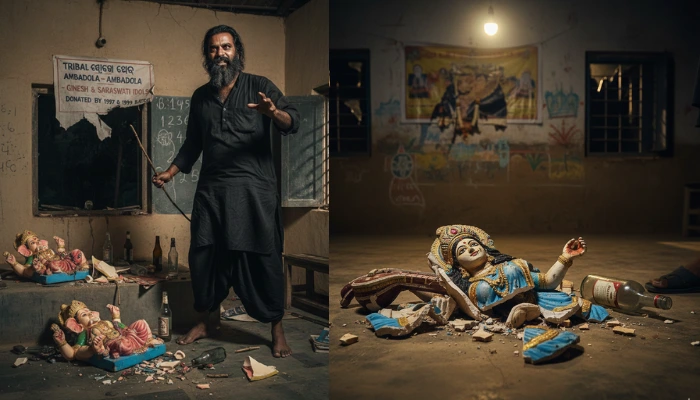
Case Summary
In Ambadola, Rayagada district, Odisha, idols of Hindu deities were mocked and desecrated by a man named M Krishnaraju, a teacher by profession. This occurred just days ahead of Saraswati Puja, a revered Hindu festival, which was to be celebrated on 23 January 2026. According to media reports, this occurred in a tribal school in Ambadola, Rayagada. This school had Ganesh and Saraswati idols donated by former students of the 1999 and 1997 batches. The idols were revered by the students and other staff; however, the teacher M Krishnaraju, who was a drunkard, used to mock those idols and say that they did not know English and did not have any educational qualifications. On the day of the incident, the accused came at night in a drunken state and insulted the idols again, saying they cannot speak English. Then he broke the idols into pieces. The following morning, the other teachers found the broken pieces and then tried to fix them in their proper state. Hindu organisations called this act an insult to the religious sentiments of the Hindu community. Hindu Dharmarakshya Samiti, a Hindu organisation, took serious cognisance of the issue. They filed a police complaint against the teacher and were seeking exemplary punishment against him. At the time of writing this report, the police have initiated an investigation to ascertain the facts surrounding the incident. Further action will be taken based on the findings of the inquiry.
Why it is Hate Crime ?
The primary category selected in this case is- Attack on Hindu religious representations. The subcategory selected is- Desecration of Hindu religious symbol. Icons and symbols or a religious representation of a spiritual ideal are widely revered in Hinduism. Iconography is of vital significance in the Hindu milieu. It helps connect people’s spiritual beliefs with the real world. Iconography within the Hindu faith takes several shapes and forms. Murtis are of most significance to Hindus, to which daily rituals, prayers and offerings are done. Besides the murtis, there are several other symbols which have deep significance in the Hindu faith – the Om and Swastika for example. Since these Hindu religious symbols hold paramount importance in Hinduism, any desecration of symbols, icons, murtis, religious representations and manifestations, is driven by animosity towards the faith itself which manifests itself through these murtis, icons and symbols. Therefore, any desecration of these Hindu religious symbols and representations is considered religiously motivated hate crimes under this category. Another primary category selected is- Hate Speech against Hindus. The subcategory selected is- Anti-Hindu slurs, mocking faith. Anti-Hindu slurs and the deliberate mocking of the Hindu faith owing to religious animosity involve the usage of derogatory terms, stereotypes, or offensive references to religious practices, symbols, or figures. One of the common anti-Hindu slurs used against Hindus is “cow-worshipper” and “cow piss drinker”. The intention of using this term is to demean and mock Hindus as a group and their religious beliefs since Hindus consider the cow holy. Additionally, some symbols and the slurs attached to them have a historical context that exacerbates the insult, hate, stereotyping, dehumanisation and oppression against Hindus. Cow worship has been used for centuries to denigrate Hindus, insult their faith and oppress Hindus specifically as a religious group. There has been overwhelming documentation about how cow slaughter has been used to persecute Hindus with cow meat being thrown in temples and places of worship. There has also been overwhelming documentation where cow meat (beef) has been force-fed to Hindus to either forcefully convert them to Islam or denigrate their faith. Apart from cow worship, the Swastika – which holds deep religious significance for the Hindus – has also been misinterpreted and distorted to use as a slur against Hindus. Similarly, the worship of the Shivling has been used by supremacist ideologies and religions to denigrate Hindus owing to religious animosity. Such slurs and denigration stem out of inherent animosity and hate towards Hindus and their faith, therefore, it is categorised as hate speech targeted at Hindus specifically owing to their religious identity. This case constitutes a clear instance of a religiously motivated offence, as the perpetrator mocked and desecrated the sacred idols of Goddess Saraswati and Lord Ganesha, two revered deities in Hinduism. Hindu idols, known as murtis, represent physical embodiments of the divine, meticulously crafted through rituals known as prana pratishtha to invoke the presence of deities such as Goddess Saraswati and Lord Ganesha. Deeply revered by Hindus, these murtis serve as focal points for worship involving daily offerings of flowers, incense, food, and prayers, symbolising the deity's qualities like wisdom for Saraswati and obstacle-removal for Ganesha, thereby fostering spiritual connection and community devotion. Any act of mocking or desecrating them amounts to a direct assault on the Hindu faith. Motivated by religious animosity, the desecration of these sacred Hindu religious symbols that Hindus hold so dearly showcases the perpetrator's deep-seated, religiously motivated hate towards Hindus and Hindu sacred symbols. Such acts are done to hurt the sentiments of Hindus, making it a religiously motivated crime. Furthermore, the act of mocking these revered idols amounts to hate speech and anti-Hindu slurring because it directly attacks the sacred essence of Hindu worship. By ridiculing their supposed lack of education or English skills, the accused reduces these transcendental symbols to laughable objects, imposing irrelevant metrics on spiritual entities Hindus revere beyond human qualities. This belittles Hindu devotion and constitutes an assault on Hindu faith itself. Such derision perpetuates stereotypes of Hinduism as backward, signalling deep contempt for Hindu identity and provoking distress among devotees. It qualifies as targeted hate speech by intentionally demeaning symbols unique to Hinduism, fostering division and animosity towards the community. The fact that this desecration occurred just days before the Saraswati Puja celebrations on 23 January 2026 underscores that it was no random act of vandalism. Instead, it directly aimed to desecrate idols and create hurdles in the festival's preparations, disrupting religious worship and instilling fear. Such precise timing showcases deep animosity towards the Hindu community and their faith, elevating this to a clear case of a religiously motivated hate crime. Some may claim that the accused acted under the influence of alcohol and that it was not necessarily a hate crime. However, it is important to note that it was not just one instance of demolishing the idol that he committed. He constantly mocked these idols over a long period. This showcases his entrenched hatred, excusing neither this behaviour nor the trope of being an alcoholic or under the influence of alcohol. If that were truly the case for desecrating the idols, why did he only target Hindu idols? He did not target religious symbols of any other faith or anything non-religious for desecration. He selectively chose a Hindu religious symbol for desecration, showcasing his deep-seated hatred for Hinduism and the Hindu community, making it a religiously motivated offence. Since this case meets the parameters of a religiously driven hate crime, it is being added to the Hate Crime Database of the Hinduphobia Tracker. Disclaimer: The Hinduphobia Tracker records incident dates based on when crimes occur, rather than when they are reported by the media. In this case, the media report does not specify the exact date of the crime. Henceforth, 16 January 2026, the date when the media reported this incident, is being selected as the indicative incident date. This date is selected for documentation purposes only.


Case Status
Complaint filed


Perpetrators Details
Perpetrators
Others
Perpetrators Range
One Person
Perpetrators Gender
male
 Sources




