Hindu man found dead in Munshiganj amidst ongoing rampant persecution of Hindus in Bangladesh
 Dhaka Division, Bangladesh
  15 January, 2026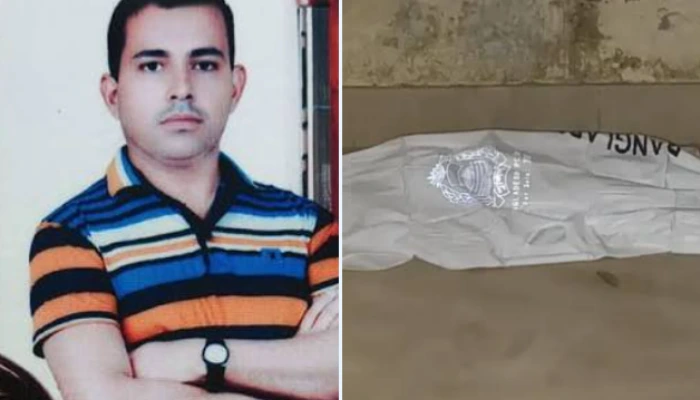
Case Summary
In Gazaria Upazila of Munshiganj, located in the Dhaka Division of Bangladesh, a 33-year-old Hindu man named Joy Chakraborty was found dead floating in a river. This incident came to light when the police recovered the body of the deceased victim, which was floating in the Meghna River. The body was recovered by the naval police from the Dubar Char area of Hossaindi Union of the upazila around 11 am on 21st January 2026. The police said that according to the driving licence found in the deceased's pocket, his name was Joy Chakraborty (33), son of Swadesh Chakraborty of the Thakurpara area of Comilla metropolis. According to local and police sources, the body had been floating in the Meghna River since the morning of 21 January 2026. At that time, a crowd of people gathered to see the body. Later, the local people informed the police and the body was recovered. Regarding the matter, Sharjit Kumar Ghosh, the inspector in charge of Gazaria Naval Police Outpost, told the media, "We recovered the body in the morning after receiving the news. A driving licence was found in his pocket. The name is Joy Chakraborty. It is believed that the body was five days old. The body has decomposed. We have contacted his family members." As per the deceased's elder brother, Nayan Chakraborty, after a minor disagreement with his family, Joy left his mobile phone at home at 8 am on 16 January 2026. Since then, no trace of him could be found. After searching at various places, a complaint was also filed in this regard at the Comilla Kotwali Police Station on 17 January 2026. A fresh wave of anti-Hindu violence prevailed across Bangladesh following the death of Sharif Osman Bin Hadi. This escalation occurred against the backdrop of ongoing anti-Hindu violence that had persisted since the ouster of the Sheikh Hasina government in August 2024, during which Hindu homes, temples, and religious spaces were repeatedly attacked, and the Hindu community faced intimidation, arson, and mob attacks. In the aftermath of Hadi’s death, Hindu homes were selectively targeted and set ablaze in multiple localities by Muslim mobs, forcing families to flee and rendering many homeless. The violence was not sporadic but patterned, with Muslim mobs targeting Hindu neighbourhoods, properties, and religious symbols with impunity. One of the many victims of this wave of violence was a Hindu man named Dipu Chandra Das, who was brutally lynched by a Muslim mob over false allegations of blasphemy. Such targeting of innocent Hindus over fabricated charges illustrated the vulnerability of the Hindu minority under conditions of rising communal hostility. Posters and written materials calling for the extermination of Hindus were displayed in public spaces, signalling an alarming normalisation of genocidal rhetoric. Combined with acts of physical violence, arson, and vandalism, these developments demonstrated a coordinated campaign designed to terrorise the Hindu community and assert Islamic dominance. Notably, Sharif Osman Bin Hadi was a Muslim political activist and student leader known for his anti-Hindu and anti-India stance. He was actively involved in the political unrest that followed the fall of Sheikh Hasina’s government and was killed in Dhaka in December 2025 during clashes, after which Hindus were blamed and subsequently targeted.
Why it is Hate Crime ?
This case has been added to the tracker under the primary category- Attack resulting in death. Within it, the sub-category selected is- Attacked for Hindu identity. In several cases, Hindus are attacked merely for their Hindu identity without any perceived provocation. A classic example of this category of religiously motivated hate crime is a murder in 2016. 7 ISIS terrorists were convicted for shooting a school principal in Kanpur because they got ‘triggered’ seeing the Kalava on his wrist and tilak that he had put. In this, the Hindu victim had offered no provocation except for his Hindu religious identity. The motivation for the murder was purely religious, driven by religious supremacy. Such cases where Hindus are targeted merely for their religious identity would be documented as a hate crime. Under this category, cases where the attack led to the death of the Hindu victim/s would be documented. In this case, a 33-year-old Hindu man named Joy Chakraborty was found dead after going missing for five days, with his body recovered from the Meghna River in the Dubar Char area of Gazaria upazila, Munshiganj, Bangladesh. Although the body showed decomposition with no specific injury marks mentioned and was estimated to be five days old, the circumstances of his sudden disappearance after a minor family disagreement and recovery in a remote river location raised concerns beyond a natural death. While some may argue that the case details do not explicitly state a religious motive, the broader context of anti-Hindu persecution in Bangladesh remains relevant for classification. During periods of sustained violence against Hindus based on religious identity, the Hinduphobia Tracker applies a contextual presumption that attacks on Hindu victims are likely faith-targeted, even when the immediate report does not record a specific religious marker. In such periods, the normalisation of religious hostility and dehumanisation of minorities, particularly Hindus, can contribute to crimes against them without perpetrators openly stating the motive. For the purpose of documenting the 2024 to 2026 ethnic cleansing of Hindus in Bangladesh and the subsequent persecution after the death of Sharif Osman Hadi, the Hinduphobia Tracker records such incidents as likely religiously motivated at the point of entry. If any case is later established through credible investigation or court findings to stem from motivations other than religious hostility, it will be revised or removed from the hate crime database. In this case, the sudden disappearance of a young Hindu man from Comilla and recovery of his decomposed body from the Meghna River aligned with patterns observed in other attacks on Hindu victims during this period, where vulnerable individuals faced unexplained deaths amidst rising communal tensions. This supported the contextual classification of likely religious hostility pending autopsy results or further evidence. The case was documented as likely involving faith targeting, given the victim’s identity and the surrounding pattern of persecution, while remaining open to revision if new facts emerged. Notably, this murder occurred just weeks after a Hindu man, Dipu Chandra Das, was killed by a Muslim mob in Bhaluka town, Bangladesh, on 18 December 2025, following a false blasphemy allegation. When viewed alongside such incidents, the present case is recorded as part of a broader cycle of violence affecting Hindus, reinforcing the contextual presumption applied in this period. Therefore, this case is being recorded in the Hate Crime database of the Hinduphobia Tracker. Disclaimer: The Hinduphobia Tracker records incident dates based on when crimes occur, rather than when they are reported by the media. In this case, since the media report does not specify the exact date of the victim's death, 16 January 2026, the date he went missing is adopted as the indicative incident date solely for documentation purposes.
Victim Details
Total Victim
1
Deceased
1
Gender
- Male 1
- Female 0
- Third Gender 0
- Unknown 0
Caste
- SC/ST 0
- OBC 0
- General 1
- Unknown 0
Age Group
- Minor 0
- Adult 1
- Senior Citizen 0
- Unknown 0


Case Status
Unknown


Perpetrators Details
Perpetrators
Unknown
Perpetrators Range
Unknown
Perpetrators Gender
unknown
 Sources




