Practicing Hindu faith called a disciplinary offence; officer dragged for honouring sacred Paryaya tradition, Ududpi, Karnataka
 Udupi, Karnataka, India
  17 January, 2026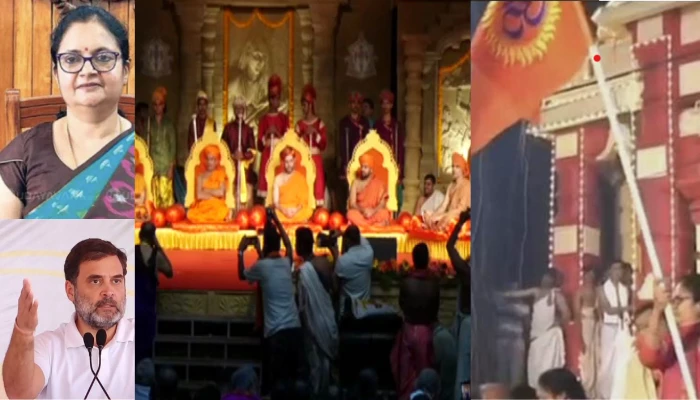
Case Summary
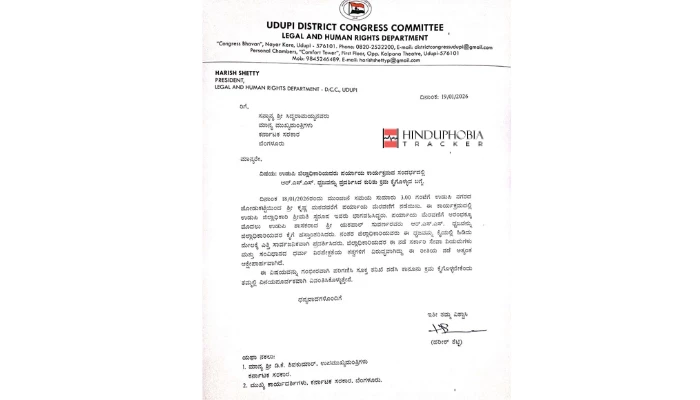
An age-old Hindu Paryaya procession, waving a saffron Hindu flag, was called grave misconduct by the Karnataka Congress, which demanded action against Udupi Deputy Commissioner Swaroopa. A political controversy erupted in Udupi, Karnataka, following the participation of the Udupi Deputy Commissioner, Smt Swaroopa T.K., in the centuries-old Paryaya festival procession held on 18 January 2026. The Paryaya ceremony was a long-standing religious and cultural tradition associated with the Sri Krishna Math, drawing lakhs of Hindu devotees and forming a core part of Udupi’s religious identity. The Paryaya procession commenced from Jodukatte to Sri Krishna Math. Before the procession began, the Deputy Commissioner, Smt Swaroopa T.K., briefly held and raised a saffron (Kesari) flag to signal the formal start of the procession. Visuals of this moment circulated widely on social media. Subsequently, the Udupi District Congress Committee, through its Legal and Human Rights Cell, submitted a written complaint to Chief Minister Siddaramaiah and Deputy Chief Minister D.K. Shivakumar, demanding action against the Deputy Commissioner. The complaint stated that holding the saffron flag amounted to “grave misconduct,” violated government service rules, and undermined the constitutional principle of secularism. The Congress further characterised the flag as a Rashtriya Swayamsevak Sangh symbol and sought a formal inquiry and legal action against the officer. In a letter addressed to Chief Minister Siddaramaiah, Harish Shetty, President of the Legal and Human Rights Department of the District Congress Committee, called for immediate action. The letter stated that the Deputy Commissioner raised the Rashtriya Swayamsevak Sangh flag in public, which had been handed over by Udupi Member of the Legislative Assembly Yashpal Suvarna, ahead of the Paryaya procession on January 18, 2026 (Sunday). The letter noted: “On 18 January 2026, at around 3.00 am, a Paryaya procession was held from Jodukatte in Udupi city to Sri Krishna Math. Udupi Deputy Commissioner Smt Swaroopa participated in this programme. Before the start of the Paryaya procession, Udupi Member of the Legislative Assembly Shri Yashpal Suvarna handed over the Rashtriya Swayamsevak Sangh flag to the Deputy Commissioner. The Deputy Commissioner then held this flag in her hand, raised it high, and displayed it in public.” Describing the action as undermining the Constitution’s principles of secularism, Shetty urged a proper probe and legal action in the matter. The letter stated: “This action of the Deputy Commissioner was against the Government Service Rules and the principles of secularism enshrined in the Constitution, and this kind of action was highly objectionable. I humbly request that this matter be taken seriously, that a proper investigation be conducted, and that legal action be initiated.” In response, Bharatiya Janata Party leaders and Hindu organisations strongly objected to the complaint, asserting that the saffron flag was a widely recognised Hindu religious symbol and an integral part of the Paryaya tradition. They stated that the Deputy Commissioner acted in an official administrative capacity, following established civic practice during a historic religious event, and did not engage in any political activity. Reacting to the demands for legal action against the Udupi Deputy Commissioner, Bharatiya Janata Party leader C.T. Ravi questioned what he described as the Congress party’s anti-Hindu ideology and defended the Deputy Commissioner, stating that hoisting the saffron flag was not a crime. Ravi emphasised the meaning of the saffron flag, describing it as an inspiration to crores of people. He stated, “This showed the anti-Hindu ideology of the Congress. Is there a ban on the Bhagwa flag, or is it Pakistan’s flag? It inspired crores of people because it symbolised sacrifice and courage. Hoisting the saffron flag was not a crime. The Deputy Commissioner did not commit any crime. The Constitution contains images of Lord Ram, Lord Krishna and Lord Buddha. What message does that send? Not a single terrorist was born out of saffron; it always conveyed a message of sacrifice and courage.” Meanwhile, former Energy Minister and Karkala Member of the Legislative Assembly V. Sunil Kumar also criticised the Congress, questioning whether a Congress flag or a green flag should have been displayed instead of a saffron flag during a Hindu religious procession. Describing the move as reflective of a “petty mindset,” he objected to the district Congress committee writing to the Chief Minister and Deputy Chief Minister seeking action against Deputy Commissioner Swaroopa T.K. In response to the controversy, Deputy Commissioner Swaroopa T.K. clarified that she participated in the procession solely as part of her administrative duties as the head of the Udupi City Municipal Council and had no political intent. Despite this clarification, demands for action against her continued, intensifying political and public debate. Consequently, the incident escalated into a broader dispute over the treatment of Hindu religious symbols and traditions in public life. Critics highlighted what they viewed as the selective application of secularism and the targeting of Hindu cultural practices, while supporters of the Congress maintained that government officials were required to adhere strictly to religious neutrality.
Case Images
Why it is Hate Crime ?
The first primary category selected here is 'Attack not resulting in death, and within this, the sub-category chosen is- 'Attacked for Hindu identity' In several cases, Hindus are attacked merely for their Hindu identity without any perceived provocation. A classic example of this category of religiously motivated hate crime is a murder in 2016. 7 ISIS terrorists were convicted for shooting a school principal in Kanpur because they got ‘triggered’ seeing the Kalava on his wrist and the ilak that he had put. In this, the Hindu victim had offered no provocation except for his Hindu religious identity. The motivation for the murder was purely religious, driven by religious supremacy. Such cases where Hindus are targeted merely for their religious identity would be documented as a hate crime under this category. The second primary and sub- category selected is 'Hate speech against Hindus; Attacked for supporting/being part of perceived Hindu party/org or working for Hindu community' In several cases, Hindus are attacked specifically or tangentially for their association with parties or organisations perceived to be pro-Hindu and/or for working in favour of the Hindu community. One of the classic cases was the attack against a Bharatiya Janata Party Yuva Morcha (BJYM) worker, Praveen Nettaru. Nettaru was attacked and hacked to death for his association with Hindu organisations and his work for the Hindu community. He was murdered by PFI, a terror organization which aimed to commit a genocide of Hindus, target Hindu leaders specifically and turn India into an Islamic Nation. In such cases, the immediate trigger for the violence may be non-religious, either according to the perpetrator or the police. However, there are surrounding circumstances from which the conclusion can be reached that the victim was attacked for his association with a Hindu organisation. In a similar case, Rinku Sharma was attacked by radicals. He was a member of Bajrang Dal and regularly worked for the Hindu community. While the police cited a different non-religious trigger for the attack, he was indeed associated with a Hindu organization and the family of Rinku Sharma specifically attributed his gruesome murder to his working for Bajrang Dal and raising Jai Shree Ram slogans. Such cases are intrinsically driven by religious hate and would therefore be documented as a hate crime under this category. This case constituted a non-violent but institutional hate crime against Hindus, arising from the use of political and administrative pressure to penalise the public expression of Hindu religious identity. Although the incident did not result in physical harm, it involved coercive demands for disciplinary action that caused social injury, intimidation, and deterrence. The targeting of a senior government official for respectfully participating in a centuries-old Hindu religious procession sent a message that Hindu faith and tradition were unwelcome in public and civic spaces. In particular, the action directly targeted Hindu identity. The objection raised by the Karnataka Congress focused not on any breach of administrative protocol but on the visible display of a saffron (Kesari) flag during the Paryaya festival, a sacred Hindu ceremony inseparable from the religious and cultural identity of Udupi and Sri Krishna Math. By categorising an established Hindu cultural practice as “misconduct,” the incident framed Hindu religious expression as incompatible with constitutional values, thereby treating Hindu identity itself as a problem to be regulated or punished. Moreover, the language and framing used in the formal complaint amounted to institutional hate speech against Hindus. A widely recognised Hindu religious symbol was characterised as politically dangerous and constitutionally improper, despite its long-standing spiritual and cultural significance. This portrayal delegitimised Hindu beliefs, stigmatised Hindu symbols, and reinforced the notion that Hindu faith had to be hidden or suppressed to satisfy secular expectations, while similar standards were not applied uniformly to other religious expressions in public life. Furthermore, the Deputy Commissioner was targeted for perceived association with Hindu organisations or Hindu community life, despite acting solely in an official civic capacity. By labelling the saffron flag as a Rashtriya Swayamsevak Sangh symbol and equating participation in a Hindu festival with political alignment, the complaint created a chilling effect. It conveyed a clear warning that public officials could face punitive consequences for engaging with Hindu religious traditions or supporting community-rooted cultural practices. Additionally, the incident exposed a distorted interpretation of secularism that was applied selectively to Hindus. Secularism did not require individuals or institutions to abandon their own religious practices while permitting or encouraging the public expression of others. The demand that Hindu participation be restrained, questioned, or punished during a Hindu religious procession revealed an unequal standard. The Paryaya event was a Hindu temple procession, conducted within a Hindu religious context, where the raising of a Hindu flag was both customary and symbolic. The act was not directed against any other faith, nor was it capable of causing religious offence, as it occurred within a sacred Hindu setting attended by Hindu devotees. Questioning whose beliefs were harmed by a Hindu flag at a Hindu procession underscored the absence of any genuine grievance and highlighted the discriminatory nature of the objection. Taken together, the incident reflected a broader pattern of selective enforcement and appeasement politics, in which Hindu traditions were subjected to heightened scrutiny and punishment. By turning a sacred event attended by lakhs of devotees into a disciplinary controversy, the Karnataka Congress transformed a religious and cultural practice into a political offence. This episode constituted a direct institutional attack on Hindu religious freedom and identity, fostering fear, marginalisation, and unequal treatment of Hindus in public and administrative life.
Victim Details
Total Victim
1
Deceased
0
Gender
- Male 0
- Female 1
- Third Gender 0
- Unknown 0
Caste
- SC/ST 0
- OBC 0
- General 0
- Unknown 1
Age Group
- Minor 0
- Adult 1
- Senior Citizen 0
- Unknown 0


Case Status
Unknown


Perpetrators Details
Perpetrators
State and Establishment
Perpetrators Range
From 2 To 5
Perpetrators Gender
male
 Sources




