Hindu saint's samadhi in Shravasti desecrated by Muslims who built illegal Islamic shrine over it
 Shrawasti, Uttar Pradesh, India
  19 January, 2026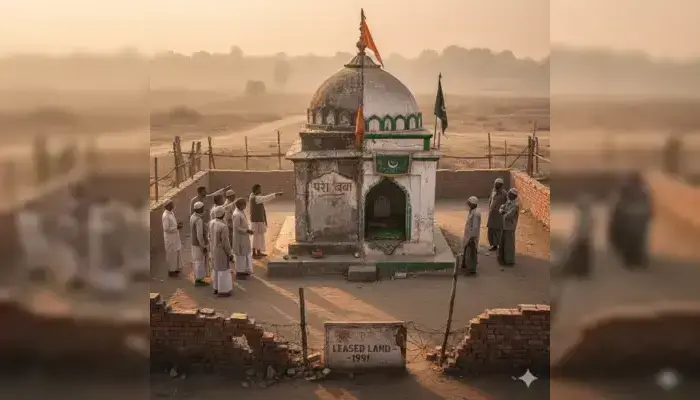
Case Summary
In Belhari village, Shravasti, Uttar Pradesh, a Hindu saint named Pera Baba's samadhi was desecrated by Muslims who illegally built an Islamic shrine (mazaar) over it. In Hinduism, Samadhi refers to the tomb or memorial shrine built over the burial or cremation site of a Hindu saint or spiritual figure who attained mahasamadhi, the final conscious exit from the body. The incident came to light when the local administration in Shravasti bulldozed the illegally constructed Islamic shrine. On 20 January 2026, under the direction of Sub-Divisional Magistrate Bhinga Ashish Bhardwaj, in the presence of a heavy police force, not only the shrine but also an illegal room built nearby was reduced to rubble. The administration stated this action removed illegal encroachments on "new fallow" land recorded in revenue records. Given the tension in the area, tight security arrangements remained in place during the action, and police were deployed at every corner. The entire controversy began when Hindu villagers complained that some members of the Muslim community illegally converted the samadhi of a Sanatan Dharma (Hinduism) follower named "Pera Baba" into a mazaar a few years ago. The land was leased to four local residents 32 years ago, but was gradually encroached upon. Following objections from Hindu organisations and the original landowners, an investigation found the encroachment illegal. The administration clarified that this action of demolishing the mazaar was not taken to offend any religious sentiments, but to remove encroachment from government land. Hindu organisations welcomed the decision, calling it a just act.
Why it is Hate Crime ?
This case has been added to the tracker under the primary category- Attack on Hindu religious representations. The subcategory selected is- Desecration of Hindu religious symbol. Icons and symbols or a religious representation of a spiritual ideal are widely revered in Hinduism. Iconography is of vital significance in the Hindu milieu. It helps connect people’s spiritual beliefs with the real world. Iconography within the Hindu faith takes several shapes and forms. Murtis are of most significance to Hindus, to which daily rituals, prayers and offerings are done. Besides the murtis, there are several other symbols which have deep significance in the Hindu faith – the Om and Swastika for example. Since these Hindu religious symbols hold paramount importance in Hinduism, any desecration of symbols, icons, murtis, religious representations and manifestations, is driven by animosity towards the faith itself which manifests itself through these murtis, icons and symbols. Therefore, any desecration of these Hindu religious symbols and representations is considered religiously motivated hate crimes under this category. This case constitutes a clear instance of a religiously motivated hate crime, as the Muslim perpetrators desecrated the sacred samadhi of Hindu saint Pera Baba in Shravasti, Uttar Pradesh, by illegally constructing an Islamic mazaar over it. In Hinduism, saints (sants) represent enlightened spiritual guides who embody divine wisdom, selfless service, and the path to moksha, earning eternal reverence from devotees who visit their samadhis, tombs marking the site of mahasamadhi, the conscious final exit from the body, for prayers, rituals, and blessings. These sites function as living embodiments of Hindu sanctity, akin to temples, where communities gather to honour the saint's legacy and seek spiritual solace. The act of desecrating such a revered symbol and overlaying it with an Islamic shrine reveals deep-seated religious animosity towards Hinduism, its saints, and the Hindu community, as it directly profanes a core element of their faith, intending to erase and supplant Hindu sacred space with symbols of another religion. Building an Islamic mazaar over a Hindu samadhi transcends mere desecration, serving as an assertion of Islamic dominance over Hindu religious symbols and territory, a pattern repeated historically by Islamic invaders who demolished Hindu temples, mathas (monastic institutions), and samadhis to erect mosques, dargahs, or mazars, viewing such conquests as triumphs of faith. Prominent examples include the Babri Masjid constructed over the Ram Janmabhoomi temple in Ayodhya, the Gyanvapi Mosque built atop the Kashi Vishwanath temple in Varanasi, and the Shahi Idgah Mosque erected over the Krishna Janmabhoomi site in Mathura, where original temple remnants and structures confirm the systematic desecration of sacred Hindu sites and their replacement with Islamic ones. This methodical desecration and appropriation not only humiliates the Hindu community by visibly replacing their venerated sites but also instils fear and subjugation, fulfilling hate crime criteria through bias-motivated selection of a religious target and actions designed to maximise communal offence. In this instance, the perpetrators' choice to encroach gradually over 32 years on leased government land, converting Pera Baba's samadhi into a mazaar despite Hindu objections, mirrors these historical precedents, where desecrating Hindu symbols symbolises pride and religious glory for the Muslim perpetrators, cementing this as a deliberate, religiously motivated hate crime rather than an isolated instance of land encroachment. Since this case meets the parameters of a religiously driven offence, it is being added to the hate crime database of the Hinduphobia Tracker. Disclaimer: The Hinduphobia Tracker records incident dates based on when a crime occurs, rather than when the media reports it. In this case, media reports do not state the exact date when Muslims desecrated the Hindu samadhi. Therefore, the date of the administrative action, 20 January 2026, serves as the indicative incident date. This date is recorded for documentation purposes only.


Case Status
Complaint filed


Perpetrators Details
Perpetrators
Muslim Extremists
Perpetrators Range
Unknown
Perpetrators Gender
unknown
 Sources




