Mass genocide of Hindus in Bangladesh downplayed by the government; called petty crimes and non-communal
 Dhaka District, Bangladesh
  18 January, 2026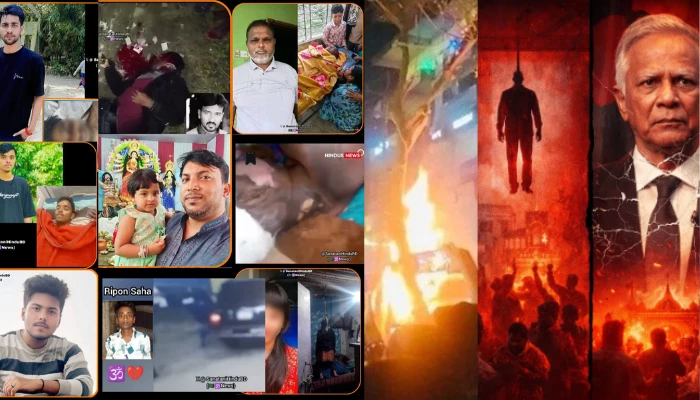
Case Summary
In Bangladesh, the Muhammad Yunus-led government issued a statement saying the attacks on Hindus were merely criminal and non-communal. On 9 January 2026, Ministry of External Affairs spokesperson Randhir Jaiswal urged the Bangladeshi authorities to deal with communal incidents swiftly and firmly. The Indian government criticised attempts by the Bangladeshi administration to attribute these attacks to personal rivalries, political differences or extraneous reasons, stating that such disregard only emboldened perpetrators and deepened insecurity among minorities. Amid brutal murders of Hindus in Bangladesh, the Muhammad Yunus-led interim government issued a statement saying the majority of these incidents were criminal in nature and not driven by communal motives. This statement was issued by Chief Adviser Muhammad Yunus’ Press Wing in response to the Indian government’s call to Bangladesh on 9 January to deal “swiftly and firmly” with the attacks taking place on Hindu minorities. The interim government of Bangladesh, through a statement posted on the Chief Adviser’s verified social media handle, stated that a total of 645 incidents involving minority communities were recorded between January and December 2025. The report stated, “The findings show that 71 incidents were identified as having communal elements, while 574 incidents were assessed as non-communal in nature. Communal incidents primarily involved vandalism or desecration of religious sites and idols, along with a small number of other offences.” These included 38 cases of temple vandalism, eight cases of arson, one case of theft, one murder, and 23 other incidents such as threats to break idols, provocative social media posts and damage to worship pavilions. The statement posted on the official handle read, “While every incident is a matter of concern, the data presents a clear and evidence-based picture: the overwhelming majority of cases were criminal in nature rather than communal. While all crimes are serious and demand accountability, the data demonstrates that most incidents involving minority victims were not driven by communal hostility, but by broader criminal and social factors that affected citizens across religious and ethnic lines.” Even as several Hindus were targeted in Bangladesh, especially ahead of elections scheduled for 12 February 2026, the interim government defended its record on the protection of minorities by preparing a report on the cases registered after the incidents. Recent attacks on Hindus in Bangladesh raised concerns about minority safety. In January 2026, a Hindu businessman, Liton Chandra Ghosh, was beaten to death in Gazipur district over a banana dispute, while another Hindu, Ripon Saha, was crushed by a vehicle attempting to escape without paying for fuel. These incidents followed a series of violent attacks on Hindus, including the killing of Dipu Chandra Das, who was lynched over blasphemy allegations. More than 15 Hindus were murdered between December 2025 and January 2026, with some cases involving premeditated violence and the targeting of victims’ assets. The Bangladesh Hindu Buddhist Christian Unity Council, a human rights organisation against religious discrimination, reported 51 incidents of communal violence in December 2025 alone. The forum expressed grave concern over the escalating attacks on minority communities across the country. The forum stated that as the date of the general elections drew nearer, communal violence increased to prevent minority voters from casting votes for candidates of their choice. India’s Ministry of External Affairs expressed grave concern regarding a disturbing pattern of recurring attacks on Hindu minorities in Bangladesh. It strongly condemned recent incidents, including the barbaric killing of a Hindu youth, Dipu Chandra Das, in Mymensingh and other lynchings. The Ministry of External Affairs noted that over 2,900 incidents of violence against minorities, including killings, arson and land grabbing, were documented by independent sources during the tenure of the interim government. According to the 2022 census, the Hindu population in Bangladesh was approximately 13.13 million, accounting for about 7.95 per cent of the country’s total population. The Buddhist population was approximately 1.01 million (0.61 per cent), Christians nearly 500,000, and other religions, including Sikh and Animist, approximately 200,000 (0.12 per cent). While the Indian High Commission in Dhaka continued to monitor the situation closely, the Ministry of External Affairs reiterated that the primary responsibility for protecting the life and liberty of all citizens, including minorities, rested with the Government of Bangladesh. A fresh wave of anti-Hindu violence prevailed across Bangladesh following the death of Sharif Osman Bin Hadi. This escalation occurred against the backdrop of ongoing anti-Hindu violence that had persisted since the ouster of the Sheikh Hasina government in August 2024, during which Hindu homes, temples, and religious spaces were repeatedly attacked, and the Hindu community faced intimidation, arson, and mob attacks. In the aftermath of Hadi’s death, Hindu homes were selectively targeted and set ablaze in multiple localities by Muslim mobs, forcing families to flee and rendering many homeless. The violence was not sporadic but patterned, with Muslim mobs targeting Hindu neighbourhoods, properties, and religious symbols with impunity. One of the many victims of this wave of violence was a Hindu man named Dipu Chandra Das, who was brutally lynched by a Muslim mob over false allegations of blasphemy. Such targeting of innocent Hindus over fabricated charges illustrated the vulnerability of the Hindu minority under conditions of rising communal hostility. Posters and written materials calling for the extermination of Hindus were displayed in public spaces, signalling an alarming normalisation of genocidal rhetoric. Combined with acts of physical violence, arson, and vandalism, these developments demonstrated a coordinated campaign designed to terrorise the Hindu community and assert Islamic dominance. Notably, Sharif Osman Bin Hadi was a Muslim political activist and student leader known for his anti-Hindu and anti-India stance. He was actively involved in the political unrest that followed the fall of Sheikh Hasina’s government and was killed in Dhaka in December 2025 during clashes, after which Hindus were blamed and subsequently targeted.
Why it is Hate Crime ?
The primary category selected under this case is Hate speech against Hindus. The sub-category selected is Denial or mocking of genocide/large-scale persecution. Denial or mocking of genocide/large-scale persecution/ethnic cleansing refers to the act of denying or minimising the fact of the ethnic cleansing and/or genocide and/or religious persecution of Hindus. This often involves denying the scale, mechanisms, religious intent, or even the occurrence of the ethnic cleansing and/or genocide and/or religious persecution of Hindus. Hate speech of this kind involves the dissemination of falsehoods that deny or distort established historical facts or mock the suffering of Hindus by saying that they deserved the persecution, motivated by Hinduphobia. Denying such atrocities is not only about the denial of facts or rewriting/revising history, but it also delegitimises the religiously motivated persecution of Hindus, the religious hate/motivation/animosity that led to the persecution, and dehumanises Hindus as a religious group. Such denial of ethnic cleansing and/or genocide and/or religious persecution of Hindus not only denies the suffering but also paves the way for future/present atrocities and hate speech, inciting prejudice and violence against Hindus. It also justifies violence by delinking religious animosity from religiously motivated crimes committed against Hindus. Since such denial and/or mocking of genocide/ethnic cleansing/atrocities motivated by religious animosity leads to present and future ramifications of creating more hate speech, violence, dehumanisation and delegitimisation, it would be considered hate speech under this category. This case was included in the hate crime database because it represented direct and undeniable communal motivation. The Muhammad Yunus-led government, by refusing to recognise the communal hatred expressed through deadly attacks on Hindus, itself carried out an act that diminished the safety and dignity of Hindus. Moreover, it supported anti-Hindu communal attacks by reducing them to mere criminal acts. Unless religious animosity was recognised, these communal crimes could not be addressed effectively. Denying the animosity and hatred with which these brutal attacks were committed created space for attackers to engage in further violence. At the same time, it instilled fear among Bangladeshi Hindus, as the so-called “criminal attacks” systematically targeted Hindus and their households. Recalling cases of brutal violence, such as the lynching of Dipu Chandra Das on an allegation of blasphemy, a charge uniquely weaponised against religious minorities, highlighted this pattern clearly. The killing of Khokon Das occurred without any substantiated dispute and took place in a broader context of anti-Hindu hostility. Liton Chandra Ghosh was beaten to death for defending a minor over a banana, Mithun Sarkar was killed on presumptive allegations of theft, and Samir Kumar Das was murdered under similar circumstances. All these cases displayed extreme brutality, combined with the absence of any motive other than identity-based vulnerability, reflecting hatred rather than ordinary criminal conduct. Crucially, the denial of the communal nature of these crimes by Muhammad Yunus and the interim government constituted a more severe injustice against Hindus. When a state refused to acknowledge that targeted violence existed, it did not remain neutral; it actively facilitated future crimes. Denial erased patterns, suppressed accountability, and emboldened perpetrators by signalling that religious motivation would not be recognised or prosecuted. Not accepting that Hindus were being targeted was equivalent to legitimising the conditions under which such violence thrived. It delegitimised victim testimony, prevented the application of hate crime frameworks, and allowed extremist elements to continue operating under the cover of “ordinary crime.” This systemic denial transformed individual acts of violence into an institutional failure, where the state became complicit through omission. In conclusion, these incidents were not isolated, accidental, or purely criminal. They constituted a pattern of Hinduphobia, marked by religious targeting, mob violence, impunity, and official minimisation. Recording them as hate crimes was not ideological; it was a necessary step towards truth, justice, and prevention. Therefore, this case is being recorded in the hate crime database of the Hinduphobia Tracker.


Case Status
Unknown


Perpetrators Details
Perpetrators
State and Establishment
Perpetrators Range
One Person
Perpetrators Gender
male
 Sources




