Hindu residents face religious coercion by Christian preachers near temple area in Ramanathapuram, Tamil Nadu
 Ramanathapuram, Tamil Nadu, India
  15 January, 2026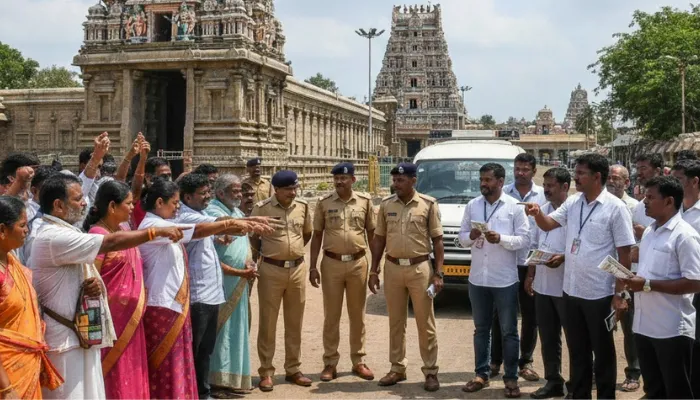
Case Summary
Hindu residents were forced into participating in religious conversion activities by Christian preachers near a temple linked to the Ramanathaswamy Temple in Rameswaram, Ramanathapuram district, on 16 January 2026. Around ten Christian preachers were distributing pamphlets and preaching near the Bhadrakali Amman temple, which falls under the Ramanathaswamy Temple administration, in Rameswaram. Local residents objected to the activity and staged a protest at the spot. Following the protest, the preachers moved a short distance away. They resumed preaching and continued distributing leaflets, including to Ayyappa devotees in the area, which led to a fresh argument with local people. Town police arrived at the scene, held talks with both sides, and pacified the situation. The police subsequently asked the preachers to leave the area, restoring normalcy. No arrests were reported, and the situation remained under control at the time of reporting. Some sources say that more than fifty people from Chennai, who were engaged in religious conversion propaganda using loudspeakers near the Rameswaram temple, were stopped by Vishva Hindu Parishad members. The police were informed, and they were removed from the area. A photograph accompanying the incident was circulated on social media, highlighting the police intervention to remove the conversion activists. Local residents emphasised the need to protect the dignity of the holy site.
Why it is Hate Crime ?
This case has been documented under the selected primary category: Predatory proselytisation. Under this, the selected secondary category is: Proselytisation by grooming, brainwashing, manipulation, or subtle indoctrination. Under this, the selected tertiary category is: Pattern of targeting Hindus. Religious brainwashing essentially means the often subtle and forcible indoctrination to induce someone to give up their religious beliefs to accept contrasting, regimented ideas. Religious grooming or brainwashing also involves propaganda and manipulation. It involves the systematic effort, driven by religious malice and indoctrination, to persuade “non-believers’ to accept allegiance, command, or doctrine to and of a contrasting faith. Cases of such grooming or brainwashing are far more nuanced than direct threats, coercion, inducement, and violence. In such cases, it is often seen that there is repeated, subtle, and continual manipulation of the victim to induce disaffection towards their own faith and acceptance of the contrasting faith of the perpetrator. While subtle indoctrination is widely acknowledged as predatory, an element which is often understated in such conversions or the attempts of such conversion is the role of loyalty and trust which might develop between the perpetrator and the victim. Fiduciary relationships are often abused to affect such religious conversion. For example, an educator transmitting religious doctrine of a competing faith to a Hindu student. The Hindu student is likely to accept what the teacher is transmitting owing to the existence of the fiduciary relationship. The exploitation of the fiduciary relationship to religiously indoctrinate victims would also be included in this category. Since the underlying animosity towards the victim’s faith forms the basis of predatory proselytization, such cases are considered religiously motivated hate crimes. The other category selected here is- Attack on Hindu religious representation, and within this, the sub-category selected is- Breaking rules of places of worship. Sanatan Dharma is not a religion of one book, which is to say that while it has religious scriptures that form the central tenets of the faith, there are several traditions followed through thousands of years, mostly passed from generation to generation orally. One of these oral traditions or written traditions is the rules of specific temples. Certain temples have rules which are traditional rules, dependent on the worship of the presiding deities. These rules and traditions have been followed for thousands of years whether they find scriptural mention or not. Such traditions are based on the nature and rules of worship of the presiding deity of that temple. Any non-compliance of these traditions owing to animosity towards the faith or for the sake of activism stems not only from the lack of faith in the presiding deity but also disregard for the faith of the devotees of that deity/temple and implicit bias against the faith, the tradition and the deity itself. Since these specific traditions are central to the faith of the devotees of that specific temple and presiding deity, any non-compliance with these traditional rules would be considered a religiously motivated hate crime. This incident is recorded as a hate case because the activity was organised as targeted conversion propaganda in the immediate vicinity of a Hindu sacred space under the Ramanathaswamy Temple administration, and it specifically attempted to engage Hindu devotees present there. Conducting proselytisation near a temple is not a neutral choice of venue. It leverages the sanctity of a Hindu worship site as a pressure point, turning a protected religious environment into a contest zone and signalling that Hindu religious space is open to intrusion and ideological capture. The distribution of conversion leaflets to Ayyappa devotees further indicates community targeting rather than general outreach. Devotees identifiable by their religious practice were approached while in a devotional setting, which amounts to an attempt to disrupt or redirect Hindu worship and identity at the point of practice. When residents objected, and the group merely shifted a short distance and resumed, it reinforced that the objective was to persist with conversion messaging around the temple zone despite local resistance, heightening the coercive character of the act. Given the pattern in which missionary groups seek out Hindu religious gatherings and sacred spaces to initiate conversions, the incident is documented as religious hostility expressed through conversion targeting and interference in Hindu religious life, warranting inclusion in the tracker. Disclaimer: The exact number and gender of the Christian preachers are not confirmed. Some sources report around ten individuals, while others indicate that more than fifty people were present. For record-keeping purposes, this report considers the number of perpetrators as fifty. Additionally, only men are visible in the circulated video; however, this does not preclude the possibility that women were also involved. However, since the video shows only men, for record-keeping purposes, this report has considered the perpetrator's gender as 'male'.


Case Status
Complaint not filed


Perpetrators Details
Perpetrators
Christian Extremists
Perpetrators Range
From 10 to 100
Perpetrators Gender
male
 Sources




