Hindu residents coerced into converting to Christianity under the garb of prayer meetings and incentives in Mau, Uttar Pradesh
 Mau, Uttar Pradesh, India
  17 January, 2026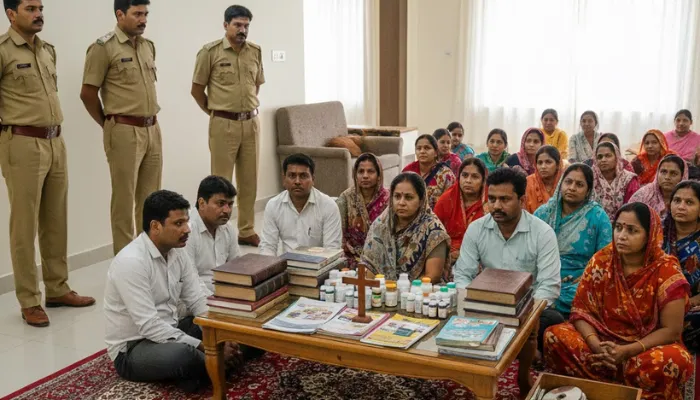
Case Summary
Hindu residents were subjected to organised religious conversion activity by people from Christian missionary during a prayer gathering in Nizamuddinpura, Mau district, Uttar Pradesh. The activity centred on persuading members of the Hindu religious community to abandon their faith. Police carried out a raid on a residential house in the Nizamuddinpura area on Sunday, January 17 2026, after receiving information about ongoing religious conversion activities. At the time of the raid, a prayer meeting was taking place inside the house, with approximately fifty men and women present. Five individuals were detained for questioning at the spot. During the operation, police seized two banners and several books from the premises. All those present were questioned, and a formal investigation was initiated. City Kotwal Anil Singh stated that the police reached the location based on specific intelligence regarding organised religious conversion activity. He confirmed that five people were taken into custody initially and that further legal action followed upon the receipt of a formal complaint. As the investigation progressed, eight people, including six men and two women, were arrested in Nizamuddinpura under the jurisdiction of the City Kotwali police station. Police recovered drugs, religious books, and other objectionable material from the site, strengthening the case of organised activity rather than an isolated religious gathering. The First Information Report was registered on the complaint of Radheshyam Singh, a resident of Sahadatpura. The complaint stated that economically vulnerable Hindu residents were coerced into converting to Christianity through monetary inducements, sustained pressure, and threats. The conversion activity was carried out over several years under the cover of prayer meetings, indicating a prolonged and deliberate effort. Local residents informed activists of the Hindu Jagran Manch after observing that these gatherings were deliberately conducted when working adults were away and children were at school. Acting on this information, the police reached the site and found around fifty men and women participating in the prayer meeting. Those arrested included Laxman Gautam of Galibpur, Udaybhan, Santosh Sahni of Rastipur, currently residing in Surwat Pali village of Ghazipur district, Abhishek of Dumrav, Amit Kumar also known as Saurabh, Indrajit Maurya of Musardah, Rita of Ghalibpur Bhiti, and Savita of Nizamuddinpura. Police records showed that a First Information Report had previously been registered against Indrajit Maurya in 2008 at Sarayakhanshi police station. Similar incidents connected to religious conversion activity had been recorded in Mau district in earlier years. On 2 August 2025, police raided a prayer meeting attended by around four hundred people in Pavni village of Ghosi tehsil and arrested two individuals while seizing objectionable material, including a Christian religious book. On 17 August 2025, two more individuals were arrested during a prayer meeting in Chhoti Kamharia for pressuring a local resident to convert using monetary inducement. On 24 August 2025, Bibles and Christian symbols were recovered from a prayer meeting site in Barlai, leading to arrests under the Prohibition of Religious Conversion Act. Confirming the present action, Additional Superintendent of Police Anoop Kumar stated that the police raided the location after receiving information about a prayer meeting being used for religious conversion, arrested eight people including the organiser, confiscated Bibles, promotional material, and other objectionable items, registered a First Information Report, and initiated further legal proceedings.
Why it is Hate Crime ?
This case has been documented under the selected primary category: Predatory proselytisation. Under this, the selected secondary category is: Proselytisation by grooming, brainwashing, manipulation or subtle indoctrination. Under this, the selected tertiary category is: Pattern of targeting Hindus. Religious brainwashing essentially means the often subtle and forcible indoctrination to induce someone to give up their religious beliefs to accept contrasting regimented ideas. Religious grooming or brainwashing also involves propaganda and manipulation. It involves the systematic effort, driven by religious malice and indoctrination, to persuade “non-believers’ to accept allegiance, command, or doctrine to and of a contrasting faith. Cases of such grooming or brainwashing are far more nuanced than direct threats, coercion, inducement and violence. In such cases, it is often seen that there is repeated, subtle and continual manipulation of the victim to induce disaffection towards their own faith and acceptance of the contrasting faith of the perpetrator. While subtle indoctrination is widely acknowledged as predatory, an element which is often understated in such conversions or the attempts of such conversion is the role of loyalty and trust which might develop between the perpetrator and the victim. Fiduciary relationships are often abused to affect such religious conversion. For example, an educator transmitting religious doctrine of a competing faith to a Hindu student. The Hindu student is likely to accept what the teacher is transmitting owing to existence of the fiduciary relationship. The exploitation of the fiduciary relationship to religiously indoctrinate victims would also be included in this category. Since the underlying animosity towards the victim’s faith forms the basis of predatory proselytization, such cases are considered religiously motivated hate crimes. Another selected secondary category is: Conversion/attempts to convert by inducements. Predatory Proselytisation is not just limited to threat, harassment, force and violence, but it also has contours of stealth. In several cases, the Hindu victim is exploited to convert, with non-Hindus taking advantage of their poverty. In such cases, the Hindu victim who is suffering financially is offered monetary benefits, including lucrative offers for jobs, health treatment, education, etc, to induce the victim into changing his/her religion. In such cases, the religious identity of the victim and the aim to disenfranchise him from his faith form the heart of the crime. Also, taking advantage of and exploiting an individual’s economic vulnerabilities is widely acknowledged as exploitation, forms of which are often penalised by law. Such cases therefore are considered religiously motivated hate crimes since the victim’s religious identity forms the very heart of the crime itself. This incident amounted to a religiously motivated hate crime because the actions were directed at Hindu residents specifically because of their religious identity. The conversion activity did not occur randomly or incidentally. It focused on members of one faith with the clear intention of breaking their religious continuity and replacing it with another. Religion was not a background factor but the central reason why these individuals were approached, targeted, and pressured. The conduct went beyond the expression of religious belief and entered the realm of coercion. Hindu residents, many of whom were economically vulnerable, were subjected to monetary inducements, sustained pressure, and threats to force a change of faith. When a person’s poverty or social vulnerability was used to corner them into abandoning their religion, it stripped them of genuine choice. This directly attacked their freedom of conscience and dignity, which lay at the core of their religious identity. The manner in which the activity was organised further showed deliberate targeting. Prayer meetings were repeatedly held inside a residential house and timed carefully when adults were away at work and children were at school. This pattern demonstrated planning, secrecy, and intent. It showed that the organisers were not engaging openly with society but were systematically focusing on a particular religious community in a controlled environment to influence and pressure them. The harm suffered by the victims arose solely because they were Hindu. There was no personal dispute, property disagreement, or social rivalry between the parties. The only factor that brought the victims into contact with the offenders was their religion. The pressure to convert, the inducements offered, and the threats used all stemmed from hostility towards the victims’ continued adherence to their faith. Law enforcement treated the matter as religion-based harm, not as a routine gathering or private religious event. The registration of a First Information Report, multiple arrests, and the seizure of religious material and promotional items reinforced that the offence was rooted in organised religious targeting. The repeated occurrence of similar incidents in the same district over previous years further showed a pattern of conduct aimed at undermining a specific religious community. Taken together, the facts showed a clear case of a hate crime because Hindu residents were deliberately singled out, exploited, and pressured to abandon their faith through organised and sustained actions. Their religious identity was the sole reason they were targeted, and the offence sought to erase that identity through coercion rather than respect for lawful, voluntary belief. Disclaimer: Reports mention that around 50 men and women were being targeted for conversion. However, since the exact number and gender-wise breakdown have not been specified in any of the available sources, the total number of victims has been recorded as 50, and they have been evenly divided, recording 25 male and 25 female victims for the sake of consistency in documentation.
Victim Details
Total Victim
50
Deceased
0
Gender
- Male 0
- Female 0
- Third Gender 0
- Unknown 50
Caste
- SC/ST 0
- OBC 0
- General 0
- Unknown 50
Age Group
- Minor 0
- Adult 50
- Senior Citizen 0
- Unknown 0


Case Status
Complaint filed


Perpetrators Details
Perpetrators
Christian Extremists
Perpetrators Range
From 5 to 10
Perpetrators Gender
both
 Sources




