Hindu women face religious conversion attempts to Christianity through inducements in Ajmer, Rajasthan
 Ajmer, Rajasthan, India
  17 January, 2026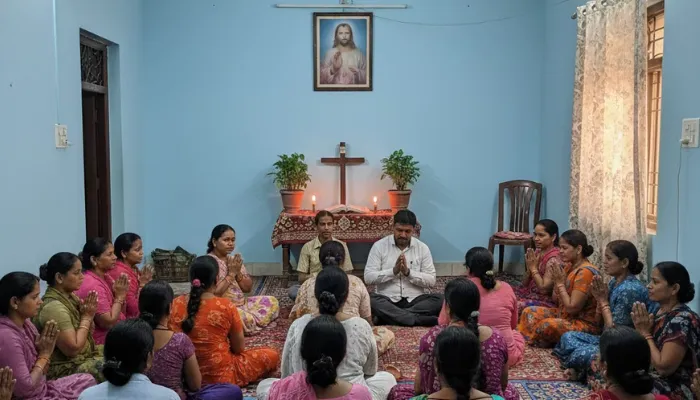
Case Summary
Hindu women faced religious conversion activity at a private home in Paltan Bazaar, Ajmer, Rajasthan, when prayers dedicated to Jesus Christ prompted protests and police intervention. The incident occurred on January 18, 2026, at the residence of Munnalal Dadoria, a resident of Kundan Nagar, where he, his wife, Alka Devi, and their relatives were praying in their private home. During the session, approximately 25 to 30 women and two men were present. The two men fled the scene upon the arrival of Bajrang Dal members. The family informed the police that their faith in Jesus Christ was personal. They stated that when they were childless and had three daughters, they prayed to Jesus Christ and were later blessed with a son, after which their prayers continued. The family maintained that they were not conducting religious conversions, offering inducements, or violating the conversion law, and stated that their practice fell within the scope of religious freedom guaranteed by the Constitution of India. Following the prayer activity, objections were raised, and the matter escalated into a public controversy. Bajrang Dal members shouted slogans outside the home, after which the incident was reported to the police. The dispute extended to the Civil Lines Police Station, where leaders and activists from the Vishwa Hindu Parishad, Bajrang Dal, and other Hindu organisations gathered, raised slogans, and demanded strict action. The organisations asserted that illegal religious conversions were taking place in the area. A written complaint submitted to the police stated that individuals were luring Hindus into converting to Christianity. The complaint detailed that women, children, and vulnerable individuals were being targeted through financial inducements, promises of curing illnesses, and assurances of education and employment. The organisations stated that religious conversions conducted without following the legal process constituted a crime and created tension in society. They demanded an impartial investigation and strict legal action against those involved. Civil Lines Police Station in-charge Shambhu Singh confirmed that Ghanshyam Jangid filed the complaint regarding religious conversion and that officials from the Vishwa Hindu Parishad and Bajrang Dal were involved. Police personnel controlled the situation at the station and initiated an investigation after hearing both sides. The police station in charge stated that if the investigation revealed violations of the conversion law, action would be taken in accordance with the law.
Why it is Hate Crime ?
This case has been documented under the selected primary category: Predatory proselytisation. Under this, the selected secondary category is: Conversion/attempts to convert by inducement. Predatory Proselytisation is not just limited to threat, harassment, force and violence, but it also has contours of stealth. In several cases, the Hindu victim is exploited to convert, with non-Hindus taking advantage of their poverty. In such cases, the Hindu victim who is suffering financially is offered monetary benefits, including lucrative offers for jobs, health treatment, education, etc, to induce the victim into changing his/her religion. In such cases, the religious identity of the victim and the aim to disenfranchise him from his faith form the heart of the crime. Also, taking advantage of and exploiting an individual’s economic vulnerabilities is widely acknowledged as exploitation, forms of which are often penalised by law. Such cases therefore are considered religiously motivated hate crimes since the victim’s religious identity forms the very heart of the crime itself. In this incident, the complaint highlights an inducement based conversion method in which Hindu women, children, and other vulnerable persons are lured through promises of money, education, employment, and relief from illness. This fits the inducement category because it shifts the conversion pitch from belief and conscience to material benefit and crisis relief, using vulnerability as leverage. The health angle is especially significant. When serious illness or medical distress is used as the hook for religious messaging, it exploits desperation at the most fragile moment for an individual and their family. In such circumstances, “healing” assurances function as coercive inducements because the person is not choosing freely in a stable state, but responding under fear, pain, and urgency. The conversion push turns a health crisis into a bargaining chip, offering hope and care conditional on religious alignment, or implying that relief is more likely if the person participates in the religious activity. The same coercive logic applies to promises of money, education, and employment. These incentives prey on economic insecurity and social aspiration, especially among women and families seeking stability for their children. When religious change is dangled alongside financial help, schooling support, job assurances, or access to opportunities, it transforms faith into a transaction and creates undue influence over people who may feel they cannot refuse. It also produces pressure within families and neighbourhoods, where accepting benefits can become tied to continued participation and gradual religious assimilation. This tactic creates a predatory outreach dynamic that undermines informed consent and targets those least able to resist pressure. For Hindu women and vulnerable families, it becomes an attack on religious autonomy by exploiting distress, dependency, and inequality. For these reasons, the case is documented as an attempt to convert through inducements, with the reported use of health crises and material promises treated as central markers of inducement-based conversion targeting, subject to confirmation through the ongoing police investigation. Disclaimer: The number of victims is reported to range between 25 and 30; therefore, for documentation purposes, 30 is used as the indicative figure. The exact number of perpetrators is unknown; for record-keeping, four are counted: the couple whose residence was involved and the two men who fled the scene.
Victim Details
Total Victim
30
Deceased
0
Gender
- Male 0
- Female 30
- Third Gender 0
- Unknown 0
Caste
- SC/ST 0
- OBC 0
- General 0
- Unknown 30
Age Group
- Minor 0
- Adult 30
- Senior Citizen 0
- Unknown 0


Case Status
Complaint filed


Perpetrators Details
Perpetrators
Christian Extremists
Perpetrators Range
From 2 To 5
Perpetrators Gender
both
 Sources




