Hindu woman targeted through identity concealment, religious coercion, and attempted sexual assault by Muslim colleague
 Khatima, Uttarakhand, India
  17 January, 2025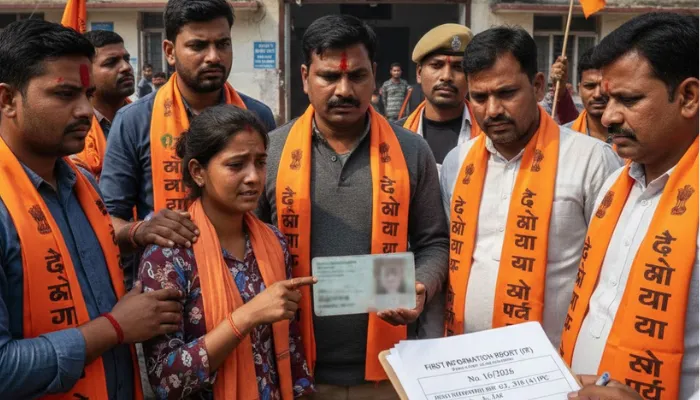
Case Summary
A 19-year-old Hindu girl was trapped by a Muslim colleague who concealed his religious identity, took her to a hotel on a false pretext, and then pressured her to convert to Islam while threatening blackmail. The incident took place on January 18 2026, at around 10:00 am in the Kotwali Khatima area of Udham Singh Nagar district, Uttarakhand. The woman stated that her coworker from a medical store, who had introduced himself as Sonu, took her to a hotel, claiming he would take her on a tour and booked a room under the name Sonu. She stated that inside the hotel, she found an Aadhaar card showing his real identity as Shahnawaz, son of Mohammad Din, a resident of Islam Nagar, Khatima. She said he attempted to force physical relations on her, pressured her to convert, and threatened her with consequences if she disclosed the incident. She also stated that he had objectionable material in his possession, which he used to blackmail her. The victim managed to flee the hotel and later approached the police. At around 2:30 pm the same day, she reached Kotwali Khatima with her father and submitted a written complaint. FIR 16 of 2026 was registered under IPC sections 62, 64, and 318(4). Police initiated an investigation and stated that the accused fled and was absconding at the time of reporting.
Why it is Hate Crime ?
This case has been documented under the selected primary category: Crimes against women and other sexual crimes. Under this, the selected secondary category is: Man pretends to be Hindu. Under this the selected tertiary category is: Name changed, Raped and/or murdered after Hindu woman finds out real identity. When a non-Hindu man pretends to be a Hindu to deceive a Hindu woman into a relationship, the act is seen as triggered by malafide intentions. In some cases, the woman eventually accepts the man’s original religious identity and converts after the man’s identity is revealed. These cases could be argued as cases of religious brainwashing and a result of the pressure a woman feels after getting into a relationship with a man. The woman, it can be argued, also changed her religious identity because of the stigma she believes she might face if she chooses to walk out of a deceptive relationship. However, for the purpose of documenting hate crimes, the cases in this subcategory are limited to those where there is explicit violence aimed at religious conversion against the wishes of the victim (force-feeding beef, blackmailing with intimate videos, rape on refusal to convert, etc), or if the woman herself complains of the man’s religious deception. In such cases, it is established that the deception of the non-Hindu man had a specific aim of religious conversion or targeting of the victim due to her Hindu religious identity, therefore, making it a religiously motivated hate crime. Another selected secondary category is: Assault or threat upon refusal to convert. When Hindu women are in a relationship with non-Hindu men, there are cases where the woman faces threats or assault after she refuses to convert and change her religious identity owing to pressure/force by the non-Hindu man. Such relationships may be consensual with the religious identity of the non-Hindu man known to the victim. Somewhere along the relationship, the non-Hindu man starts pressurizing the Hindu woman to convert to Islam and upon her refusal, assaults or threatens the victim. Such cases are driven by specific religious motivations and against the religious identity of the victim and are therefore qualified as hate crimes. Cases where the Hindu woman converts to Islam and does not file a complaint about the force or threat, are not considered a part of the hate tracker, even though, it may be argued that the woman was brainwashed or threatened to convert to Islam. Another selected secondary category is: Brainwashed and/or groomed. Within this, the tertiary category selected is- Rape and sexual assault/harassment. In our database, we have not added incidents where women have converted to another religion of their free will and no allegations of forced/involuntary conversion have been made. However, there are certain cases of conversion where the consent itself is a result of the brainwashing or grooming of a minor by the non-Hindu perpetrator trying to victimise a woman for her Hindu religious identity. The phenomenon of grooming points to non-Hindu perpetrators identifying their Hindu victims’ vulnerabilities and exploiting them over months and sometimes years, to extract the supposed ‘consent’ in order to convert their religion. In most cases of grooming, the victims are minors or the grooming started when the victim was a minor. In other cases of grooming, the non-Hindu perpetrator brainwashes and grooms a minor victim to extract their trust and then proceeds to rape them repeatedly with the intent of converting them to their faith. It is pertinent to understand here that when the victim is a minor, the ‘consent’ to convert or enter into a romantic relationship with an adult itself is redundant – addressed by POCSO. While every case of conversion of a minor and incidents of establishing a physical relationship with a minor by an adult is a crime, for the purpose of this database, a case would be considered a hate crime only if there is a distinct religious angle to the grooming. For example, in the UK, if a Hindu minor is targeted by Pakistani grooming gangs, it would be considered a hate crime because the victims are specifically targeted owing to their non-Muslim religious identity with the perpetrators being Muslim. In other cases, if a Hindu minor is brainwashed into entering a physical relationship with the non-Hindu adult perpetrator and the family alleges grooming/brainwashing of the minor to convert her religion, it would form a part of this database. If the victim is a Hindu adult, the case would form a part of this database only if the victim herself says that she was brainwashed/groomed to convert her religion. However, if the victim is deceased (murdered or otherwise), the case would form a part of this database if her family/friends provided testimony that the victim was brainwashed/groomed to convert her religion. Since these crimes have a distinct religious angle where the victim is being targeted owing to her Hindu religious identity, these cases are considered a hate crime. This incident qualified as a religiously motivated hate crime because religion was not incidental to the offence. The victim’s Hindu identity was directly targeted, manipulated, and attacked, and the harm inflicted on her was inseparable from religious coercion. Firstly, the accused deliberately hid his religious identity and presented himself as a Hindu man for a prolonged period. This deception was purposeful. It allowed him to gain the trust of a Hindu woman who would not have consented to closeness had she known his true identity. The crime began with religious misrepresentation, making religion central to how the victim was assessed and harmed. Secondly, the pressure to convert to Islam placed religion at the heart of the violence. The demand for conversion occurred alongside the attempted sexual assault. This showed that the attack was not only against the woman’s body but also against her faith. Her religion was treated as something to be broken through fear, pressure, and force rather than respected as a personal right. Thirdly, the attempted sexual assault functioned as a tool of domination linked to religious coercion. The violence followed the exposure of the accused’s real identity and coincided with insistence on conversion. The victim was targeted because she was a Hindu woman, and violence was used to overpower her autonomy, dignity, and beliefs. Fourthly, the use of threats to silence the victim reinforced the hate-based nature of the offence. The intimidation is aimed at preventing her from speaking after she refuses to submit or convert. This demonstrated an effort to erase her voice and agency as a Hindu woman through fear and control. Taken together, these actions showed a clear pattern in which religious identity drove the offence. The victim was not harmed randomly. She was targeted as a Hindu woman, deceived because of her faith, pressured to abandon it, and attacked when she resisted. This placed the incident squarely within the definition of a religiously motivated hate crime. Disclaimer: In such cases, the identity of the victim was concealed to safeguard her dignity and personal safety. In some reports, a changed name, Sangeeta, was used. This clarification is being made to ensure that readers do not confuse a protected identity with the victim’s real name. The Hinduphobia Tracker recorded incident dates based on when the crime occurred rather than when it was reported by the media. In this case, media reports did not specify the exact date on which the victim’s ordeal began and stated only that the incident had begun a year earlier. Therefore, for documentation purposes, 18 January 2025, the date of media reporting, was selected as the indicative incident date.
Victim Details
Total Victim
1
Deceased
0
Gender
- Male 0
- Female 1
- Third Gender 0
- Unknown 0
Caste
- SC/ST 0
- OBC 0
- General 0
- Unknown 1
Age Group
- Minor 0
- Adult 1
- Senior Citizen 0
- Unknown 0


Case Status
Complaint registered


Perpetrators Details
Perpetrators
Muslim Extremists
Perpetrators Range
One Person
Perpetrators Gender
male
 Sources




