Hindu man was fatally run over by Muslim extremists in Rajbari district, Bangladesh
 Rajbari District, Bangladesh
  16 January, 2026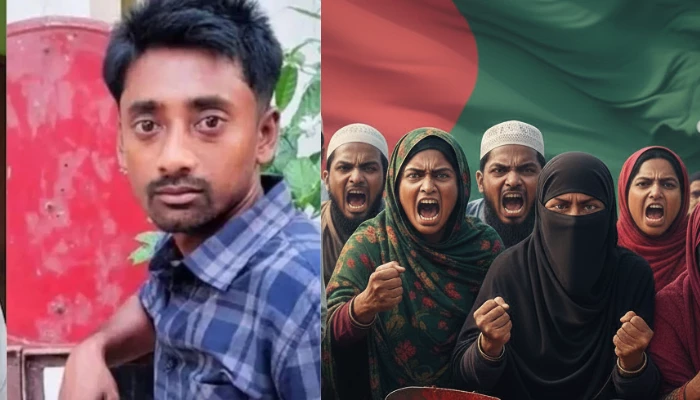
Case Summary
In Bangladesh, a 30-year-old Hindu man, Ripun Saha, was fatally run over by an SUV driven by Kamal Hossain after he attempted to stop the vehicle from leaving without paying for petrol. The incident occurred on Friday, January 17 2026, at Karim Filling Station near Goalanda Mor along the Dhaka–Khulna highway in Rajbari Sadar Upazila. According to police, a black Toyota Land Cruiser bearing registration Dhaka Metro-Gha 13-3476 arrived at the station and was refuelled with approximately Taka 5,000 (about ₹3,710) worth of petrol. Police and witnesses confirmed that the incident took place when Ripun Saha demanded payment after the vehicle had been refuelled at the station. When the driver attempted to drive away without settling the bill, Ripun Saha, a fuel station worker on duty, ran and stood in front of the vehicle on the road to stop it and demanded payment. Closed-circuit television footage reviewed by authorities showed the sports utility vehicle accelerating forward, striking Saha and crushing him. Another worker, Jakir Hossain, also ran after the vehicle but found Ripun’s body on the highway with severe injuries to the head and face. He was pronounced dead at the scene. Police from Ahladipur Highway Police Station recovered Saha’s body from the highway and conducted an autopsy before releasing it to his family. The victim was the son of Pabitra Saha from Sahapara in Khan Khanapur area of Rajbari Sadar. Authorities later arrested two suspects: Abul Hashem, also known as Sujan, aged 55, the owner of the vehicle who was a passenger in the sports utility vehicle, and the driver, Kamal Hossain, aged 43. Notably, Hashem was a leader of the Bangladesh Nationalist Party and a former treasurer of the Rajbari District unit of the party. Earlier, he had served as president of Jubo Dal, the youth wing of the Bangladesh Nationalist Party. The vehicle was seized, and a murder case was expected to be filed based on the evidence, including closed-circuit television footage and witness statements. Senior police official Ziaur Rahman told local media that the act appeared deliberate, with the driver accelerating after Saha blocked the path. While the primary motive seemed tied to the payment dispute, the incident drew attention amid broader concerns over minority safety in Bangladesh. This killing is the latest in a series of violent incidents targeting Hindus in recent weeks, heightening fears within the community as the country approaches general elections. A fresh wave of anti-Hindu violence prevailed across Bangladesh following the death of Sharif Osman Bin Hadi. This escalation occurred against the backdrop of ongoing anti-Hindu violence that had persisted since the ouster of the Sheikh Hasina government in August 2024, during which Hindu homes, temples, and religious spaces were repeatedly attacked, and the Hindu community faced intimidation, arson, and mob attacks. In the aftermath of Hadi’s death, Hindu homes were selectively targeted and set ablaze in multiple localities by Muslim mobs, forcing families to flee and rendering many homeless. The violence was not sporadic but patterned, with Muslim mobs targeting Hindu neighbourhoods, properties, and religious symbols with impunity. One of the many victims of this wave of violence was a Hindu man named Dipu Chandra Das, who was brutally lynched by a Muslim mob over false allegations of blasphemy. Such targeting of innocent Hindus over fabricated charges illustrated the vulnerability of the Hindu minority under conditions of rising communal hostility. Posters and written materials calling for the extermination of Hindus were displayed in public spaces, signalling an alarming normalisation of genocidal rhetoric. Combined with acts of physical violence, arson, and vandalism, these developments demonstrated a coordinated campaign designed to terrorise the Hindu community and assert Islamic dominance. Notably, Sharif Osman Bin Hadi was a Muslim political activist and student leader known for his anti-Hindu and anti-India stance. He was actively involved in the political unrest that followed the fall of Sheikh Hasina’s government and was killed in Dhaka in December 2025 during clashes, after which Hindus were blamed and subsequently targeted.
Why it is Hate Crime ?
This case has been documented under the selected primary category: Attack resulting in Death. Under this, the selected subcategory is: Attacked for Hindu identity. In several cases, Hindus are attacked merely for their Hindu identity without any perceived provocation. A classic example of this category of religiously motivated hate crime is a murder in 2016. 7 ISIS terrorists were convicted for shooting a school principal in Kanpur because they got ‘triggered’ seeing the Kalava on his wrist and the tilak that he had put. In this, the Hindu victim had offered no provocation except for his Hindu religious identity. The motivation for the murder was purely religious, driven by religious supremacy. Such cases where Hindus are targeted merely for their religious identity would be documented as a hate crime. Under this category, cases where the attack led to the death of the Hindu victim/s would be documented. This incident is recorded as a hate case because the victim was a Hindu man killed in a period when Hindus in Bangladesh have faced heightened communal hostility and repeated identity based violence, making Hindu identity a vulnerability marker even in situations that begin as everyday disputes. In such environments, routine confrontations can escalate into lethal violence against Hindu individuals because the broader social climate has already normalised contempt, impunity, and dehumanisation toward the minority community. The manner of killing is also relevant. Authorities noted the act appeared deliberate, with the vehicle accelerating after the victim blocked its path. Choosing to crush a person demanding payment, rather than stop, argue, or flee, reflects a level of disregard for the victim’s life that aligns with persecution climates where minority victims are treated as disposable and violence is exercised as domination rather than mere evasion. This killing also drew attention amid a wider wave of anti Hindu attacks and intimidation reported after the death of Sharif Osman Bin Hadi, including arson against Hindu homes, mob violence, and public calls advocating extermination. Against that backdrop, a Hindu worker being deliberately run over during a confrontation is not viewed in isolation but as part of a wider pattern of violence and insecurity affecting Hindus, where perpetrators can act with confidence that accountability will be limited and social sympathy will not lie with the Hindu victim. For these reasons, the case is documented as likely involving religious targeting, based on the victim’s Hindu identity, the deliberate nature of the lethal act, and the contemporaneous pattern of anti Hindu hostility in Bangladesh, while remaining open to revision if subsequent investigation establishes a clearly unrelated motive.
Victim Details
Total Victim
1
Deceased
1
Gender
- Male 1
- Female 0
- Third Gender 0
- Unknown 0
Caste
- SC/ST 0
- OBC 0
- General 0
- Unknown 1
Age Group
- Minor 0
- Adult 1
- Senior Citizen 0
- Unknown 0


Case Status
Arrested


Perpetrators Details
Perpetrators
Muslim Extremists
Perpetrators Range
From 2 To 5
Perpetrators Gender
male
 Sources




