Hindu residents face religious conversion attempts by Christian missionary under guise of prayer meeting in Bijnor, Uttar Pradesh
 Bijnor, Uttar Pradesh, India
  15 January, 2026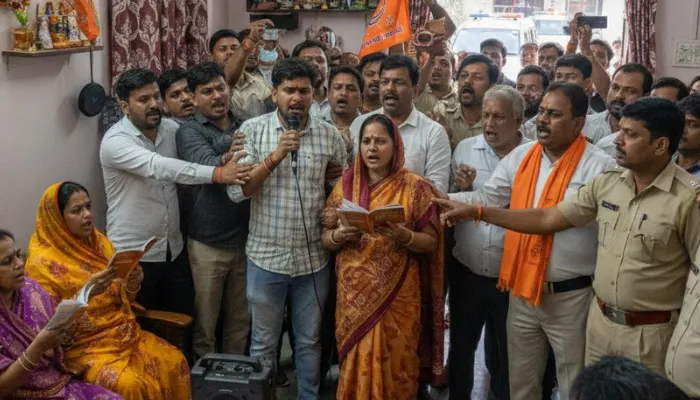
Case Summary
Hindu residents faced religious conversion activity during a prayer meeting organised by a Christian missionary held in Mohalla Basantgarh of Seohara town in Bijnor district, Uttar Pradesh. The program was conducted in the name of kirtan at a residential house, where Christian sermons and hymns were presented by a man and a woman, leading to strong objections from the local Hindu community. The event began at around 1:30 pm on 16th January 2026, at Mahendra Saini’s residence. A young man named Nitin and a woman were conducting the gathering, during which Christian religious teachings were delivered. Four to five women were present and participated in the event. Books containing Christian sermons and hymns were used, and the people attending the gathering memorised the written material. Hindu residents of the locality, including Abhishek Saini, Pankaj Saini, Vikas Tomar, Vinod Saini, Arvind Kumar, Mahipal Saini, and Bittu, reached the house after learning about the nature of the event. They objected to the Christian religious preaching taking place in the name of a prayer meeting. A commotion followed, and the residents caught hold of the man and the woman conducting the program. Members of the Bajrang Dal and Vishva Hindu Parishad, including Saurabh Saini, Vishal Tomar, Suresh Kumar, Manoj Kumar, Abhishek Saini, Pankaj Saini, Rahul Joshi, and Ompal Singh, reached the spot and protested against the event. The activists objected to what they described as religious conversion activity under the guise of a prayer meeting and created an uproar in the locality. Following information about the disturbance, the police reached the scene and stopped the event. The police seized books containing Christian sermons and hymns from the premises. Mahendra Saini’s wife, Poonam Saini, Nitin Kumar and Lakshmi were taken into custody and brought to the police station. Police station in-charge Sanjay Kumar stated that there was no case of religious conversion and that four to five women were sitting at the location and participating in a event. Circle Officer Dhampur A. K. Pandey stated that the program was being conducted at Poonam Saini’s house and that hymns of a particular religion were being presented. Although no case of religious conversion was registered, Poonam Saini, Nitin Kumar and Lakshmi were challaned under provisions related to disturbance of peace.
Why it is Hate Crime ?
This case has been documented under the primary category: Predatory proselytisation. Under this, the selected secondary category is: Proselytisation by grooming, brainwashing, manipulation or subtle indoctrination. Religious brainwashing essentially means the often subtle and forcible indoctrination to induce someone to give up their religious beliefs to accept contrasting, regimented ideas. Religious grooming or brainwashing also involves propaganda and manipulation. It involves the systematic effort, driven by religious malice and indoctrination, to persuade “non-believers’ to accept allegiance, command, or doctrine to and of a contrasting faith. Cases of such grooming or brainwashing are far more nuanced than direct threats, coercion, inducement and violence. In such cases, it is often seen that there is repeated, subtle and continual manipulation of the victim to induce disaffection towards their own faith and acceptance of the contrasting faith of the perpetrator. While subtle indoctrination is widely acknowledged as predatory, an element which is often understated in such conversions or the attempts of such conversion is the role of loyalty and trust which might develop between the perpetrator and the victim. Fiduciary relationships are often abused to affect such religious conversion. For example, an educator transmitting religious doctrine of a competing faith to a Hindu student. The Hindu student is likely to accept what the teacher is transmitting owing to the existence of the fiduciary relationship. The exploitation of the fiduciary relationship to religiously indoctrinate victims would also be included in this category. Since the underlying animosity towards the victim’s faith forms the basis of predatory proselytization, such cases are considered religiously motivated hate crimes. The primary category selected is Predatory Proselytisation. The sub- category selected is: Conversion/ attempts to convert by inducement. Predatory Proselytisation is not just limited to threat, harassment, force and violence, but it also has contours of stealth. In several cases, the Hindu victim is exploited to convert, with non-Hindus taking advantage of their poverty. In such cases, the Hindu victim who is suffering financially is offered monetary benefits, including lucrative offers for jobs, health treatment, education, etc, to induce the victim into changing his/her religion. In such cases, the religious identity of the victim and the aim to disenfranchise him from his faith form the heart of the crime. Also, taking advantage of and exploiting an individual’s economic vulnerabilities is widely acknowledged as exploitation, forms of which are often penalised by law. Such cases therefore are considered religiously motivated hate crimes since the victim’s religious identity forms the very heart of the crime itself. In this case, the accused called people to their homes, conducted prayer meetings based on Christian religious scriptures, and forced them to change their religion. This case has been added to the tracker firstly because Hindu villagers were targeted and manipulated for religious conversion through Christian religious texts by three Christian evangelists. The accused also conducted prayer gatherings in the village and conducted prayers in the name of Jesus. What is presented as a simple prayer gathering inside a house is, in reality, a covert attempt at religious conversion. These are not genuine community prayers but calculated efforts to exploit the trust of Hindus and manipulate them into abandoning their faith. It is a well-recognised tool in organised Christian proselytisation networks. These gatherings usually employ songs, testimonies and emotionally charged prayer sessions to influence and induce vulnerable individuals without openly declaring the underlying objective. By conducting such gatherings, the Christian evangelists sought to manipulate vulnerable Hindus, taking advantage of their emotional and social circumstances to push them towards conversion. Secondly, the focus on Hindu households, repeated engagement through prayer meetings, and use of religious messaging aimed at replacing Hindu belief systems demonstrates a pattern of intentional religious targeting. It is noteworthy to mention that pressuring a Hindu individual to discard his religious faith and embrace another was a direct attack on his religious identity and dignity. It was not a matter of personal choice; it was coercion rooted in hostility towards the victim's Hindu identity. Such an attempt reflected religious animosity because the act was not simply about personal differences but about erasing the victim’s Hindu faith, making it a religiously motivated crime. Such actions are designed to violate and undermine the beliefs of Hindu victims and are clear indicators of religious hostility towards Hindus and their religious identity. Such actions demonstrate that this was not an isolated incident of evangelism, but rather part of a broader, organised operation to further religious conversions. When Christian religious material is used to exploit trust, sow doubt, and misrepresent the beliefs of Hindus to coerce conversion, particularly in a systematic manner, it constitutes a religiously motivated offence. Because the core motivation of the act stemmed from hostility towards the victim’s religion, it met the threshold of a hate crime and was therefore categorised as such in the database. Disclaimer: The reports stated that five to six women were present as participants for this event. For the purpose of records, the number of victims has been mentioned as six.
Victim Details
Total Victim
6
Deceased
0
Gender
- Male 0
- Female 6
- Third Gender 0
- Unknown 0
Caste
- SC/ST 0
- OBC 0
- General 0
- Unknown 6
Age Group
- Minor 0
- Adult 6
- Senior Citizen 0
- Unknown 0


Case Status
Unknown


Perpetrators Details
Perpetrators
Christian Extremists
Perpetrators Range
From 2 To 5
Perpetrators Gender
both
 Sources




