Hindu politician receives 'Sar Tan Se Juda' threat from Muslim man over false blasphemy allegation
 Deoria, Uttar Pradesh, India
  12 January, 2026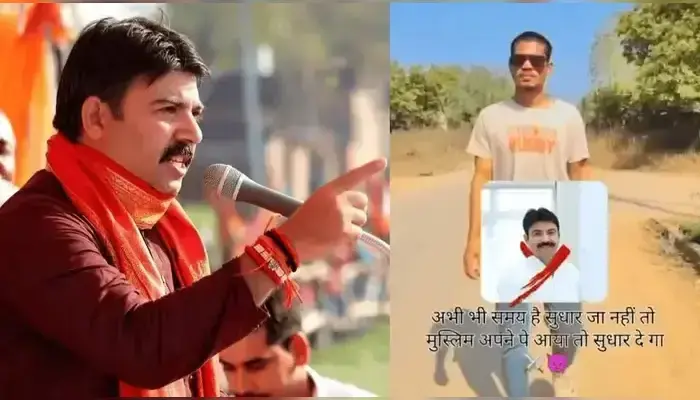
Case Summary
A Hindu politician, Bharatiya Janata Party Member of the Legislative Assembly from Deoria Sadar, Dr Shalabh Mani Tripathi, openly received a beheading threat (Sar Tan Se Juda) from a Muslim man on social media. The accused made allegations of blasphemy against the victim after the demolition of an illegal Islamic structure (mazaar) in the area. According to reports, a video of the accused circulated on social media and showed him walking down the street, with a red cross drawn across the BJP MLA's photo, writing, "There's still time, mend your ways, or if Muslims turn on them, they'll reform you." In this viral video, the threat of beheading is played with music in the background. It said, "This man's (victim) words hurt us so much that if he were to appear before us, I would behead him. We will not tolerate any disrespect to our Huzoor (prophet)." A screenshot of the accused's comment section even went viral, in which one of the users asked the man not to make such remarks, as he would get arrested. To this, the accused replied by saying, "Except Allah, I am not scared of anyone". The accused's video immediately sent shockwaves through the administration and police. The police immediately launched an investigation and viewed this incident as a conspiracy to incite communal tension. Reports confirmed that the victim, Shalabh Mani Tripathi, was involved in an administrative action which demolished an illegal mazaar, following which the accused said that this was blasphemy against Prophet Muhammad and hence he issued threats of beheading (Sar Tan Se Juda).
Why it is Hate Crime ?
This case has been added to the tracker under the primary category- Hate Speech against Hindus. The subcategory selected is- Violent Threats. Violent threats, explicit, implicit or implied, is the most dangerous form of hate speech since it goes beyond discriminatory and prejudicial language to express the intent of causing harm to an individual or a group of people based on their religious identity and faith. There could be several different kinds of threats that are issued to Hindus based on religious animosity. An explicit threat would mean the direct threat of violence towards an individual Hindu, a group of Hindus or Hindus at large. Physical violence, death threats, threats of destruction of property belonging to Hindus and threats of genocide would mean explicit threats against Hindus for their religious identity. Implicit threats may not be a direct threat but implied through the use of symbols of actions – for example – in the Nupur Sharma case, other than explicit threats, there were also implicit threats when Islamists took to the streets to burn and beat her effigies. It implies that they want to do the same to Nupur Sharma – thereby is considered an implicit threat. Violent threats can be delivered in person, through letters, phone calls, graffiti, or increasingly through social media and other online platforms. It would be important to understand that a threat – explicit or implicit, online or offline – to an individual who happens to be a Hindu does not qualify as a religiously motivated threat. Such a threat, while vile and dangerous, could be owing to non-religious reasons and/or personal animosity. To qualify as a religiously motivated threat, it would need to exhibit an indication that the individual is being targeted for religious reasons and/or owing to his/her religious identity as a Hindu. In this case, the beheading threat issued to Hindu politician Dr Shalabh Mani Tripathi, Bharatiya Janata Party Member of the Legislative Assembly from Deoria Sadar, amounted to a direct and unambiguous act of hate speech driven by anti-Hindu animosity. The phrase "Sar Tan Se Juda", a slogan synonymous with calls for beheading, came from the accused solely because Dr Shalabh Mani Tripathi took part in administrative action to demolish an illegal mazaar, which the accused labelled as blasphemy against Prophet Muhammad. Just for taking part in that administrative action, the accused issued the beheading threat. This reveals how the pretext of "blasphemy" served merely as an excuse to target Hindu individuals. Demolishing illegal structures does not constitute blasphemy, yet the accused branded it as such to justify his violent act, exposing a calculated effort to weaponise religious offence against members of the Hindu community. This threat struck not just at one man but at the heart of Hindu political representation, grounded in profound religious hatred towards Hindus. Such violent threats embodied a deep hostility designed to silence and intimidate anyone involved in administrative action against illegal Islamic structures. The attack on Dr Shalabh Mani Tripathi stemmed from clear religious malice aimed at his faith and his role in the demolition, a pattern that endangers Hindus across regions of India. As a glaring example of religiously motivated hate speech, this incident highlighted the alarming surge in violent threats against Hindu politicians who participate in such administrative actions, turning routine governance into a battleground for communal aggression. Dr Shalabh Mani Tripathi faced heightened targeting also as a Bharatiya Janata Party member, a party often perceived as pro-Hindu by Muslim extremists. The accused singled him out, which showed hatred towards anyone working for Hindus or linked to a party seen as defending Hindu interests. This choice of victim underscored how hate speech zeroes in on visible symbols of Hindu identity and political advocacy, amplifying the crime's intent to terrorise an entire community. Such acts formed no isolated reactions; rather, they represented deliberate violent threats soaked in religious animosity, aimed at a Hindu individual for his involvement in administrative duties that challenged encroachments, all rooted in theological indoctrination that fuels repeated aggression against Hindus. This hate crime sought to instil fear, suppress lawful action, and perpetuate division, marking it as a profound violation of communal harmony and personal safety. It is also important to note that the slogan, “Gustakh-e-Rasool ki Ek hi saza, sar tan se Juda, sar tan se Juda”, which translates to “There is only one punishment for being disrespectful to Rasool (Prophet Muhammad), their head separated from their torso, their head separated from the torso”, is an Islamist clarion call, that has become a staple feature of violent protests that have so far claimed the lives of at least 6 Hindus, including Kanhaiya Lal in Udaipur and Umesh Kolhe in Amravati, after Muslim fundamentalists, egged on by the dog-whistling of Alt News co-founder Mohammed Zubair against former BJP spokesperson Nupur Sharma, resorted to violence for what they perceived as ‘blasphemy’ against Prophet Muhammad. From Kanpur in India’s northern plains to the southern metropolis of Bengaluru, from Kolkata in the east to Hyderabad in the south, protests in the name of blasphemy have erupted in almost every corner of the country as Islamists took to the streets running amok and shouting “Sar Tan Se Juda” chants over the perceived belief of blasphemy against the Prophet. Though a radical Muslim outfit in Pakistan coined the slogan, it has gained popularity among Islamists in regions beyond its geographical origins. Over the years, we have seen large crowds of Islamists chanting the “Sar Tan Se Juda” slogan, which is nothing but a direct incitement to violence, leading to murders committed in the name of 'blasphemy'. The radicalised outcry is not merely a statement of disapproval; it is a call for the execution of an individual through beheading, based on their religious identity. When this slogan is raised, it sends a clear and terrifying message not just to the individual targeted but also to anyone else who might share similar views or dare to express them. This tactic of intimidation aims to silence dissent and suppress freedom of expression, particularly in religious discourse. It aims to instil fear in the broader community. Islamists use this tactic to settle personal scores with non-Muslims, particularly Hindus, by levelling fabricated charges of blasphemy against them, which causes outrage and paints a target on them. The underlying hatred and animosity toward non-Muslims, especially Hindus, is demonstrated when 'Sar Tan Se Juda' or beheading threats are issued by Muslims. Henceforth, it is a clear example of anti-Hindu speech. This incident involving Deoria Bharatiya Janata Party Member of the Legislative Assembly directly aligns with patterns seen in prior cases, such as that of Nupur Sharma, where the victim faced doxxing and harassment for voicing religious opinions or critiquing historical or contemporary Islamic violence. Here too, Dr Shalabh Mani Tripathi's Hindu identity and firm opposition to illegal Islamic structures served as the sole trigger for explicitly communal hate. Consequently, this qualifies as a religiously motivated hate crime. Therefore, it is being added to the hate crime database of the Hinduphobia Tracker. Disclaimer: The Hinduphobia Tracker records the dates of incidents based on when the crime occurs, rather than when it is reported by the media. However, in this case, media reports have not specified the exact date when the accused made these beheading threats. Henceforth, the date when the media first reported it, that is, on 13 January 2026, serves as the indicative date of the incident. This date is recorded for documentation purposes only.
Victim Details
Total Victim
1
Deceased
0
Gender
- Male 1
- Female 0
- Third Gender 0
- Unknown 0
Caste
- SC/ST 0
- OBC 0
- General 1
- Unknown 0
Age Group
- Minor 0
- Adult 1
- Senior Citizen 0
- Unknown 0


Case Status
Unknown


Perpetrators Details
Perpetrators
Muslim Extremists
Perpetrators Range
One Person
Perpetrators Gender
male
 Sources




