Hindu sentiments outraged as Ambedkarite Buddhist man makes derogatory remarks against Hindu deities
 Sironj, Madhya Pradesh, India
  2 January, 2026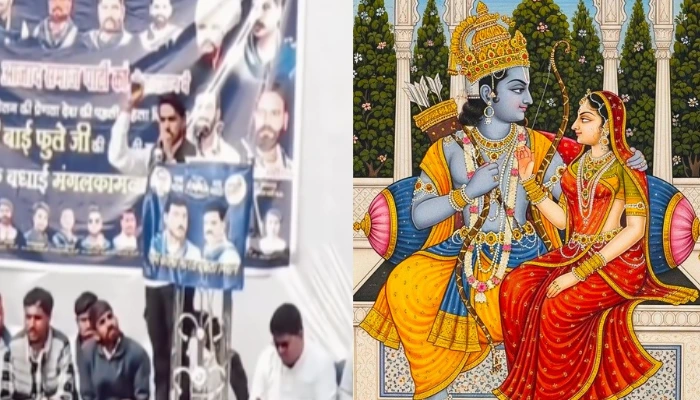
Case Summary
In Sironj, Vidisha, Madhya Pradesh, Hindu religious sentiments were outraged as a Buddhist man associated with the Bhim Army, an Ambedkarite group, an anti-Hindu group, made derogatory remarks against Lord Ram and Goddess Sita, two revered Hindu deities. This incident occurred during a Bhim Army event in Sironj on 3 January 2026 to mark the birth anniversary of Savitribai Phule. The accused was identified as Deepak Baudh, the district vice president of Bhim Army. A video of his derogatory remarks went viral on social media. Following this, the Sironj Bar Association submitted a memorandum to the Governor and Chief Minister, demanding that Deepak Baudh be booked under the National Security Act and arrested. The memorandum stated that Lord Ram is the ultimate goal of life for millions of Sanatanis (Hindus) and the very essence and soul of the nation. His insult is inexcusable. After the video of the comment surfaced, widespread protests erupted. The Karni Sena, Raghuvanshi Samaj, and Kushwaha Samaj submitted a memorandum in Sironj demanding action against Deepak Baudh. A case was registered against Deepak Baudh at the Sironj police station under Section 299 of the law. Kapil Tyagi, president of the Sironj Bar Association, clarified that Deepak Baudh's crime was unforgivable. He announced that no lawyer in Sironj would represent Deepak Baudh's case. Section 299 is bailable, but the Bar Association pushed for the National Security Act. Sironj TI Vimlesh Kumar said that a case was registered in this matter for hurting religious sentiments. The Mandi Bamora police team went to the accused's house but did not find him there. Kumar clarified that the accused will be arrested soon. Following this controversy, the Bhim Army also distanced itself from him. In addition to Sironj, memorandums were also submitted in Vidisha and Ganjbasoda. Bhim Army state vice president Gabbar Singh claimed that Deepak was not a member of their organisation. He did not support his statements. He also claimed that the organisation respected all religions.
Why it is Hate Crime ?
The primary category selected in this case is- Hate Speech against Hindus. The subcategory selected is- Anti-Hindu slurs, mocking faith. Anti-Hindu slurs and the deliberate mocking of the Hindu faith owing to religious animosity involve the usage of derogatory terms, stereotypes, or offensive references to religious practices, symbols, or figures. One of the common anti-Hindu slurs used against Hindus is “cow-worshipper” and “cow piss drinker”. The intention of using this term is to demean and mock Hindus as a group and their religious beliefs since Hindus consider the cow holy. Additionally, some symbols and the slurs attached to them have a historical context that exacerbates the insult, hate, stereotyping, dehumanisation and oppression against Hindus. Cow worship has been used for centuries to denigrate Hindus, insult their faith and oppress Hindus specifically as a religious group. There has been overwhelming documentation about how cow slaughter has been used to persecute Hindus with cow meat being thrown in temples and places of worship. There has also been overwhelming documentation where cow meat (beef) has been force-fed to Hindus to either forcefully convert them to Islam or denigrate their faith. Apart from cow worship, the Swastika – which holds deep religious significance for the Hindus – has also been misinterpreted and distorted to use as a slur against Hindus. Similarly, the worship of the Shivling has been used by supremacist ideologies and religions to denigrate Hindus owing to religious animosity. Such slurs and denigration stem out of inherent animosity and hate towards Hindus and their faith, therefore, it is categorised as hate speech targeted at Hindus specifically owing to their religious identity. This case represents a clear instance of religiously motivated hate speech as the accused, Deepak Baudh, a Buddhist by faith and an Ambedkarite by ideology, and the district vice president of Bhim Army, an anti-Hindu group, made derogatory and offensive remarks against Lord Ram and Goddess Sita, two revered Hindu deities in Hinduism. For Hindus, Lord Ram embodies the ideal man, the epitome of dharma (righteousness), and the seventh avatar of Vishnu, whose life story in the epic Ramayana teaches values of truth, honour, and devotion. Goddess Sita, his consort, symbolises purity, loyalty, and feminine strength, revered as the daughter of the Earth and an incarnation of Lakshmi. These figures form the spiritual core of Hindu devotion for over a billion followers worldwide; they inspire festivals like Diwali and Ram Navami, and their icons adorn homes and temples. Any speech aimed at mocking, abusing, or denigrating these revered deities amounts to a clear instance of hate speech, as it deliberately targets the sacred beliefs of Hindus to provoke outrage and cause hurt. Such actions stem from deep-seated animosity towards Hinduism and the Hindu community, marking it as a stark instance of anti-Hindu speech. The fact that the accused made these remarks at a public Bhim Army gathering on 3 January 2026 in Sironj demonstrates his intent to amplify the denigration of Hindu deities far and wide. This deliberate public platform underscores his aim to hurt the maximum number of Hindu sentiments, leaving no doubt that the incident was driven by anti-Hindu hatred. Even though Bhim Army members claimed that the accused had no relation to them and claimed that they respect all religions, this rings hollow. Previously, there have been multiple instances where the Bhim Army, as an organisation, have made several anti-Hindu remarks. Without evidence of a genuine change of heart or a sincere apology, such disavowals appear insincere. It is also important to note that the Bhim Army presents itself as a champion of Dalit rights, but its actions and affiliations often contradict this claim. Dalits are very much Hindus, yet the Bhim Army frequently targets Hindu symbols, festivals, and practices, including those held sacred by Dalits themselves. This pattern suggests that the organisation’s agenda is less about genuine Dalit upliftment and more aligned with broader anti-Hindu narratives that seek to divide and weaken Hindu society from within. This becomes particularly apparent when the Bhim Army aligns with leftist and Islamist platforms, where identity politics is weaponised against Hindus. In such spaces, the micro identities of caste, region, and language are secondary; what matters most is religious identity. It is the Hindu identity, regardless of caste, that often becomes the target of animosity. As seen in cases where Dalit families were attacked for displaying Hindu symbols or worshipping deities, the hostility stems not from caste differences, but from a disdain for Hindu religiosity. For example, on May 19, 2020, reports emerged in which a Dalit family in Bihar’s Kishanganj district accused the local Bhim Army unit of attacking them for their beliefs, desecrating a temple as they objected to their reverence for Hindu deities and saffron flags. Similarly, on June 29, 2021, in Saharanpur, Uttar Pradesh, a Hindu named Saurabh Sharma was attacked by Bhim Army members over political differences. The assailants used swords and rods, causing severe injuries, and threatened to eliminate the Brahmin community from the area. Moreover, Bhim Army chief Chandrashekhar Azad has repeatedly made statements and taken positions that reflect his anti-Hindu stance. For instance, he has publicly endorsed conversion as a political weapon, invoking B.R. Ambedkar’s decision to leave Hinduism, and has actively supported movements that call for a rejection of Hindu festivals and practices. In fact, Chandrashekhar Azad's political trajectory has strongly focused on building a Dalit-Muslim alliance, a strategy that became particularly visible during his active participation in the anti-CAA (Citizenship Amendment Act) protests that culminated in the Delhi anti-Hindu Riots 2020. His brand of politics, under the banner of Dalit-Muslim unity, has contributed to narratives that vilify Hindu traditions and exacerbate targeted attacks against Hindus. Thus, by attacking Hindu symbols and aligning with forces hostile to Hinduism at large, the Bhim Army effectively turns against the cultural and spiritual traditions of the Dalit community itself. In doing so, it reinforces the very forces of division and religious antagonism that marginalise Dalits, not as a caste, but as Hindus. This contradiction reveals that, despite its stated mission, the Bhim Army’s trajectory increasingly serves an anti-Hindu, rather than a pro-Dalit, agenda. In summary, this case, where the accused made derogatory remarks against Lord Ram and Goddess Sita, serves as a clear example of anti-Hindu hate speech. Therefore, it has been added to the hate crime database of the Hinduphobia Tracker.


Case Status
Complaint registered


Perpetrators Details
Perpetrators
Others
Perpetrators Range
One Person
Perpetrators Gender
male
 Sources




