Minor Hindu children targeted through Christian prayer meeting gatherings by coaching institute in Ujjain, MP
 Nagda, Madhya Pradesh, India
  13 January, 2026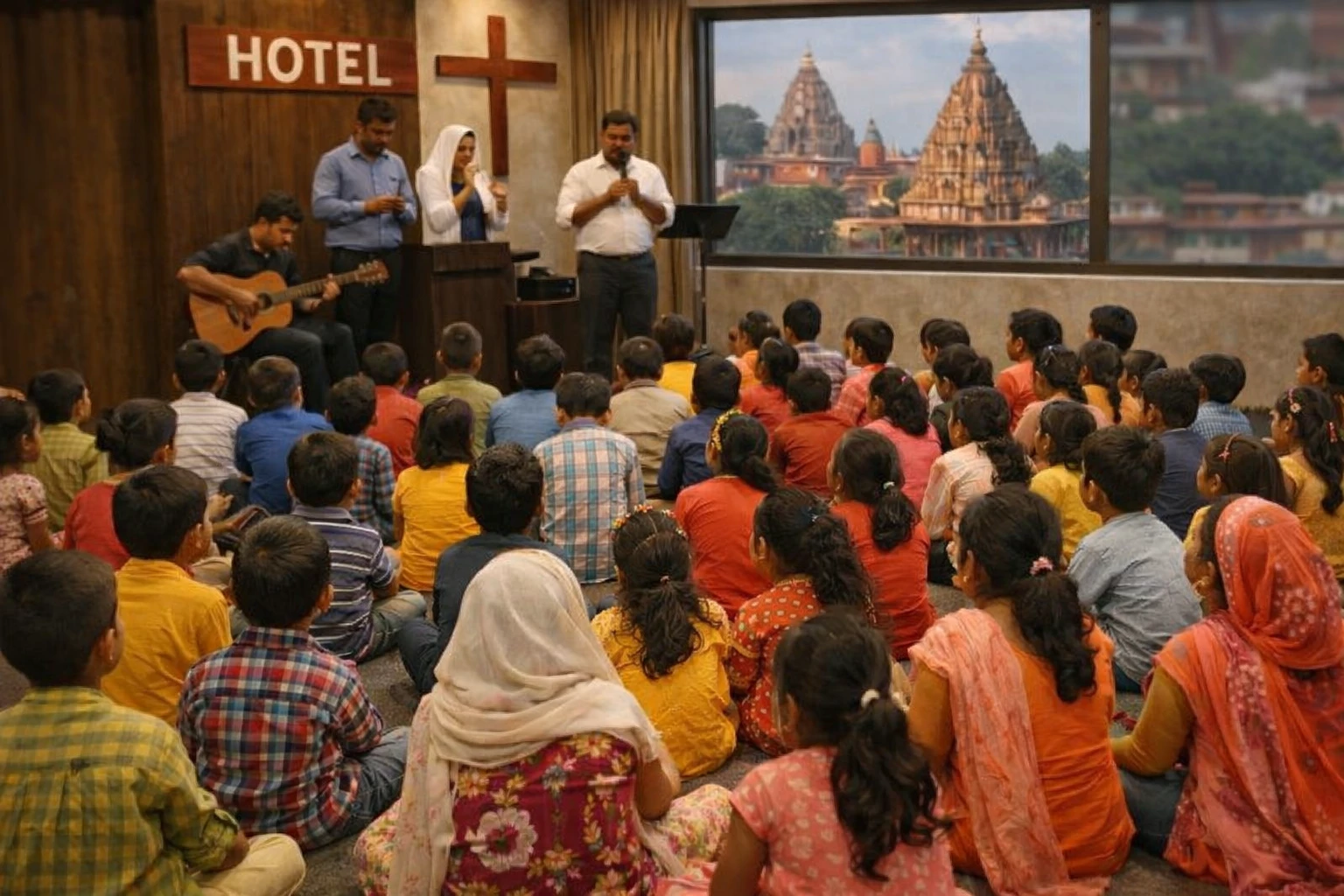
Case Summary
In Nagda, Madhya Pradesh, minor Hindu children were brainwashed and induced to convert by four Christian men through prayer meetings. The incident came to light after a dispute broke out during a Christian prayer meeting. The meeting was attended exclusively by Hindu men, women and minors at a hotel located on Sigri 95, Nagda. As soon as the members of local Hindu organisations received information regarding the Christian prayer meeting, they intervened and objected to the religious conversion activity. The prayer meeting was conducted inside the Sigri 95 Hotel. It was discovered that such prayer meetings were organised weekly for nearly one year. The gathering was run by individuals associated with a coaching institute operating from the Padlya Road area of Nagda. On the day of the incident, 50 to 70 Hindu men and women, including women and children, were present at the venue. One woman among the group claimed that the prayer meetings helped them get relieved from illness. The Hindus further stated that they attended the prayer meetings voluntarily. The Hindu organisation then submitted a complaint to the police. Birlagram Police Station Sub-Inspector Sanjay Mathur confirmed that police intervened due to the seriousness of the situation and instructed all parties to maintain peace. Police initiated restrictive action against five individuals, including four teachers who conducted the prayer meeting, namely, Naveen Peter, P. V. Josh, Ajay Parmar and Ashish Bhavasar. Preventive action was also taken against hotel manager Sonu, son of Bharat Singh. Police warned that strict action would be taken. The matter remains under investigation.
Why it is Hate Crime ?
The primary category selected is Predatory Proselytisation. The sub- category selected is Proselytisation by grooming, brainwashing, manipulation or subtle indoctrination. Tertiary categories are: Pattern of targeting Hindus and Conversion of minor. Religious brainwashing essentially means the often subtle and forcible indoctrination to induce someone to give up their religious beliefs to accept contrasting regimented ideas. Religious grooming or brainwashing also involves propaganda and manipulation. It involves the systematic effort, driven by religious malice and indoctrination, to persuade “non-believers’ to accept allegiance, command, or doctrine to and of a contrasting faith. Cases of such grooming or brainwashing are far more nuanced than direct threats, coercion, inducement and violence. In such cases, it is often seen that there is repeated, subtle and continual manipulation of the victim to induce disaffection towards their own faith and acceptance of the contrasting faith of the perpetrator. While subtle indoctrination is widely acknowledged as predatory, an element which is often understated in such conversions or the attempts of such conversion is the role of loyalty and trust which might develop between the perpetrator and the victim. Fiduciary relationships are often abused to affect such religious conversion. For example, an educator transmitting religious doctrine of a competing faith to a Hindu student. The Hindu student is likely to accept what the teacher is transmitting owing to existence of the fiduciary relationship. The exploitation of the fiduciary relationship to religiously indoctrinate victims would also be included in this category. Since the underlying animosity towards the victim’s faith forms the basis of predatory proselytization, such cases are considered religiously motivated hate crimes. The other sub-category selected here is- Conversion/ attempts to convert by inducement. Predatory Proselytisation is not just limited to threat, harassment, force and violence, but it also has contours of stealth. In several cases, the Hindu victim is exploited to convert, with non-Hindus taking advantage of their poverty. In such cases, the Hindu victim who is suffering financially is offered monetary benefits, including lucrative offers for jobs, health treatment, education, etc, to induce the victim into changing his/her religion. In such cases, the religious identity of the victim and the aim to disenfranchise him from his faith form the heart of the crime. Also, taking advantage of and exploiting an individual’s economic vulnerabilities is widely acknowledged as exploitation, forms of which are often penalised by law. Such cases therefore are considered religiously motivated hate crimes since the victim’s religious identity forms the very heart of the crime itself. This case contains multiple religious markers showing organised interference with the religious identity of Hindu families, particularly minors, through sustained and targeted proselytisation. A key concern is the involvement of minor Hindu children in repeated prayer meetings. Minors are not capable of giving informed consent to religious change, and prolonged exposure to faith based instruction functions as psychological conditioning rather than voluntary belief. Bringing Hindu children into such gatherings places them under influence at a formative age, where identity and belief systems are still developing. The fact that the prayer meetings were attended exclusively by Hindus is significant. This was not a mixed or open religious gathering but a targeted activity directed at a specific religious group. Such selectivity indicates intent to influence or reshape Hindu belief systems rather than offer neutral spiritual discourse. The meetings were conducted weekly for nearly a year, which shows sustained and organised effort rather than a one time event. Repetition over a long period is a known method of normalising religious messaging, especially among vulnerable groups. Over time, this can weaken attachment to one’s original faith, particularly for children who grow accustomed to repeated exposure. Claims that prayer helped participants recover from illness function as an inducement. Presenting religious practice as a solution to health problems exploits emotional and physical vulnerability and creates dependence. This kind of faith based promise is often used to draw individuals deeper into religious influence and discourage critical questioning. The use of a private hotel as the venue also matters. Conducting such activities outside registered places of worship reduces oversight and allows the organisers to operate discreetly. This setting enabled repeated gatherings without community awareness or institutional accountability. The involvement of individuals linked to a coaching institute adds another layer of pressure. Teachers and educators carry perceived authority, especially in the eyes of parents and children. Their participation can lend legitimacy to religious messaging and make resistance more difficult, particularly for minors who are conditioned to trust such figures. Taken together, the sustained prayer meetings, exclusive targeting of Hindus, involvement of minors, inducements linked to illness, and use of authority figures show a structured effort to influence and detach Hindu children and families from their faith. These elements indicate interference with religious autonomy and support classification of the incident as a hate-driven act targeting Hindus through coercive proselytisation. Disclaimer: Reports indicate that 50 to 70 Hindu individuals were present at the prayer meetings, including men, women, and minor children, but do not specify how many were directly subjected to conversion efforts. For documentation purposes, the maximum reported figure of 70 has been recorded as the victim count. In the absence of a precise age and gender breakdown, the distribution has been made using the most recent official demographic baseline from the 2011 Census of India, which shows a near-balanced gender ratio and a predominantly adult population. Accordingly, victims have been documented with a 50:50 gender split and an age distribution of approximately 70 per cent adults and 30 per cent minors. Based on this methodology, the case has been recorded as involving 25 adult male victims, 24 adult female victims, 11 minor male victims, and 10 minor female victims. This allocation is a standardised estimate used solely for consistency in documentation and remains subject to revision if more specific information becomes available through investigation or official records.
Victim Details
Total Victim
70
Deceased
0
Gender
- Male 36
- Female 34
- Third Gender 0
- Unknown 0
Caste
- SC/ST 0
- OBC 0
- General 0
- Unknown 70
Age Group
- Minor 21
- Adult 49
- Senior Citizen 0
- Unknown 0


Case Status
Complaint filed


Perpetrators Details
Perpetrators
Christian Extremists
Perpetrators Range
From 2 To 5
Perpetrators Gender
male
 Sources




